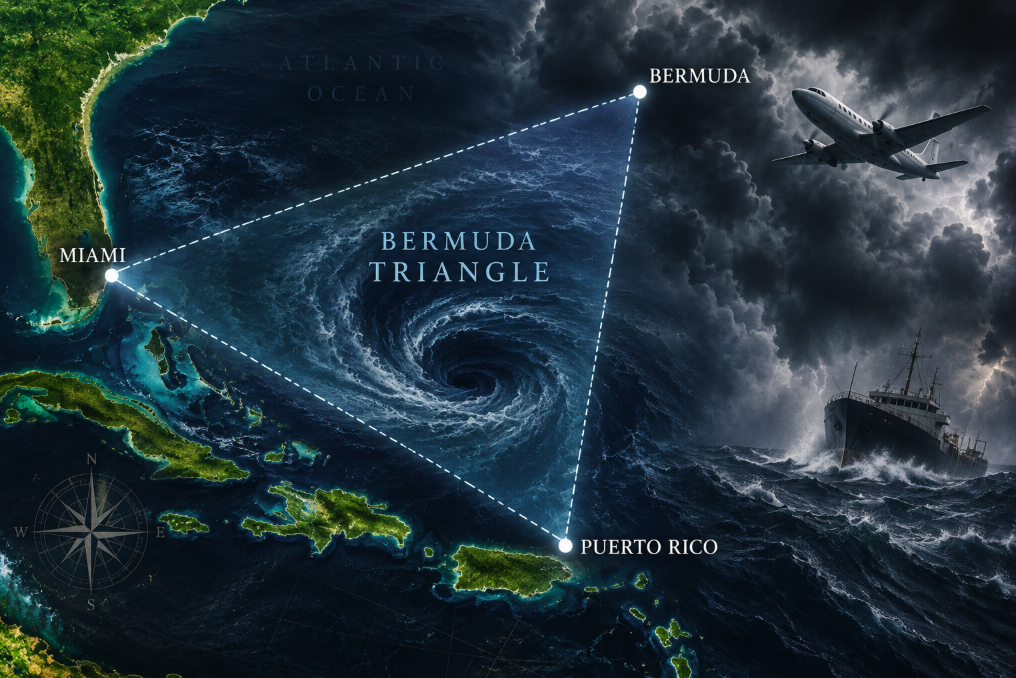
Draw a line from Miami to Bermuda, another from Bermuda to Puerto Rico, and a third back toward Florida, and you have the rough outline of one of the most famous imaginary places on Earth. The Bermuda Triangle has been blamed for ships disappearing without wreckage, aircraft vanishing from radar, compasses behaving strangely and crews apparently being swallowed by the Atlantic.
There is only one difficulty: the Bermuda Triangle is not an officially defined geographic region, and there is no evidence that mysterious disappearances happen there more frequently than in other large, heavily traveled parts of the ocean.
That does not mean every loss associated with the Triangle has been solved. Some remain genuine historical mysteries. But an unexplained accident is not the same thing as evidence for a supernatural zone. When the most famous cases are examined individually, a more familiar set of dangers emerges: violent weather, navigational uncertainty, mechanical failure, human error, deep water and a powerful ocean current capable of carrying evidence far from an accident site.
The mystery, in other words, may tell us less about a strange patch of Atlantic than about what happens when real tragedies are gathered together and turned into a legend.
A triangle without official borders
The classic version stretches between southern Florida, Bermuda and Puerto Rico, although different writers have drawn radically different boundaries. Some versions encompass roughly half a million square miles; others expand the supposed danger zone much farther across the western North Atlantic.
That ambiguity matters. If the boundaries can change, incidents can be included or excluded according to the needs of the story. The U.S. Board on Geographic Names does not recognize “Bermuda Triangle” as an official geographic name, while the U.S. Coast Guard does not recognize the area as a specific hazard to ships or aircraft.
The National Oceanic and Atmospheric Administration is similarly direct: there is no evidence that mysterious disappearances occur with greater frequency in the Bermuda Triangle than in any other large, well-traveled area of ocean.
That final phrase is crucial. The waters around Florida, the Bahamas and the Caribbean have long carried substantial commercial, military and recreational traffic. If many ships and aircraft pass through a region, accidents will happen there even if the underlying risk is entirely ordinary.
Flight 19: the disappearance that defined the legend
No incident is more closely associated with the Bermuda Triangle than Flight 19. On December 5, 1945, five U.S. Navy TBM Avenger torpedo bombers left Naval Air Station Fort Lauderdale on a routine navigation and bombing training exercise over the Bahamas. Fourteen men were aboard the five aircraft.
The first portion of the exercise proceeded normally. Then the flight became disoriented.
Surviving radio communications indicated navigation and compass problems. Lieutenant Charles C. Taylor, the flight leader, appears to have become uncertain about the formation’s position. According to the U.S. Naval History and Heritage Command’s reconstruction, the likely sequence involved disorientation followed by fuel exhaustion as deteriorating weather moved into the area.
The five Avengers never returned. No confirmed wreckage or remains have been recovered.
The tragedy became even more haunting when a PBM Mariner flying boat carrying 13 men was dispatched to search for them and also disappeared. At first glance, six aircraft vanishing during the same episode seems almost impossibly mysterious. Yet the Navy’s historical assessment points toward a different explanation for the Mariner. A ship reported seeing a flaming aircraft fall from the sky in the relevant area, and the PBM type was vulnerable to the accumulation of gasoline vapor. An in-flight fire or explosion is considered likely, although the exact cause remains officially unresolved.
The Navy’s original inquiry could not establish precisely what happened to Flight 19. That uncertainty gave later writers enormous room for speculation. Over time, details were embellished and the training flight became the centerpiece of stories about magnetic anomalies, UFOs and supernatural forces. The Navy’s modern account of the loss still treats it as an enduring aviation mystery, but the available evidence does not require anything beyond navigational confusion, worsening conditions and the unforgiving mathematics of limited fuel.
The Atlantic does not need supernatural help
The western North Atlantic can be dangerous for reasons that are entirely measurable. Tropical storms and hurricanes regularly move through the broader region. Before satellites, modern radar and accurate forecasting, ships could encounter dangerous conditions with far less warning than crews receive today.
NOAA notes that the majority of Atlantic tropical storms and hurricanes pass through the area commonly identified with the Triangle. Severe weather is not merely about towering waves. Visibility can collapse, winds can change rapidly, thunderstorms can disrupt aircraft operations and a navigational mistake that would be recoverable on a calm day can become fatal in rough conditions.
Then there is the Gulf Stream. This major current flows northward along Florida before turning into the North Atlantic. Its speed and interaction with weather can contribute to difficult sea conditions. Just as importantly for a mystery story, a strong current can rapidly move floating wreckage away from the location of an accident. A vessel can sink in deep water while debris is scattered over a broad area, making the absence of an obvious wreck site less astonishing than it first appears.
The region also contains islands, reefs, banks and shallow waters that historically complicated navigation. Before GPS, crews depended heavily on celestial observations, charts, dead reckoning, radio navigation and magnetic compasses. Small errors accumulated over time, particularly when weather prevented pilots or mariners from obtaining reliable visual references.
What about strange compasses?
Compass stories are a central part of Bermuda Triangle folklore. The popular version claims that compasses behave uniquely inside the Triangle, spinning wildly or pointing toward the wrong north.
The reality is less dramatic. Magnetic north and geographic, or “true,” north are not the same location. The angular difference between them, known as magnetic declination, varies depending on where you are on Earth and changes gradually over time. Navigators have long accounted for this.
NOAA notes that there are places where a magnetic compass can align with true north, but this is not evidence of a mysterious energy field. Nor is the Bermuda Triangle the only region where magnetic variation must be considered. Claims of extraordinary magnetism have never produced convincing evidence for a unique mechanism capable of making ships or aircraft disappear.
The same caution applies to more exotic proposals. Methane eruptions from the seabed, rogue waves and unusual atmospheric effects are sometimes presented as scientific solutions to the entire mystery. Such phenomena can be real in appropriate circumstances, but demonstrating that something is physically possible is not the same as showing that it caused a particular disappearance. There is no need for one universal Bermuda Triangle mechanism because the incidents occurred at different times, under different conditions and for different probable reasons.
The USS Cyclops and the power of an unsolved case
Some losses remain genuinely unresolved. In March 1918, the massive U.S. Navy collier USS Cyclops disappeared while traveling from Barbados toward Baltimore with 306 people aboard. No confirmed wreckage has ever been found. The loss remains the largest non-combat loss of life in U.S. Naval history involving a single ship.
That is a real mystery. But “we do not know exactly what happened” and “something paranormal happened” are not equivalent statements. The Naval History and Heritage Command has noted that catastrophic structural failure is a likely explanation for the Cyclops, and two of its sister ships were later lost at sea under circumstances suggesting serious vulnerabilities in the class.
Historical accidents frequently leave incomplete evidence. Ships sink beyond recovery depth, storms erase clues, wartime records are imperfect and eyewitnesses may not survive. Mystery is often simply the name we give to the gap between what happened and what the surviving evidence allows us to reconstruct.
How the Bermuda Triangle became a cultural phenomenon
The ocean had accumulated unexplained losses long before anyone imagined a triangle connecting them. The modern legend developed in the twentieth century as writers began grouping incidents within the same vaguely defined area. By the 1960s and especially the 1970s, books, magazines and television programs transformed the Triangle into a global phenomenon.
The formula was powerful. Begin with a true disappearance, emphasize the lack of wreckage, remove inconvenient weather or navigational details, connect it with other tragedies across decades, and suggest that conventional explanations are inadequate. Each new story then reinforces the previous ones.
Flight 19 was ideal material because the disappearance was real, the radio communications were dramatic and the wreckage had not been found. The loss of the rescue aircraft added another layer that seemed almost designed for supernatural interpretation. Once those events were placed inside an already mysterious “triangle,” coincidence itself became evidence.
The U.S. Navy and Coast Guard have repeatedly rejected supernatural explanations. Their conclusion is considerably less cinematic: nature and human fallibility are more than capable of producing disasters at sea.
The real mystery is why the story survives
The Bermuda Triangle endures because it sits at the intersection of several things humans find irresistible: the vastness of the ocean, incomplete evidence, sudden disappearance and the possibility that familiar rules stop working somewhere beyond the horizon.
Modern technology has reduced some of the uncertainties that nourished the legend. Satellite weather observations, GPS navigation, emergency beacons and improved communications make it much harder for a ship or aircraft simply to vanish without leaving electronic traces. Yet the older cases remain open enough for imagination to enter.
There is nothing irrational about being fascinated by Flight 19 or the Cyclops. Both involved devastating losses whose exact final moments remain unknown. The mistake is turning those unanswered questions into evidence that the surrounding ocean itself is anomalous.
NOAA’s conclusion is remarkably simple: disappearances are not demonstrably more common there than in comparable heavily traveled waters. Hurricanes cross the region. The Gulf Stream moves quickly. Navigation can fail. Machines break. People make mistakes. The Atlantic is deep enough to conceal the evidence.
The Bermuda Triangle may therefore be most mysterious when viewed from a map. Out on the ocean, the forces that made it famous are largely the same forces sailors and aviators have always feared — weather, distance, uncertainty and a sea powerful enough to make ordinary disasters look supernatural.