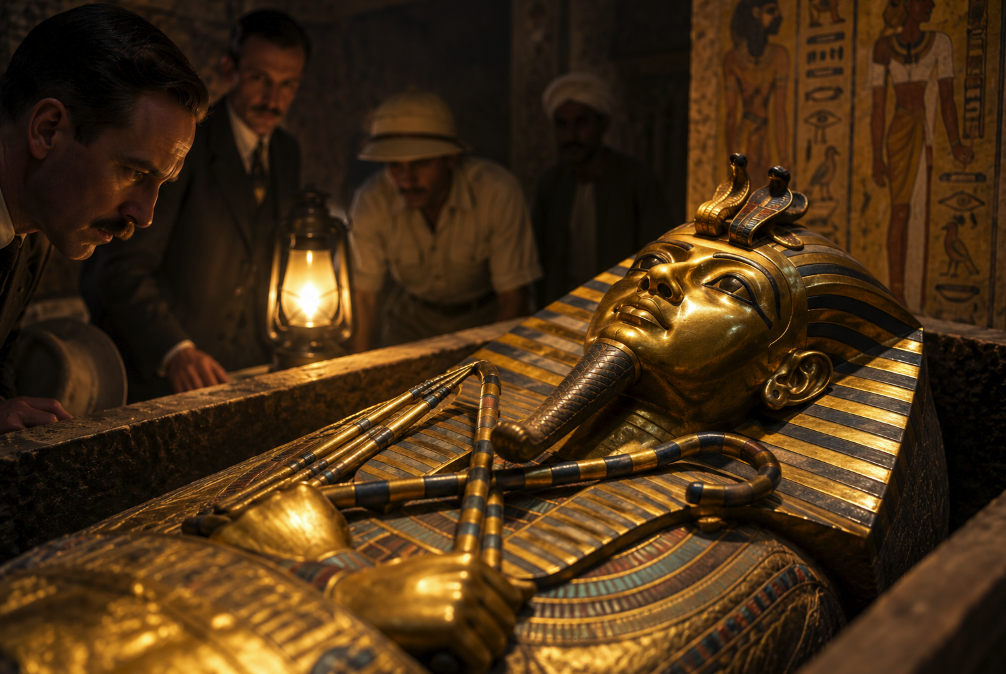
When George Herbert, the 5th Earl of Carnarvon, died in Cairo on April 5, 1923, the timing was almost too perfect for a sensational story. Only months earlier he had stood with archaeologist Howard Carter at one of the most extraordinary discoveries in archaeological history: the virtually intact tomb of Tutankhamun in Egypt’s Valley of the Kings. Now the wealthy patron of the excavation was dead, and newspapers had an irresistible explanation. The pharaoh had taken revenge.
The story would become known as the curse of Tutankhamun, or more broadly the curse of the pharaohs. Over the following years, almost any illness, accident or death that could be connected — sometimes very loosely — to the excavation was recruited as further evidence. The legend became so durable that it eventually overshadowed an inconvenient fact: no convincing evidence shows that Tutankhamun’s tomb carried a supernatural death sentence at all.
What the curse does reveal is something nearly as fascinating as an ancient spell. It shows how archaeology, celebrity, newspaper competition, coincidence and Western fascination with ancient Egypt combined to manufacture one of the twentieth century’s most successful supernatural legends.
The discovery that electrified the world
Howard Carter had spent years searching the Valley of the Kings for the burial place of Tutankhamun, a relatively obscure ruler of Egypt’s 18th Dynasty. His excavations were financed by Lord Carnarvon, an English aristocrat with a deep interest in Egyptology. By 1922, patience and money were running thin.
Then, on November 4, workers uncovered a step cut into the rock. More steps followed, leading to a sealed doorway. Carnarvon traveled to Egypt, and later that month Carter entered the tomb’s antechamber. The discovery was astonishing. Unlike many royal burials robbed in antiquity, Tutankhamun’s tomb still contained an extraordinary concentration of funerary objects. The Metropolitan Museum of Art, whose Egyptian Expedition later assisted Carter’s team, records the discovery date as November 4, 1922. More than 5,000 objects would ultimately be documented from the tomb.
The burial chamber itself was officially opened in February 1923. The excavation instantly became an international media event. Photographs by Harry Burton helped audiences far from Egypt experience the discovery visually, while newspapers competed for every detail of the story. Tutankhamun, a king who had died more than three millennia earlier, became a modern celebrity.
That competition mattered. Carnarvon had granted The Times privileged access to excavation news. Rival newspapers needed their own angles, and the mysterious atmosphere surrounding Egyptian tombs offered one. Tales of ancient warnings, supernatural guardians and fatal consequences were far more marketable than the slow technical work of cataloguing thousands of objects.
Then Lord Carnarvon died
Carnarvon’s health had already been fragile for years. In March 1923, he became seriously ill in Cairo after a mosquito bite on his face became infected, reportedly aggravated when he cut the area while shaving. His condition developed into severe infection and pneumonia, and he died on April 5 at the age of 56.
To a newspaper editor, the narrative almost wrote itself. A wealthy English lord had helped open a pharaoh’s sealed tomb and was dead weeks later. Reports rapidly connected the death with warnings supposedly associated with the burial. As additional people linked in some fashion to Tutankhamun died in subsequent years, the curse acquired a body count.
Some of the details repeated in later versions became increasingly theatrical. One famous story claimed that at the moment Carnarvon died, Cairo’s lights mysteriously went out. Another said that his dog in England howled and died at precisely the same time. Such anecdotes are part of the folklore surrounding the curse, but their repetition should not be confused with strong historical evidence.
There is also a basic problem with the idea of a specific deadly inscription threatening anyone who entered Tutankhamun’s tomb. The dramatic curse formulas often quoted in popular accounts are not securely documented as warnings found at the entrance to his burial. In a response discussing the later epidemiological study of the legend, researcher Mark Nelson noted that the supposed curse associated with the excavation was largely whatever deaths the contemporary press chose to connect with it, rather than a clearly documented inscription from Tutankhamun’s tomb.
The survivors are less famous than the victims
Curse stories have a natural statistical advantage: deaths are memorable, survival is not. Once people expect a pattern, every death connected with an excavation appears meaningful while decades of ordinary life among the survivors attract little attention.
Howard Carter is the most obvious problem for the legend. If anyone should have been exposed to the wrath of the disturbed pharaoh, the archaeologist who led the excavation and spent years working with the tomb should have ranked near the top. Carter did not die mysteriously in 1923. He lived until 1939, dying at the age of 64, more than sixteen years after the burial chamber was opened.
Many other people associated with the excavation also lived for years or decades. This prompted a wonderfully unusual piece of medical research. In 2002, Mark R. Nelson published a historical cohort study in The BMJ examining whether people potentially exposed to the supposed mummy’s curse actually died sooner.
Nelson identified 44 Westerners whom Carter had recorded as being in Egypt around key events connected with the tomb between 1923 and 1926. Twenty-five were classified as potentially exposed to the curse. Their average age at death was about 70, compared with 75 among those considered unexposed. After statistical analysis, the study found no significant association between exposure and survival. In short, entering or being closely connected with Tutankhamun’s tomb did not produce the pattern of premature mortality the legend would predict.
The paper was partly playful — applying evidence-based medicine to a supernatural curse is an irresistible premise — but its point was serious. A cluster of selectively remembered anecdotes is not the same thing as evidence.
Could there have been a biological “curse”?
Once supernatural explanations lose credibility, another possibility often appears: perhaps ancient tombs contained dangerous fungi, bacteria or toxins. It is not absurd in principle to ask whether sealed environments can pose biological hazards. Archaeologists and conservators do encounter molds, dust and other environmental risks.
But turning that general possibility into an explanation for Carnarvon’s death requires evidence. Various microorganisms, including fungi associated with respiratory disease, have been proposed over the years, yet no such hypothesis has been established as the cause of the supposed Tutankhamun curse. Carnarvon’s documented illness following an infected mosquito bite provides a much less exotic explanation, and the lack of unusual mortality among other people connected with the excavation works strongly against a single lethal agent lurking in the tomb.
The biological theory nevertheless demonstrates the adaptability of legends. When supernatural curses become difficult to defend, the same narrative can be reinterpreted in scientific language: perhaps the “curse” was really mold, spores or poison. The explanation changes while the dramatic structure survives.
A curse older than Tutankhamun — and younger than ancient Egypt
Ancient Egyptians certainly used protective texts and threats in some contexts, and tomb violation was a genuine concern in a civilization that invested enormous religious importance in preserving the dead. But the modern image of a mummy unleashing supernatural revenge owes as much to nineteenth- and early twentieth-century European and American culture as it does to ancient Egyptian belief.
Mummies had already become fixtures of Gothic fiction, stage entertainment and popular fascination long before Carter discovered Tutankhamun. Egyptomania supplied a ready-made cultural script: mysterious tomb, ancient secret, forbidden intrusion, terrible punishment. The 1922 discovery provided the most spectacular archaeological setting imaginable, and Carnarvon’s death supplied the plot twist.
The treasures themselves intensified the effect. Carter’s team was confronting nested shrines, gilded coffins, jewelry, chariots, furniture and ritual objects that had remained hidden for more than 3,000 years. The Metropolitan Museum’s account of the excavation captures the extraordinary scale of the material that emerged from the four chambers. To audiences consuming the story through dramatic newspaper reports, it was easy to imagine that such riches must have been protected by equally dramatic forces.
The real power of Tutankhamun’s curse
The curse survives because it is a better story than coincidence. Carnarvon’s death came close enough to the opening of the burial chamber to feel connected, even though temporal proximity is not proof of causation. Later deaths could then be added retrospectively, while survivors quietly disappeared from the narrative.
That mechanism is not unique to archaeology. Humans are exceptionally good at finding patterns, particularly after being told what pattern to expect. Once the public had heard that disturbing a pharaoh brought death, ordinary mortality among a large network of excavators, visitors, officials and acquaintances could be transformed into evidence for a supernatural design.
Ironically, the most durable legacy of the supposed curse may be its contribution to Tutankhamun’s fame. The young pharaoh was not among ancient Egypt’s most powerful rulers, yet his name became globally recognizable because his tomb survived unusually intact and because its discovery generated an extraordinary modern mythology.
No statistical evidence shows that the people who encountered the tomb were condemned to early death. There is no securely documented death spell at Tutankhamun’s doorway matching the famous legend. What did exist was an archaeological discovery of almost unprecedented richness, followed by the timely death of its aristocratic patron and a press eager for stories the public could not resist.
The pharaoh did not need a curse to achieve immortality. The newspapers gave him one.