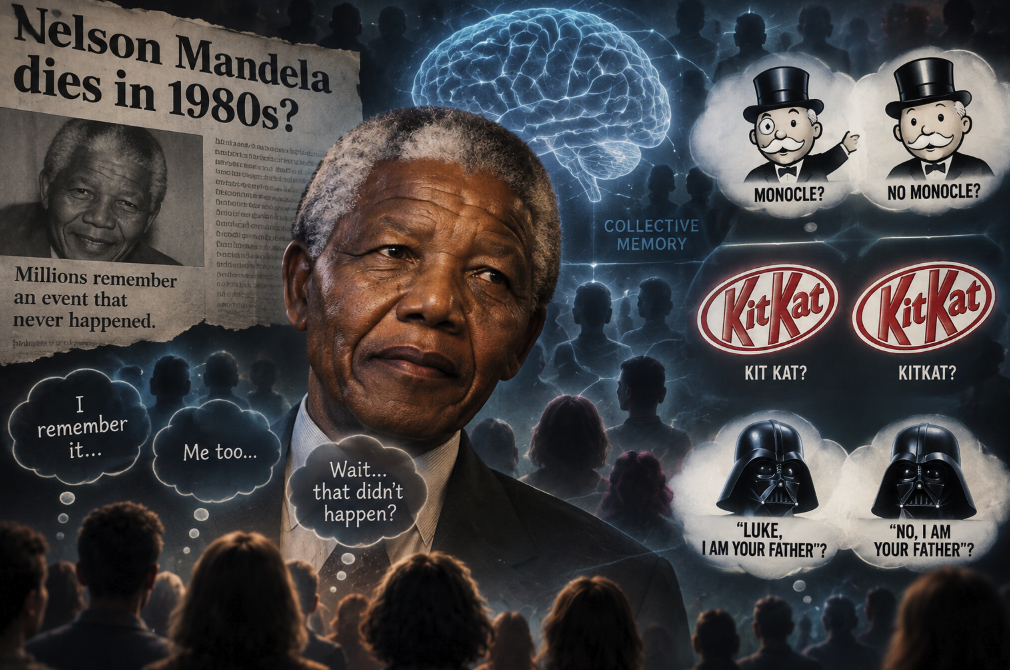
Nelson Mandela did not die in a South African prison in the 1980s. He was released in 1990, became South Africa’s first Black president in 1994 and died in 2013 at the age of 95. Yet some people have reported vivid memories of hearing about his death decades earlier, sometimes accompanied by seemingly detailed recollections of television coverage and public mourning.
That contradiction gave a name to one of the internet age’s favorite psychological mysteries: the Mandela Effect. The term describes situations in which many people appear to share the same incorrect memory. It can involve historical events, spellings, movie dialogue, fictional characters or tiny details in famous logos. What makes the phenomenon compelling is not merely that people get things wrong. Humans do that constantly. It is that large numbers of people can get the same thing wrong in remarkably similar ways — and feel confident that they remember it correctly.
Online discussions have turned these discrepancies into evidence for alternate timelines, parallel universes and changes in reality itself. Psychology offers a less spectacular explanation, but arguably a stranger one. Memory is not a recording stored intact inside the brain. It is a reconstruction, assembled whenever we remember. And under certain conditions, different brains can reconstruct the same wrong answer.
How Mandela gave the effect its name
The term “Mandela Effect” was popularized in 2009 by paranormal researcher Fiona Broome, who described remembering Nelson Mandela dying while imprisoned in the 1980s. She said she encountered other people who recalled something similar, and discussions of the apparent shared memory spread online.
The historical record is unambiguous. Mandela remained imprisoned until February 11, 1990, later served as president of South Africa from 1994 to 1999 and died on December 5, 2013. The discrepancy was therefore not a disputed interpretation of an obscure event. It was a memory of a major event that had not occurred.
Broome entertained paranormal explanations, including the possibility that people with conflicting memories had somehow experienced different realities. The idea proved irresistible online. Soon, communities were collecting examples: logos remembered with elements that were never there, quotations that differed from the original films, and brand names that seemed somehow “wrong” when people saw the official spelling.
Scientists do not need parallel universes to establish that the underlying experience is real. False memories are a well-documented feature of human cognition. As a University of Chicago overview of false-memory research explains, false memories are recollections of events that did not happen or facts that are not true. They are not the same thing as deliberately lying, and they can feel completely authentic to the person experiencing them.
The Monopoly Man’s missing monocle
Some of the clearest examples are visual. Picture Rich Uncle Pennybags, better known as the Monopoly Man. He has a top hat, white mustache, formal clothes and a cane. Does he also have a monocle?
Many people are certain that he does. He does not.
Or picture Pikachu, the yellow Pokémon character. A common recollection gives the tip of its lightning-shaped tail a black marking. The canonical design does not. People also frequently remember the Fruit of the Loom logo as fruit spilling from a cornucopia, even though the company’s familiar logo does not contain one.
These examples are more than internet trivia. Psychologists Deepasri Prasad and Wilma Bainbridge at the University of Chicago systematically investigated what they called the Visual Mandela Effect. Their research found that certain familiar images produce widespread, specific and consistent false memories. Participants did not merely choose random incorrect versions. For particular icons, many gravitated toward the same error.
Even more strikingly, confidence did not protect them. People could be highly familiar with an image and still confidently select the false version. In recall experiments, participants sometimes spontaneously drew the incorrect feature themselves. The University of Chicago’s account of the research describes participants producing errors such as Pikachu’s black tail tip despite having been exposed to the correct character.
This matters because it rules out one easy explanation: that every Mandela Effect is simply caused by people repeatedly encountering a doctored image online. Exposure to misinformation certainly can create false memories, but some shared visual errors arise even when the false version is not the dominant version people have seen.
Your brain remembers meaning, not pixels
Human memory would be impossibly inefficient if it preserved every experience as a perfect high-resolution recording. Instead, the brain extracts useful information, relationships and meaning. When a memory is retrieved, missing details can be reconstructed from expectations, associations and general knowledge.
Psychologists often discuss these expectations in terms of schemas: mental frameworks built from previous experience. A monocle, for instance, belongs to a familiar cultural stereotype of the old-fashioned wealthy gentleman. The Monopoly Man already has a top hat, mustache and formal attire, so the brain may add an accessory that fits the character even though it was never present.
This kind of explanation is powerful, but it is not universal. The University of Chicago researchers specifically tested whether schemas could explain all Visual Mandela Effects and found that they could not. The Fruit of the Loom cornucopia is a particularly awkward example. Participants preferred the nonexistent cornucopia version over another altered version showing the fruit on a plate, even though a plate is arguably a more common association with fruit.
The researchers also examined whether people simply failed to look at the relevant part of an image. That explanation did not account for the results either. Something more complicated happens between perception and recall. Certain images appear unusually likely to generate particular false memories, although scientists do not yet have a single theory explaining every case.
Why movie quotations mutate
The same reconstructive process helps explain why famous lines can become more famous in an altered form. In The Empire Strikes Back, Darth Vader does not say the often-quoted phrase “Luke, I am your father.” The actual line begins, “No, I am your father.”
The altered version makes sense outside the film because adding Luke’s name immediately identifies the characters and context. A quotation repeatedly retold in conversation, comedy, advertising and parody can therefore become more useful culturally than the original wording. Eventually, the paraphrase may feel like the source.
This illustrates another route to collective false memory: repetition. People do not build memories only from original encounters. They also encounter retellings, jokes, memes, references, descriptions and other people’s recollections. The source of a detail can become detached from the detail itself. After years of hearing an altered quotation, a person may remember not merely hearing the paraphrase but hearing the actor say it in the film.
Psychologists call mistakes about where information came from source-monitoring errors. The content feels familiar, but the brain attributes that familiarity to the wrong origin. Similar processes help misinformation become memorable, particularly when it is repeated.
Why do people share the same wrong memory?
This is the part that makes the Mandela Effect more interesting than ordinary forgetfulness. If memory errors were purely random, we would expect people to invent thousands of unrelated versions of familiar images. Instead, some mistakes cluster around one particular alternative.
Shared culture supplies part of the answer. People grow up with overlapping visual conventions, stereotypes, stories and language patterns. Their brains therefore use many of the same expectations when reconstructing incomplete memories. A population exposed to similar cultural material can independently arrive at similar errors.
The properties of the remembered object itself also matter. Bainbridge’s broader research examines “memorability”: the surprising finding that people tend to remember and forget many of the same images. Some visual material is intrinsically more memorable than other material across different observers. The Visual Mandela Effect suggests that certain images may similarly possess characteristics that make particular distortions unusually likely.
Social transmission can amplify the process further. Once somebody asks, “Wasn’t there a monocle?” the suggestion itself can influence later memory. Online communities are exceptionally efficient at collecting people who share the same recollection, making an uncommon memory error suddenly appear enormous. None of this means participants are pretending. A memory can be socially reinforced while still being subjectively sincere.
No evidence that reality changed
Parallel universes provide the Mandela Effect with its most entertaining mythology. If two groups remember incompatible versions of history, perhaps, the story goes, timelines merged or people somehow crossed between realities.
There is no scientific evidence that Mandela Effects are caused by travel between universes, alterations of history or glitches in reality. Invoking such explanations also creates a larger problem than the phenomenon requires: known properties of human memory already demonstrate that people can confidently remember things that did not occur.
In fact, laboratory evidence makes the psychological explanation particularly compelling. Researchers can observe shared visual errors forming over short periods. Bainbridge has described experiments in which people were shown the correct image and still introduced the familiar false feature when drawing it from memory only minutes later. That is difficult to reconcile with the idea that the discrepancy requires a universe to change.
The uncertainty lies not in whether false memories exist, but in why some specific false memories are so consistent across people. Researchers are still investigating the mixture of visual structure, semantic expectations, cultural associations, attention and memory processes that produces them.
Memory is a storyteller, not an archive
The Mandela Effect is unsettling because confidence feels like evidence. We tend to assume that a vivid memory must be an accurate one, particularly when somebody else says, “I remember that too.” But confidence and accuracy are not identical.
That lesson extends far beyond misspelled brands and cartoon characters. False-memory research matters in eyewitness testimony, political misinformation, education, interpersonal disputes and our understanding of autobiography. A person can sincerely describe an incorrect memory without deception. Multiple people can even agree on an incorrect detail without proving that it happened.
Yet the fallibility of memory is not simply a defect. A system that stored every visual detail indiscriminately would be overwhelmed by information. Human memory is selective and adaptive. It compresses experience, connects it with previous knowledge and reconstructs what is useful. Those same abilities allow us to generalize, learn and make sense of the world — while occasionally placing a monocle on a man who never wore one.
The Mandela Effect therefore does not require reality to be unstable. The stranger discovery is that memory itself is flexible enough to create a convincing alternate version of reality — and sometimes, many minds independently create the same one.