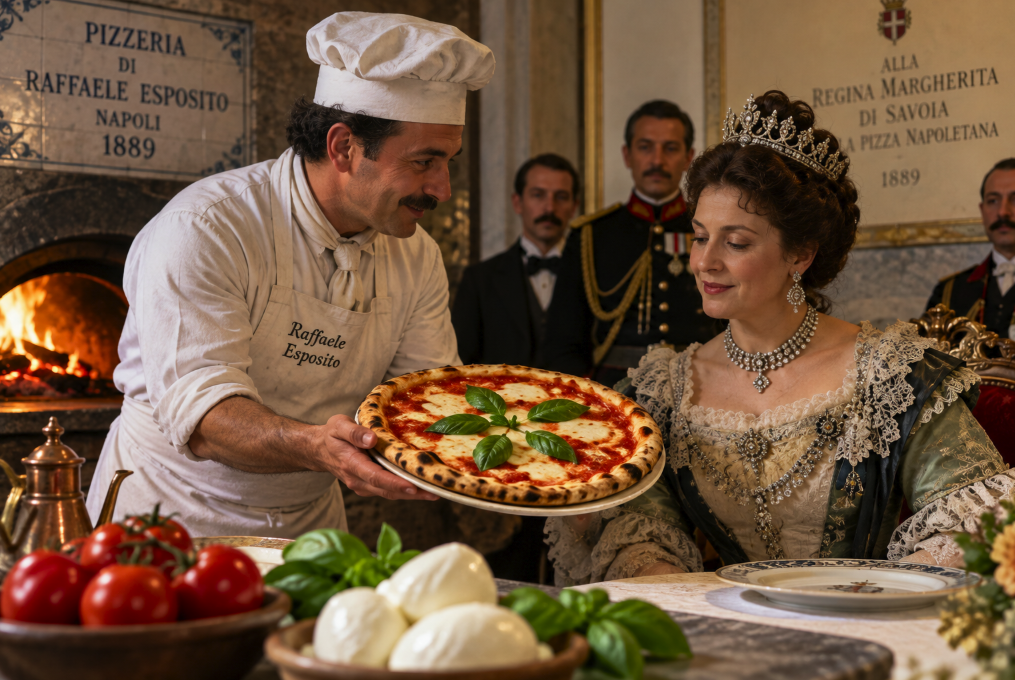
Few foods carry a national story as neatly as Pizza Margherita. Red tomato, white mozzarella and green basil seem to reproduce the Italian flag on a circle of dough. According to the story repeated in pizzerias and cookbooks around the world, the combination was invented in Naples in 1889 by pizzaiolo Raffaele Esposito for Queen Margherita of Savoy, who liked it so much that the pizza was named after her.
It is almost too perfect: a queen, a patriotic tricolor and the birth of what would become one of Italy’s most recognizable dishes.
There is only one problem. Neapolitans were eating pizzas topped with the essential ingredients of a modern Margherita before 1889. The royal episode may have helped give the pizza its famous name and an irresistible origin story, but the evidence does not support the simple claim that Esposito suddenly invented tomato, mozzarella and basil for the queen.
The real history is richer. Pizza Margherita emerged from the streets and ovens of nineteenth-century Naples, then acquired a royal legend that transformed an existing popular food into a national symbol.
Before the queen, there was Naples
Pizza did not begin as royal cuisine. By the nineteenth century it was deeply associated with Naples and with the everyday life of the city. Flatbreads, of course, are ancient, but the recognizably Neapolitan pizza developed in a much more specific setting as tomatoes became integrated into southern Italian cooking.
Naples was crowded, energetic and economically unequal. Pizza suited the city. It was inexpensive, fast, adaptable and could be sold in modest establishments or eaten as practical street food. Long before global chains and elaborate restaurant menus, there were already multiple styles of pizza with different toppings.
Contemporary writing confirms that variety. In Il ventre di Napoli, published in 1884 — five years before the famous royal encounter — journalist and novelist Matilde Serao described pizzas with tomato, mozzarella and cheese, as well as versions with anchovies, oil, oregano and garlic. The Soprintendenza Archeologia, Belle Arti e Paesaggio for Naples reproduces Serao’s account while discussing the history of the dish.
An even earlier description appears in Francesco De Bourcard’s nineteenth-century work on the customs of Naples. In the chapter on the pizzaiolo, Emmanuele Rocco described pizza toppings that included grated cheese, lard, basil, thin slices of mozzarella and, in some cases, tomato. The exact modern recipe was not standardized in the way we expect from a contemporary menu, but the building blocks of the supposed 1889 invention were already firmly present in Neapolitan pizza culture.
So when Queen Margherita arrived, Naples did not need someone to invent pizza for her. It already had a thriving pizza tradition.
The royal visit of 1889
The traditional story takes place in June 1889, less than three decades after the political unification of Italy. King Umberto I and his wife, Queen Margherita of Savoy, were staying at the royal residence of Capodimonte in Naples. Raffaele Esposito, a prominent local pizzaiolo, was called upon to prepare pizzas for the queen.
According to the familiar account, Esposito made several varieties. One combined tomato, mozzarella and basil. Its colors — red, white and green — matched the Italian tricolor, and the queen supposedly preferred it. Esposito then named the pizza “Margherita” in her honor.
The story is sufficiently embedded in Italian cultural history that Italy’s Ministry of Culture has described the Capodimonte tradition, including the historic oven associated with the royal pizza episode. The ministry’s account says that Esposito prepared several pizzas and that the queen favored the one with mozzarella and tomato, subsequently named Margherita.
A famous thank-you letter, dated June 11, 1889 and attributed to Camillo Galli of the royal household, has long been displayed by the establishment descended from Esposito’s pizzeria. It praises the pizzas prepared for Her Majesty. For generations, the document has functioned almost like a birth certificate for Pizza Margherita.
But food history rarely offers birth certificates that simple.
Did Raffaele Esposito actually invent it?
If “invent” means being the first person to place tomato, mozzarella and basil on pizza, almost certainly not. Written descriptions show that similar combinations existed decades earlier. That alone changes the meaning of the 1889 story.
Esposito may instead have done something culturally more powerful: connected an existing Neapolitan preparation with the queen and, by extension, with the new Italian nation. Whether the tricolor symbolism was consciously designed at that precise moment or strengthened in later retellings, the association was brilliant. A food identified strongly with Naples could now be narrated as a miniature edible Italian flag.
Historians have also raised questions about the authenticity and details of the celebrated royal letter. Discrepancies in its format, handwriting and bureaucratic characteristics have led some researchers to doubt whether the surviving document is exactly what later tradition claims. That does not prove that Esposito never served pizza to the queen. It means that the tidy version of events should be treated as a historical tradition rather than as an unquestionable transcript of what happened.
This distinction matters because origin legends often compress gradual cultural change into a single memorable scene. Foods are particularly vulnerable to this. Recipes evolve through countless cooks, households, markets and restaurants, but later generations prefer an inventor, a date and a dramatic occasion.
Pizza Margherita has all three.
Why the tricolor story was so powerful
The political timing made the legend especially resonant. The Kingdom of Italy had been proclaimed in 1861, but national identity was still being constructed across regions with powerful local histories and traditions. Naples had been the capital of the Kingdom of the Two Sicilies before becoming part of the unified state.
A pizza made from ordinary Neapolitan ingredients could therefore acquire a second identity. Tomato became red, mozzarella became white and basil became green. What had been a local combination could be interpreted as a national emblem.
Queen Margherita herself was an ideal figure around whom to build such a story. She was highly visible and became associated with popular expressions of Italian identity. Naming a pizza after her linked street-level Neapolitan culture with the monarchy at the top of the new state.
There is a pleasing reversal in the tale as well. Royal food normally travels downward: elite fashions are copied by the middle classes and eventually become widespread. Pizza Margherita’s legend runs in the opposite direction. A queen supposedly encounters the food of Naples and gives it aristocratic approval. The dish does not become special because the palace invented it; the palace recognizes something the city already knew was good.
From Naples to the world
In the late nineteenth century, pizza remained overwhelmingly associated with Naples. Serao even wrote about an unsuccessful attempt to establish a Neapolitan pizzeria in Rome, describing pizza as something that seemed out of place once removed from its native environment. The observation is striking today because pizza would eventually become one of the most successfully transplanted foods in history.
Italian migration carried pizza traditions abroad, especially to the United States, while economic and social changes in twentieth-century Italy helped spread the dish far beyond Naples. Different cities and countries transformed it, producing thick crusts, thin crusts, new cheeses and an almost unlimited catalogue of toppings.
Yet the Margherita retained unusual authority because of its simplicity. Dough, tomato, mozzarella, basil, olive oil and heat leave little room to hide poor ingredients or technique. In Neapolitan pizza culture, simplicity is not the absence of complexity; it puts fermentation, dough handling, oven temperature and ingredient quality on display.
That culture received major international recognition in 2017, when UNESCO inscribed the art of the Neapolitan pizzaiuolo on its Representative List of the Intangible Cultural Heritage of Humanity. The recognition concerns the craft and social tradition of pizza-making rather than a claim that one individual invented Pizza Margherita.
A legend that tells a real story
Calling the 1889 episode a legend does not make it worthless. Legends can preserve cultural truths even when their details become polished over time. Raffaele Esposito, Queen Margherita and the royal visit belong to the history of how this pizza acquired its identity. What should be discarded is only the overly simple version in which no one had thought of combining these ingredients until a royal commission inspired a single genius.
The evidence points instead toward a gradual culinary evolution. Nineteenth-century Neapolitan pizzaioli were already working with tomato, cheese, mozzarella and basil. In 1889, an encounter with the House of Savoy appears to have attached a memorable name and patriotic symbolism to a combination that was already part of Naples’ food culture.
That version may actually do greater justice to pizza. The Margherita was not a royal invention generously handed down to ordinary people. It was a popular Neapolitan food that, according to tradition, climbed all the way to a queen’s table.
And perhaps that is why the story survived. Three ingredients became three national colors, a local dish became an Italian icon, and an everyday pizza acquired a name that could travel around the world.