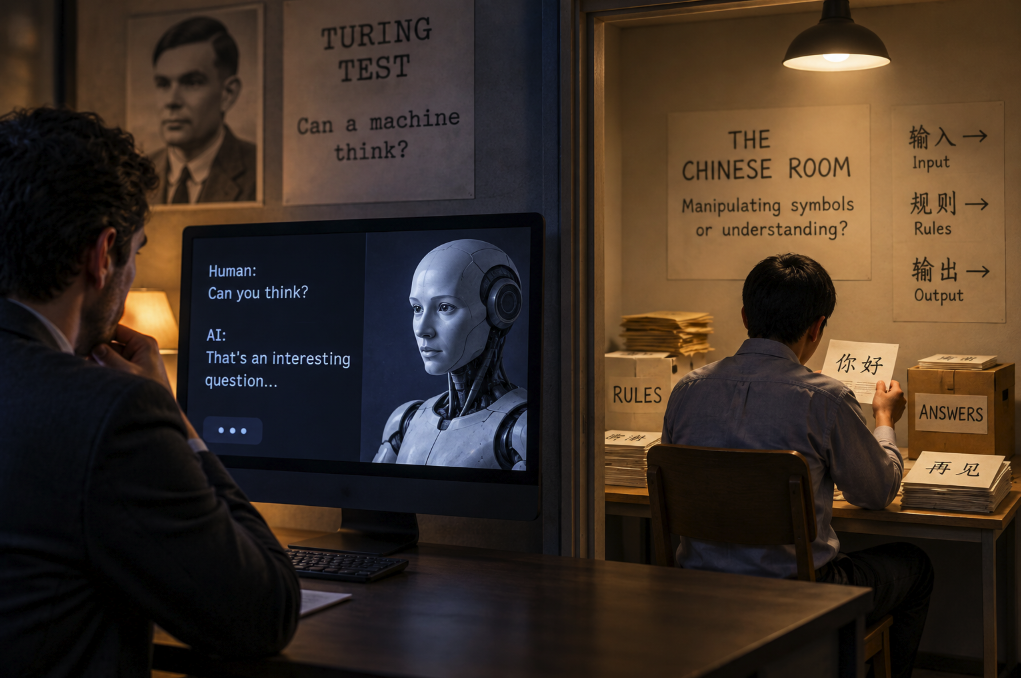
Imagine exchanging messages with an unseen stranger. The replies are witty, coherent and sensitive to context. The stranger remembers what you said earlier, catches a joke, explains a difficult idea and even turns a question back on you. Eventually you are told that there was no human on the other side at all. You were talking to a machine.
Would that prove the machine was thinking?
Alan Turing transformed a version of this question into one of the most famous ideas in computer science. Three decades later, the American philosopher John Searle attacked what he saw as a dangerous leap hidden inside it. A computer might produce language indistinguishable from that of a person, Searle argued, while understanding none of it. His weapon was an imaginary room, a rulebook and a language its occupant could not read.
Together, the Turing Test and the Chinese Room expose a problem that has become more immediate in the age of conversational artificial intelligence: how could we ever know whether fluent behavior is evidence of a mind rather than an extraordinarily successful imitation of one?
Turing changes the question
In October 1950, British mathematician Alan Turing published “Computing Machinery and Intelligence” in the journal Mind. It opened with a deceptively simple question: “Can machines think?” Turing immediately recognized the difficulty. Both “machine” and “think” invite arguments about definitions, and those arguments can become more philosophical than practical.
Instead, he proposed replacing the question with an operational game. His original “imitation game” was more specific than the simplified Turing Test commonly described today, but the enduring idea is straightforward: an interrogator communicates through text with unseen participants. If a machine can converse so successfully that the interrogator cannot reliably distinguish it from a human, its behavior gives us a reason to attribute intelligence to it.
The importance of the proposal was methodological. Turing moved attention away from the invisible interior of the machine and toward observable performance. We cannot directly inspect another human being's consciousness either. In ordinary life, we infer intelligence from speech, actions, memory, adaptation and other behavior. Why, Turing's approach implicitly asks, should an artificial system automatically be judged by an entirely different standard?
The test was never a magical meter for consciousness, and later discussions have produced many competing versions of what counts as a “Turing Test.” The Stanford Encyclopedia of Philosophy notes both the historical complexity of Turing's proposal and the long-running debate over whether imitation is an appropriate goal or measure for artificial intelligence.
Then Searle locks a man in a room
In 1980, John Searle published “Minds, Brains, and Programs” and introduced the thought experiment now known as the Chinese Room. Its setup is deliberately simple.
Imagine a person who understands English but no Chinese. He is locked inside a room containing Chinese characters and an enormous set of instructions written in a language he does understand. People outside slide Chinese messages into the room. The person cannot read them. To him, the characters are merely shapes.
But the rulebook tells him exactly what to do. When a particular sequence of symbols arrives, he finds the appropriate instructions, rearranges or selects other symbols and sends a response back through the slot. Suppose the rules are extraordinarily sophisticated. The answers are so good that native Chinese speakers outside become convinced they are corresponding with someone who understands Chinese perfectly.
Yet the person inside still understands no Chinese.
For Searle, this reveals a distinction between syntax and semantics. Syntax concerns formal relationships among symbols: their patterns and the rules for manipulating them. Semantics concerns meaning. The man in the room can perform the correct syntactic operations without knowing what any symbol means.
Searle's target was what he called “Strong AI”: roughly, the claim that an appropriately programmed computer does not merely simulate a mind but literally possesses cognitive states such as understanding. The current Stanford Encyclopedia of Philosophy overview of the Chinese Room emphasizes an important qualification that is sometimes lost in popular retellings. Searle was not arguing that no machine could ever think. Human brains are physical systems, after all. His narrower claim was that implementing the right formal computer program is not, by itself, sufficient to create genuine understanding.
Does anyone in the room understand?
The Chinese Room feels persuasive because we naturally identify the person following the instructions as the candidate who ought to understand. He plainly does not. Critics quickly pointed out that this may be the trick.
The best-known objection is the “Systems Reply.” Perhaps the individual person does not understand Chinese, critics concede, but he is only one component. The entire system — person, rulebook, symbol store and processing procedure — is what understands Chinese. Asking whether the operator understands would then be like examining a single neuron in a human brain, discovering that the neuron does not understand English, and concluding that the person containing it cannot understand English either.
Searle responded by strengthening the thought experiment. Imagine that the operator memorizes the complete rulebook and all the symbols. The room disappears; the entire procedure is now performed inside one person's head. He can receive Chinese characters and generate flawless Chinese answers while, Searle insists, still experiencing the symbols as meaningless shapes. Where, then, is the understanding?
Critics remain unconvinced. Some argue that a second cognitive system could effectively be implemented by the first person without being identical to his conscious English-speaking self. Others propose a “Robot Reply”: perhaps symbols acquire meaning when the computer is embodied in a machine that sees, moves, touches objects and causally interacts with the world. Still others question whether our intuition that the room contains no understanding should be trusted at all. A thought experiment may expose assumptions, but intuition alone does not settle the science of consciousness.
This is why the Chinese Room has survived for decades. It is not a universally accepted proof that computers cannot understand. It is a challenge demanding an account of how meaning could arise from computation — and philosophers, cognitive scientists and computer scientists disagree about whether that challenge succeeds.
Why the argument feels newly relevant
When Searle published his argument in 1980, conversational machines capable of maintaining remarkably fluent exchanges belonged largely to speculation. Today, artificial intelligence can write essays, translate languages, generate computer code, summarize scientific material and sustain conversations across an extraordinary range of subjects.
That does not automatically resolve either side of the philosophical dispute. In fact, it makes the distinction sharper. A system can now display linguistic behavior impressive enough that questions once confined to philosophy seminars arise during ordinary encounters with technology.
The temptation is to treat fluency as transparent evidence of an inner mental life. But linguistic competence and consciousness are different claims. Even extraordinarily successful performance does not by itself tell us what, if anything, a system experiences internally. Conversely, simply asserting that an artificial system is “only manipulating symbols” does not solve the problem either, because human brains also transform physical signals according to mechanisms that can be described without mentioning subjective meaning. The unanswered question is how any physical process — biological or artificial — becomes associated with understanding in the first place.
Modern AI also complicates the original metaphor. Contemporary machine-learning systems are not straightforward giant rulebooks in which programmers explicitly write a response for every possible input. Their behavior emerges from learned numerical structures and enormous training processes. Whether that difference matters philosophically is disputed. Searle's argument is intended to concern computation at a deeper level, not merely old-fashioned hand-coded software.
Behavior versus inner experience
The deepest disagreement between the two famous ideas is therefore not simply “Turing versus Searle.” Turing offered a practical way to discuss machine intelligence without first solving the definition of thought. Searle asked whether behavioral success could ever establish the kind of internal understanding that humans believe themselves to possess.
Both questions remain useful because they operate at different levels. A behavioral test can tell us something important about capability. If a machine reasons, communicates and adapts successfully across demanding situations, that performance matters regardless of what metaphysics we attach to it. But if the question is consciousness, meaning or subjective experience, behavior may leave room for competing interpretations.
The Chinese Room ultimately forces us to confront an uncomfortable fact: we do not possess a universally agreed test for genuine understanding. We recognize it in other humans largely because they resemble us, share our biology, behave in familiar ways and report inner experiences much like our own. Artificial systems weaken those assumptions.
Turing asked us to judge the conversation. Searle asked us to look behind the conversation and wonder whether anything there knows what the words mean. More than seventy years after Turing's paper and decades after Searle's imaginary room, the gap between those questions remains one of the most fascinating boundaries between computer science and philosophy.