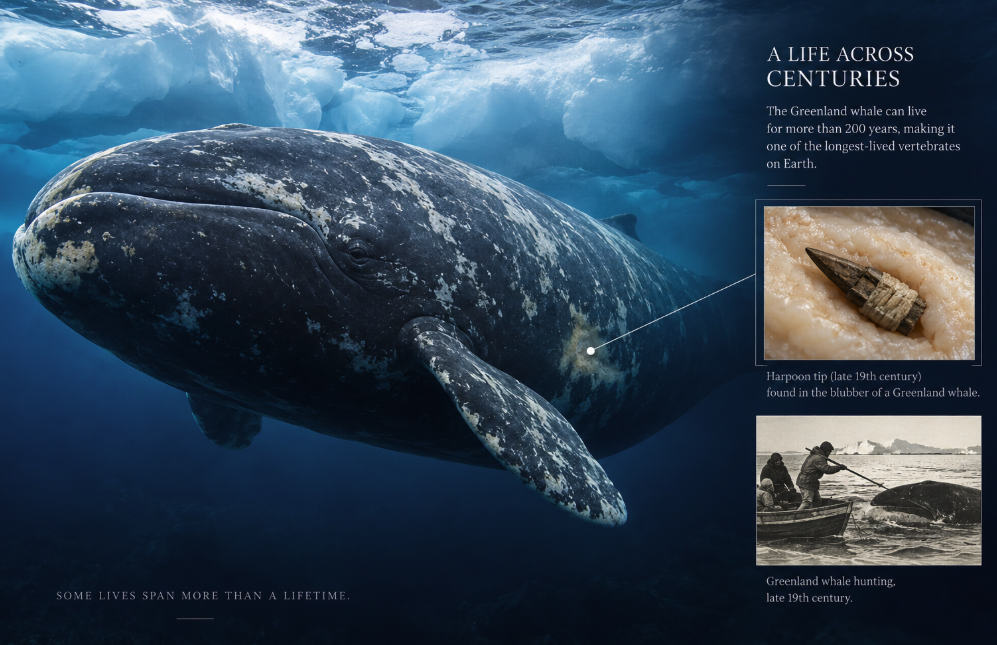
When Iñupiat hunters and biologists began finding ancient weapon fragments inside bowhead whales harvested in Arctic Alaska, the discoveries posed an extraordinary question: how long had these animals been swimming with pieces of an earlier whaling era embedded in their bodies?
Some of the objects were stone, bone or ivory points of types that had not been used for generations. In 2007, another bowhead yielded something even easier to date: part of a nineteenth-century commercial whaling bomb lance, a metal projectile manufactured roughly around the early 1880s.
The whale had survived the original attack and lived for well over a century afterward.
These discoveries helped confirm something Arctic Indigenous knowledge had long suggested and modern biology initially struggled to accept. The bowhead whale, Balaena mysticetus — also known historically as the Greenland whale — is the longest-lived known marine mammal. Some individuals can survive for more than 200 years.
That means a bowhead alive today could, in principle, have been born before the invention of the telephone, the automobile and the electric light bulb.
But the popular version of this story often mixes several discoveries together. The famous nineteenth-century fragment found in 2007 was not a Stone Age harpoon point; it was part of a metal bomb lance. Older-style stone, ivory and bone weapon fragments have been recovered from other bowheads. Together with chemical dating of the whales' eye lenses, these artifacts produced one of the most remarkable longevity stories in vertebrate biology.
An Arctic whale built like a living icebreaker
Bowhead whales spend their entire lives in Arctic and sub-Arctic waters. Unlike many other baleen whales, they do not make long migrations to tropical breeding grounds. They are specialists in cold seas, moving with seasonal ice and feeding heavily on tiny crustaceans such as copepods.
Their bodies are unmistakable. Bowheads have enormous heads that can represent roughly a third of their body length, no dorsal fin and a thick layer of insulating blubber. Their strongly arched jaws support exceptionally long baleen plates used to filter small prey from seawater.
They are also physically capable of dealing with sea ice. NOAA's Arctic Report Card notes that bowheads can break through ice up to about two meters thick and are highly adapted to life in ice-covered waters.
For centuries, these same traits made them valuable targets for commercial whalers. Their thick blubber yielded oil, while their extraordinarily long baleen was used in products ranging from corsets to buggy whips. Intensive commercial hunting drove populations down severely before the industry declined.
Some whales survived those hunts. A few appear to have carried the evidence inside them for more than a century.
The harpoons hidden under the skin
Traditional Iñupiat subsistence hunts provide scientists with rare opportunities to examine bowhead tissues and collect biological samples. During such examinations, researchers and hunters began documenting old weapon fragments embedded in whales.
A NOAA account of bowhead research in Alaska describes scientifically documented finds of ivory, stone and bone harpoon points from harvested whales. The relevant hunting technologies had not been used locally for more than a century, providing an independent clue that at least some of the animals had survived for extraordinary periods.
Then came the particularly dramatic 2007 discovery.
Iñupiat hunters near Alaska recovered a fragment of a commercial bomb lance from a bowhead. Unlike an undated stone point, the device could be tied to a specific period of industrial manufacture. Researchers John Craig George and John Bockstoce later reported in Polar Biology that fragments from historical bomb lances recovered from bowheads were probably manufactured between 1879 and 1885.
The 2007 whale was estimated to have been roughly 115 to 130 years old. The weapon had apparently entered its body during the nineteenth-century commercial whaling era and remained there while the animal survived into the twenty-first century.
It was not proof of a 200-year lifespan by itself. But it provided something unusually tangible: a historical object embedded in a living animal's biological timeline.
The eyes revealed an even stranger answer
Dating a whale is difficult. Humans have birth certificates; trees have annual growth rings. Some toothed whales preserve growth layers in teeth, and certain baleen whales can be aged using structures associated with the ear. Bowheads lack some of the convenient anatomical clocks used for other cetaceans.
Researchers therefore turned to chemistry inside the eye.
The lens of a mammalian eye contains proteins that are formed early and persist with relatively little turnover. Over time, amino acids within those proteins undergo predictable chemical changes. One particularly useful process is called aspartic acid racemization.
Amino acids can occur in mirror-image molecular forms. Living organisms overwhelmingly construct proteins using one orientation, but after formation, some molecules slowly convert to the other form. Measuring the ratio can therefore provide a chemical clock.
In a landmark 1999 study published in the Canadian Journal of Zoology, John George and colleagues analyzed eye lenses from 42 bowhead whales for which age estimates could be obtained. Their results suggested that several animals had lived for more than a century.
One whale produced an estimated age of 211 years.
The original study also made the uncertainty clear. The 211-year estimate carried a standard error of about 35 years. It should therefore not be interpreted as a birth certificate stating that one precisely known individual lived exactly 211 years.
What mattered was the convergence of evidence. Chemical estimates indicated extreme longevity, while old hunting implements recovered from other whales independently demonstrated that bowheads really could survive for well over a century.
A 120-year-old artifact matched the chemistry
Later work made the case even stronger.
Scientists compared eye-lens age estimates with historical artifacts found in individual whales. A recent review of baleen-whale longevity notes one particularly valuable example: a bowhead estimated through eye-lens chemistry to be about 133 years old carried a whaling artifact roughly 120 years old.
The two independent clocks — one chemical, one historical — pointed in broadly the same direction.
This was important because an age estimate above 200 years initially sounded so extreme that researchers had reason to wonder whether the chemistry was misleading them. Finding nineteenth-century hunting technology inside twentieth- and twenty-first-century whales made extraordinary longevity much harder to dismiss as a laboratory artifact.
Today, NOAA Fisheries states that studies suggest bowhead whales may live beyond 200 years. NOAA's National Ocean Service likewise identifies the bowhead as the longest-lived marine mammal.
Are they the longest-lived vertebrates?
Not quite.
Bowheads are sometimes described as the longest-lived vertebrates, but discoveries involving other species have displaced that broader record. Greenland sharks have been estimated to live for several centuries, although their ages also involve substantial statistical uncertainty.
The safer distinction is still astonishing: bowheads are the longest-lived known mammals and the longest-lived known marine mammals.
Even among mammals, surviving two centuries creates a biological puzzle. Large bodies contain enormous numbers of cells, and a long life gives those cells decades to accumulate mutations and molecular damage. Yet bowheads somehow maintain functional tissues while avoiding fatal disease for periods that can exceed two ordinary human lifetimes.
That has turned the species into an unexpected subject for aging research.
How does a mammal survive for 200 years?
There is no single proven “longevity gene” that explains the bowhead's lifespan. Researchers are investigating several possibilities.
Genomic studies have identified unusual features in genes involved in DNA repair, cell-cycle regulation and cancer biology. These mechanisms are particularly interesting because very large, long-lived animals face what is known as Peto's paradox: despite having far more cells in which cancer-causing mutations could occur, large species such as whales do not experience cancer at the rates a simple cell-count calculation might predict.
NOAA notes that genes associated with repairing damaged DNA may contribute to bowhead longevity. Scientists are also studying their metabolism, immune systems, cellular maintenance and resistance to age-related disease.
Cold Arctic life may be part of the evolutionary context as well. Bowheads have relatively low body temperatures for mammals, enormous energy reserves and a slow life history. They do not reach sexual maturity until roughly their mid-twenties — an age when many other mammals are already old.
A bowhead's biology operates on a different timetable.
The whale that survived history
It is tempting to imagine the life represented by one of these ancient animals.
A bowhead born around the beginning of the nineteenth century could have swum beneath Arctic ice before Charles Darwin published On the Origin of Species. It could have encountered wooden commercial whaling ships, survived the industrial whaling era, lived through two world wars and entered an ocean increasingly crossed by modern ships and affected by rapid climate change.
That narrative is hypothetical, because scientists cannot reconstruct the biography of the 211-year-old estimated individual year by year. But the timescale is biologically plausible.
The weapon fragments make that timescale tangible. A nineteenth-century whaler fired at an animal and failed to kill it. The wound closed around the foreign object. Decades passed. The whaling industry transformed. Generations of humans lived and died. The whale kept swimming.
When the fragment was finally recovered, it was no longer merely a weapon. It had become a timestamp.
An old species entering a rapidly changing Arctic
Extreme longevity has one final consequence: bowhead whales can experience environmental change across extraordinarily long periods.
An animal living for 150 or 200 years encounters not just seasonal variation but historical transformation. The Arctic it knew when young may differ profoundly from the Arctic it experiences in old age.
Sea ice is changing, shipping activity is increasing in some regions, industrial noise can alter acoustic environments, and prey distributions may shift with ocean conditions. NOAA researchers monitor bowheads partly because their long lives and dependence on Arctic ecosystems make them unusual sentinels of environmental change.
Their survival through earlier commercial whaling also makes their modern story one of recovery as well as longevity. Some populations have rebounded substantially under conservation and managed Indigenous subsistence harvests, although the status of bowhead populations differs across their range.
Scientists first found evidence of their extraordinary lifespan in chemistry so slow that it accumulates in the lens of an eye. Hunters found another kind of evidence in scars and weapons left by people long dead.
Together they revealed a mammal whose natural unit of time seems almost historical rather than biological.
The bowhead whale does not merely grow old. In the most extreme cases, it can become older than the technologies once used to hunt it.