There is a peculiar kind of certainty that appears around traditional food. A grandmother made a dish one way, a restaurant in its supposed birthplace serves it another, and suddenly one version is declared authentic while everything else is dismissed as an error. Few cultural subjects produce rules quite as confidently as recipes.
History is less cooperative. Many dishes that now seem ancient and immutable changed repeatedly before reaching their familiar form. Ingredients arrived from other continents, expensive foods became cheap, preservation methods disappeared, domestic kitchens acquired refrigerators and gas stoves, and recipes crossed regional and national borders. Sometimes the version now defended as “original” is considerably younger than the dish itself.
This does not mean tradition is meaningless. It means tradition is a process rather than a fossil. To understand a classic recipe, it is often more useful to treat it like a text whose wording changed as it was copied: compare old cookbooks, menus, newspapers and household notes, identify variants, and ask when particular ingredients entered or disappeared. Culinary history can become a kind of philology performed with frying pans.
Carbonara and the invention of certainty
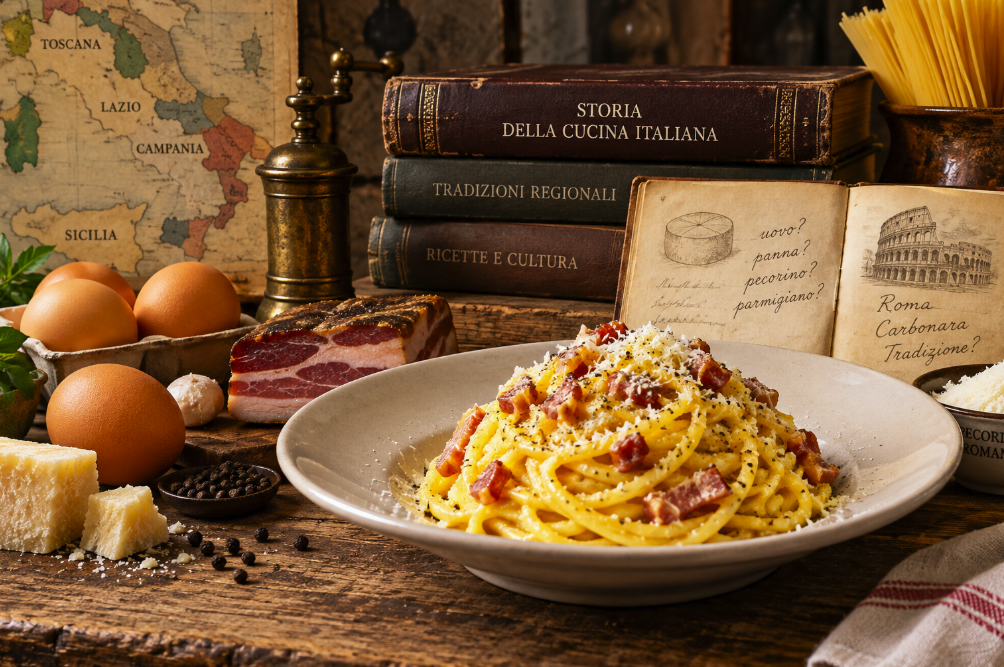
Carbonara is an almost perfect case study because the modern rules seem so clear. The Roman version now widely regarded as canonical combines pasta with egg, guanciale, pecorino romano and black pepper. Cream is excluded. Garlic and onion are generally unwelcome. Substituting bacon or pancetta for guanciale can trigger arguments far beyond Italy.
Yet the documentary history refuses to obey those rules.
The exact origin of carbonara remains disputed. One popular story links its name to charcoal workers, or carbonari. Another associates the dish with American soldiers in Italy during or immediately after the Second World War, when eggs and bacon from military supplies may have encountered Italian pasta. Older dishes based on pasta, cheese, eggs or cured pork certainly existed, but no single origin story has been demonstrated conclusively enough to settle the debate.
What historians can examine more confidently is when the name and recipes begin appearing in print. The Accademia Italiana della Cucina has traced early references around the beginning of the 1950s. A 1950 Italian newspaper mentioned American officers eating spaghetti alla carbonara in Rome. In the 1951 film Cameriera bella presenza offresi…, Aldo Fabrizi asks whether a prospective housekeeper knows how to prepare the dish.
Then come the recipes, and this is where modern certainty begins to wobble. In 1954, La Cucina Italiana published a carbonara recipe containing spaghetti, pancetta, eggs, Gruyère, garlic, salt and pepper. The combination would look almost heretical on a contemporary Roman menu. Yet it is part of the dish's documented history.
Other early versions varied too. Guanciale, today one of carbonara's defining ingredients, was not universally present from the beginning. Cream also appeared in influential twentieth-century versions and became particularly common in restaurants during later decades, partly because it made the sauce easier to keep creamy and stable.
This creates a distinction that food arguments often miss. Saying that cream appeared historically in carbonara is not the same as saying that cream belongs in the contemporary Roman standard. Both statements can be true: a recipe can have contained an ingredient during its evolution and later exclude it as its identity becomes more tightly defined.
Recipes evolve like languages
A language has rules, but those rules are the result of centuries of change. Words migrate, pronunciations shift and expressions that once sounded normal become archaic. Recipes behave in surprisingly similar ways.
Imagine several versions of the same dish printed fifty years apart. One uses butter, another olive oil. One specifies a local cheese, another a cheaper substitute. An ingredient disappears after refrigeration changes preservation habits. A restaurant version introduces a richer sauce, which home cooks later imitate. Eventually one branch of this culinary family tree becomes dominant.
Looking backward from the dominant version creates an illusion. Because today's recipe is familiar, we instinctively project it into the past. Earlier variations begin to look like mistakes rather than ancestors.
Old cookbooks are therefore valuable precisely when they contradict us. They preserve moments before a dish became standardized. Menus reveal what restaurants called it. Newspapers can show when a name entered popular language. Family notebooks record domestic versions that formal cookbooks ignored. None of these sources alone can establish an absolute “first recipe,” but together they reveal movement.
The method resembles textual criticism. A scholar studying an ancient work does not assume that every surviving manuscript contains identical wording. Variations can reveal how the text travelled. With food, substitutions and omissions perform a similar role. The differences are evidence.
The supposedly eternal ingredients that arrived late
Recipes are also constrained by geography. A cuisine cannot use an ingredient before that ingredient arrives.
This simple fact produces some of the most striking paradoxes in European food history. Tomatoes are now so closely associated with Italian cooking that imagining the cuisine without them feels almost impossible. Yet tomatoes originated in the Americas and reached Europe only after transatlantic contact in the sixteenth century. Medieval cooks in Florence, Naples or Rome had never seen a tomato.
The same broad Columbian exchange brought Europe maize, potatoes, peppers and New World varieties of beans. Over time these foreign plants became embedded so deeply in local agriculture and cooking that they acquired the aura of ancient tradition. Northern Italian polenta, for example, became strongly associated with maize even though Europeans had made porridges from other grains long before American corn arrived.
This is one reason the language of culinary “purity” can become historically misleading. Some of the foods considered most representative of a place are products of migration, trade and adaptation. Their local identity is genuine, but it was constructed over time.
Italy is not one kitchen
Regional variation complicates the picture further. Italy became a unified state only in the nineteenth century, while its food cultures developed for centuries within different climates, economies, cities and political territories. Alpine valleys, the Po plain, the Tuscan countryside, Rome, Naples and Sicily did not share one pantry or one culinary history.
Even apparently simple categories hide enormous diversity. Bread changes shape, grain and texture from region to region. Filled pasta changes name, filling and folding technique over remarkably short distances. The word ragù can point toward very different sauces depending on whether the speaker is in Bologna or Naples. Similar preparations may carry unrelated names, while the same name can describe noticeably different dishes.
What outsiders later identify as “Italian food” is therefore partly a national and international synthesis of intensely local traditions. Migration within Italy helped spread regional dishes beyond their original territories. Italian emigrants then adapted them again abroad according to available ingredients, prices and local tastes.
Those adaptations are sometimes mocked as inauthentic, but historically they belong to the same mechanism that created many traditions in the first place. People cook with what they have.
When does a variation become a tradition?
This leads to a difficult question: if recipes constantly change, when does a particular version become traditional?
There is no universal threshold. Age matters, but age alone is insufficient. Repetition matters. So does association with a community. A preparation can become traditional because families transmit it, because restaurants in one city converge around it, because festivals celebrate it or because institutions formally codify it. Sometimes all of these processes reinforce one another.
Modern media accelerate standardization. Television, cookbooks, tourism and social networks can transform one regional interpretation into the internationally recognized version. Once millions of people learn that formula, deviation becomes more visible. Paradoxically, the better documented and more famous a traditional dish becomes, the more rigid its boundaries may appear.
Carbonara illustrates the process beautifully. Its early documented recipes are heterogeneous. Over time, the combination of guanciale, egg, pecorino and pepper gained authority, particularly through its association with Roman cuisine. Today's standard is not invalid because older versions differed. Its tradition consists precisely in the cultural consensus that formed around it.
Authenticity is a historical question, not just a recipe
The word “authentic” is useful when it identifies a meaningful culinary practice, but troublesome when it pretends history never moved. A dish can be authentically Roman today without being prepared exactly as it was in Rome seventy years ago. A regional recipe can contain an ingredient whose ancestors crossed an ocean. A grandmother's version can be genuinely traditional within one family while differing from the version in the next village.
Food history becomes richer once those apparent contradictions are allowed to coexist. Instead of searching obsessively for a mythical first and perfect recipe, we can ask more revealing questions. When does the name first appear? Which ingredients were available? How did published versions differ? When did one variant become dominant? Who had the authority to define it?
Perhaps the most useful question at an Italian table is therefore not “Is this the real recipe?” but “Real according to which place, which family and which year?” A plate can contain centuries of agriculture, migration, commerce, technology and memory. The argument over what belongs in it is not a distraction from tradition. Very often, the argument is part of the tradition itself.