Ask a child to draw the Sun and there is a good chance they will reach for a yellow crayon. Search for a Sun emoji and you will find the same convention. For centuries, artists have painted it gold, yellow or orange.
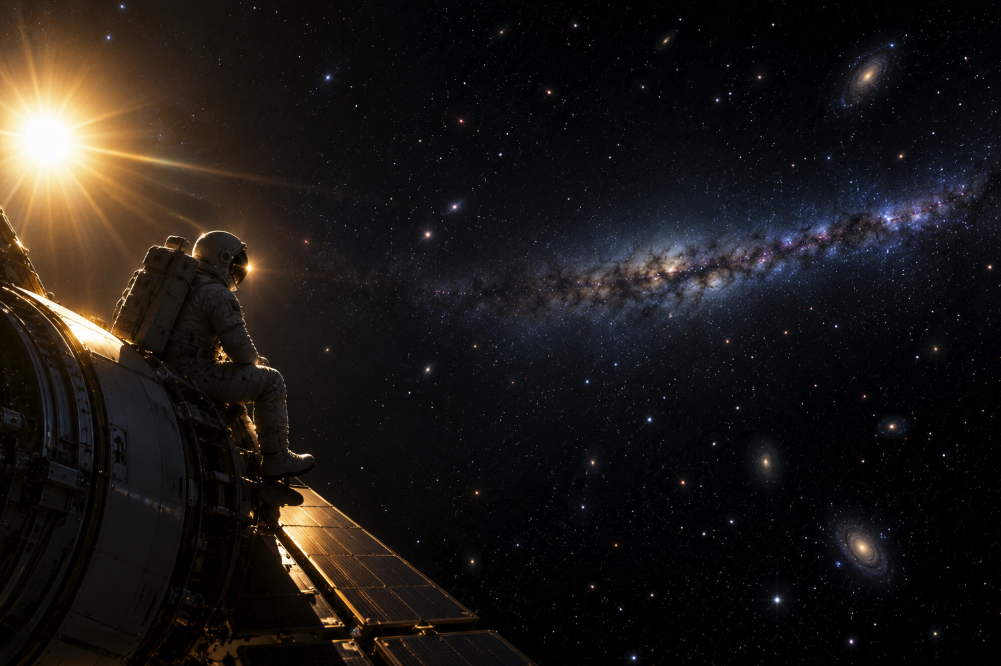
But if you could observe the Sun from above Earth's atmosphere — through proper solar protection — its visible light would appear essentially white.
The yellow Sun is not entirely an illusion, because our atmosphere really can make the direct solar disk look warmer. But one part of the familiar explanation is often wrong: the effect is not primarily caused by atmospheric refraction. The key process is scattering, the same physics that gives Earth its blue sky and fiery red sunsets.
NASA's current Heliopedia puts it plainly: the Sun's photosphere emits the white light visible to our eyes, while the Sun can appear yellow from Earth's surface because blue light is scattered by particles and molecules in the atmosphere.
Why white light comes from a star
White is not a single wavelength of light. Human vision interprets a broad mixture of visible wavelengths stimulating our red-, green- and blue-sensitive cone cells as white or nearly white.
The Sun's surface — more precisely, the photosphere from which most visible sunlight escapes — has a temperature of roughly 5,800 kelvin. A hot object at that temperature produces a broad thermal spectrum. The Sun emits strongly across the entire visible range, from red through orange, yellow, green and blue into violet, while also radiating substantial energy outside visible light in the infrared and ultraviolet.
Mix those visible wavelengths together and the result perceived by human eyes is white.
NASA's SOHO mission answers the question directly in its frequently asked questions: “The Sun is white.” NASA's eclipse education material similarly notes that an observer above the atmosphere would perceive the Sun as white because it emits strongly across all the visible colors.
There is an easy terrestrial clue. A white sheet of paper illuminated by midday sunlight still looks white. If sunlight were fundamentally yellow in the same sense that a yellow lamp is yellow, neutral objects would inherit a much stronger yellow cast.
Then why does the Sun look yellow from Earth?
Before sunlight reaches your eyes at ground level, it must cross Earth's atmosphere. Molecules in the air scatter shorter wavelengths more efficiently than longer ones, a process known as Rayleigh scattering.
Blue and violet light are therefore scattered away from the direct line between the Sun and your eyes much more strongly than red light. Some of that scattered blue light arrives from every direction across the sky, producing the familiar blue dome overhead.
The direct sunlight left behind has lost proportionally more of its shorter wavelengths. That shifts its color toward the warmer end of the spectrum and can make the Sun appear yellowish.
This is why the same atmospheric physics explains two apparently unrelated observations: a blue sky and a warmer-colored Sun.
NASA's explanation of the blue sky describes sunlight being scattered in all directions by atmospheric gases, with blue light scattered more strongly because of its shorter wavelength.
Calling this effect “refraction” confuses two different optical processes. Refraction occurs when light changes direction because its speed changes as it passes between media. Earth's atmosphere does refract sunlight — among other things, it makes the Sun appear slightly displaced near the horizon — but refraction is not the main reason the solar disk becomes yellow, orange or red.
Why sunsets turn orange and red
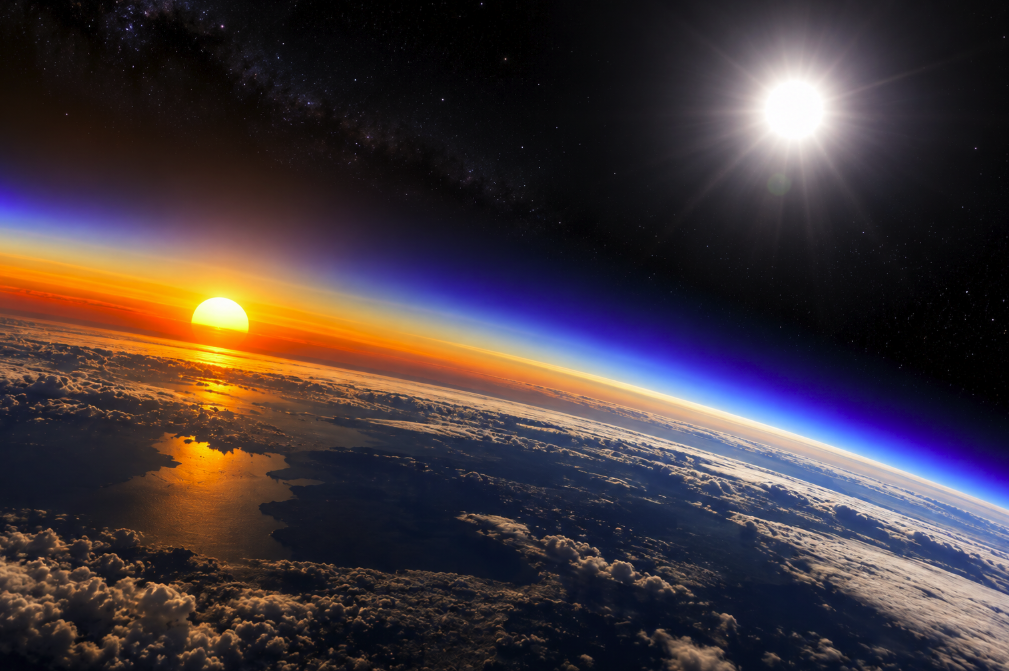
At noon, sunlight takes a comparatively short route through the atmosphere before reaching an observer. Near sunrise or sunset, the geometry changes dramatically. The Sun's rays enter at a shallow angle and travel through much more air.
That longer path gives the atmosphere more opportunity to scatter the shorter wavelengths out of the direct beam. Blue is depleted first; with enough atmospheric path length, greens and yellows are reduced too. The light reaching you directly from the low Sun becomes increasingly dominated by orange and red wavelengths.
NASA Earth Observatory's discussion of light scattering near sunset explains that the low solar angle forces sunlight through more atmosphere, increasing the removal of shorter blue wavelengths and leaving warmer colors.
Aerosols complicate the picture further. Dust, smoke, pollution, sea salt and other suspended particles can scatter and absorb light in ways that differ from pure Rayleigh scattering. This is why one sunset may be pale yellow while another becomes spectacularly crimson.
The Sun therefore has not changed color during the day. The filter between the Sun and you has changed.
Is the Sun green because its spectrum peaks in green?
This is another popular internet claim built around a real fact.
Depending on exactly how the solar spectrum is plotted, the Sun's visible emission can have a maximum around wavelengths we associate with green. But a spectral peak does not mean that an object emits only — or even overwhelmingly — that color.
The Sun's thermal spectrum is broad. It emits plenty of red and blue light alongside the wavelengths near the maximum. Our visual system combines that broad mixture, so the Sun appears white rather than green.
A narrow green laser is green because almost all of its visible output is concentrated into a tiny range of wavelengths. The Sun is nothing like that. Its spectrum spreads across the rainbow.
This also explains why the label “yellow star” can be confusing. Astronomers classify the Sun as a G-type main-sequence star, sometimes casually called a yellow dwarf. That astronomical nickname should not be interpreted as a precise statement that the Sun would look like a yellow-painted sphere from space.
Why NASA pictures show a yellow, red or blue Sun
Spacecraft imagery creates another source of confusion. Search NASA's solar archives and the Sun appears in almost every imaginable color: deep red, blazing orange, electric blue, violet, green and gold.
Many of those images are not photographs designed to reproduce what human eyes would see.
Solar observatories study wavelengths outside visible light, including extreme ultraviolet and X-rays. Scientists and image specialists assign visible colors to otherwise invisible wavelength channels so structures can be distinguished. Even observations made at visible wavelengths may use narrow filters that isolate particular spectral features.
Color in scientific imagery can encode temperature, wavelength or physical structure rather than ordinary visual appearance. A blue NASA Sun does not mean the star is secretly blue any more than a weather map showing a red heat wave means the ground has literally turned red.
NASA's “What Color Is the Sun?” resource explores this distinction between the Sun's visible appearance and the colors used to represent solar observations at different wavelengths.
Does the Sun always look yellow from the ground?
No. Under a clear atmosphere with the Sun high in the sky, it can look white or yellow-white. Its apparent color depends on atmospheric conditions, how much air the light crosses and even the way human vision adapts to the surrounding illumination.
The strongest orange and red colors usually occur when the Sun is low because the optical path through the atmosphere is longest. Smoke, dust and aerosols can intensify or alter those colors.
Our cultural expectation matters too. Because we associate the Sun with warmth and commonly see it near the horizon when it is safe enough to notice its color indirectly, yellow and orange have become deeply embedded in the way we represent it.
There is an important safety point here: never stare directly at the Sun, even when it looks dimmer through haze or at sunset. Direct solar viewing requires certified eclipse glasses or appropriate solar filters designed for that purpose.
So what color is the Sun? In ordinary human color terms, its broad visible spectrum is white. Earth's atmosphere can shift the direct light toward yellow, orange and red because shorter wavelengths are scattered out of the beam, especially when the Sun is near the horizon.
The yellow crayon is not a terrible representation of how the Sun often appears from Earth's surface. But take away our atmosphere, and the star at the center of the Solar System loses its familiar golden tint. Against the blackness of space, it is a brilliant white star.