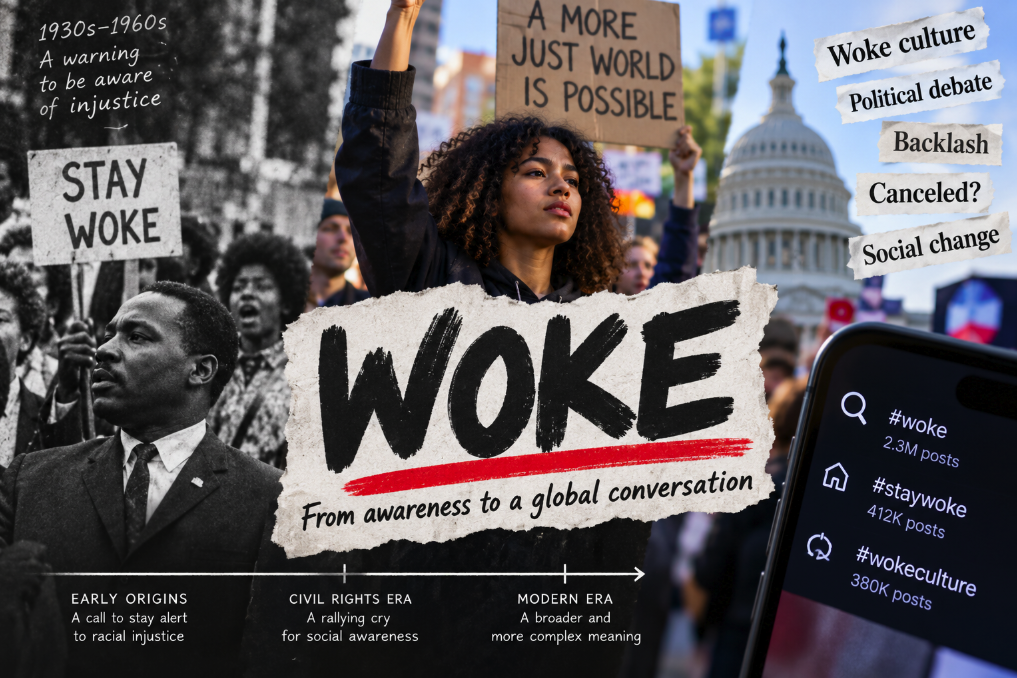
Few English words have traveled as far politically as “woke.” Depending on who says it, the word can mean alert to racial injustice, broadly progressive, excessively politically correct, performatively virtuous, or almost anything a speaker dislikes about contemporary left-wing culture.
That ambiguity is not accidental. “Woke” has passed through several distinct communities and historical moments. It began as ordinary grammar, developed a powerful metaphorical meaning in African American English, became closely associated with racial-justice activism, spread into mainstream popular culture and was then adopted by critics as a political label. Today, two people can use the same four-letter word while referring to strikingly different things.
To understand what “woke” means now, it helps to begin before Twitter, TikTok, Black Lives Matter and the modern culture wars.
Before “woke culture,” there was “stay woke”
At its most literal, woke is simply a form of wake: someone who was sleeping woke up. African American English also developed a figurative use in which being woke meant being awake in another sense—alert, watchful and conscious of what was happening around you.
The expression is much older than many people assume. Merriam-Webster’s history of “woke” documents an especially striking example from the Houston Informer, a Black newspaper, in 1924. The paper discussed “Stay Woke” as contemporary street slang and explained it as remaining alert rather than sleeping at one's post.
By 1938, the phrase appeared in a context directly connected to racial danger. Blues and folk musician Huddie Ledbetter, better known as Lead Belly, recorded a song about the Scottsboro Boys, nine Black teenagers who had been falsely accused of raping two white women in Alabama in 1931. In spoken commentary associated with the recording, Lead Belly advised Black travelers passing through Alabama to be careful, “stay woke” and keep their eyes open.
The meaning was not a vague command to hold fashionable political opinions. It was an instruction to remain aware of a society in which racism could have immediate and potentially deadly consequences.
From Black vernacular to a language of social awareness
The expression continued circulating in Black American culture. In 1962, Harlem writer William Melvin Kelley published a famous New York Times essay titled “If You're Woke You Dig It,” examining Black slang and the way expressions created within Black communities could be adopted—and altered—by white Americans.
That history matters because the modern political sense of “woke” did not suddenly appear in the 2010s. The metaphor of wakefulness had long made intuitive sense: to be asleep was to miss what was happening; to be awake was to perceive realities that others ignored.
The phrase gained renewed cultural visibility in the 2000s. Erykah Badu's 2008 song “Master Teacher” repeatedly used “I stay woke,” and she later used the phrase on social media. As hashtags became a central language of online activism, #StayWoke was perfectly suited to the format: short, memorable and already carrying decades of cultural meaning.
Then came Ferguson.
Black Lives Matter made “woke” mainstream
In August 2014, police officer Darren Wilson fatally shot Michael Brown, an 18-year-old Black man, in Ferguson, Missouri. Brown's death, the protests that followed and the national debate over policing and race accelerated the growth of the Black Lives Matter movement. “Stay woke” circulated widely on Black Twitter and among activists as a call to remain attentive to racial injustice and police violence.
Merriam-Webster now defines this slang sense of woke as being aware of and actively attentive to important societal facts and issues, especially racial and social justice. The dictionary dates its origin to African American English and notes that it gained much wider use beginning in 2014 through Black Lives Matter.
Once the word entered mainstream media, its scope expanded. Someone might be called woke for recognizing racism, but the label increasingly appeared in conversations about sexism, LGBTQ+ rights, economic inequality, environmental issues and other progressive causes. Brands adopted social-justice language. Entertainment companies emphasized diversity. Universities, workplaces and institutions discussed inclusion using terminology that had previously been more common among activists.
That expansion created the conditions for the word's next transformation.
How “woke” became an insult
By the late 2010s and early 2020s, critics—particularly conservatives, but not exclusively—were increasingly using woke sarcastically or negatively. In this usage, the word could describe politics seen as excessively progressive, rigidly focused on identity, intolerant of disagreement or more interested in symbolic displays of virtue than practical results.
Terms such as “woke culture,” “woke capitalism” and “woke Hollywood” became common. A corporation changing its advertising, a school revising a curriculum, a movie altering the representation of a character, or an institution introducing diversity policies might all be described by critics as woke.
The crucial linguistic shift is that the speaker no longer needs to share the original idea that being woke is desirable. The word can function as a negative label. Merriam-Webster consequently notes both the social-awareness sense and a disapproving use for people, policies or practices perceived as too politically liberal or progressive.
That does not mean every criticism described as “anti-woke” is identical. Some critics object to particular diversity programs or theories about race and gender. Others use the term more broadly as shorthand for contemporary progressivism. Still others apply it so loosely that “woke” becomes less a definition than a signal of political disapproval.
Supporters of the term argue that this transformation obscures its Black cultural history. In 2023, the NAACP adopted a resolution affirming “woke” as part of African American culture and connecting it to Black liberation movements and social justice. The organization argued that the term had been distorted and weaponized in contemporary politics.
Why arguments over the word are so confusing
Imagine one person saying, “We need to stay woke about racial discrimination.” They are using the word in a sense close to its historical activist meaning: remain aware and attentive.
Now imagine another saying, “The company went woke.” They may mean that a business has adopted progressive positions on race, gender or sexuality, perhaps in a way the speaker considers ideological or performative.
A third person might jokingly call an advertisement “woke” simply because it features a diverse cast. A fourth might use “fake woke” to criticize someone who publicly signals concern about injustice without changing their behavior. These are related usages, but they are not interchangeable.
This is a textbook example of semantic change. Words do not carry immutable definitions sealed at the moment of their creation. Communities borrow them, broaden them, narrow them, use them ironically and turn positive labels into insults—or insults into positive identities.
Politics accelerates that process because labels are useful precisely when they compress complicated ideas. “Woke” can replace an entire argument with one emotionally loaded syllable. The cost is precision. Two politicians can condemn “wokeness” while objecting to very different policies, just as two activists can praise being woke while holding very different views about what social awareness requires.
Is “woke” left-wing or right-wing?
Historically, the social-justice meaning is associated with Black political consciousness and later with progressive activism. In contemporary American political speech, however, woke is often spoken more frequently and prominently by its critics than by people describing themselves.
That creates an unusual situation in which a term once used as a positive self-description becomes heavily defined by opponents. Similar shifts have happened to many political labels. Once a word becomes useful in campaigning, commentary and culture-war arguments, its meaning can broaden faster than dictionaries can comfortably capture.
The fairest way to interpret “woke” today is therefore to look at context rather than assume one fixed definition. If the speaker is discussing the word's Black American history, it probably refers to alertness to racial or social injustice. If the speaker is criticizing a movie, corporation, university or government policy, it may be a pejorative shorthand for what they consider excessive progressive ideology. If the word appears in a joke or meme, its meaning may be looser still.
What does “woke” actually mean today?
The original social meaning is straightforward: to be woke is to be alert to injustice, especially racial and social injustice. That sense grew from African American English and has documented roots many decades before the contemporary political debate.
The newer political meaning is equally real as a matter of language use: “woke” can also be a critical label for ideas, institutions or people perceived as excessively or performatively progressive. Whether that criticism is fair in a particular case is a political judgment, not a dictionary definition.
That distinction explains why debates about the word so often go nowhere. One side may be defending its historical meaning while another is attacking a newer cluster of policies and cultural attitudes that it has placed under the same label.
In less than a century, “stay woke” traveled from a warning to remain alert, through Black cultural and civil-rights consciousness, into hashtags, advertising, electoral politics and global culture wars. The word itself is tiny. The history packed inside it is not.