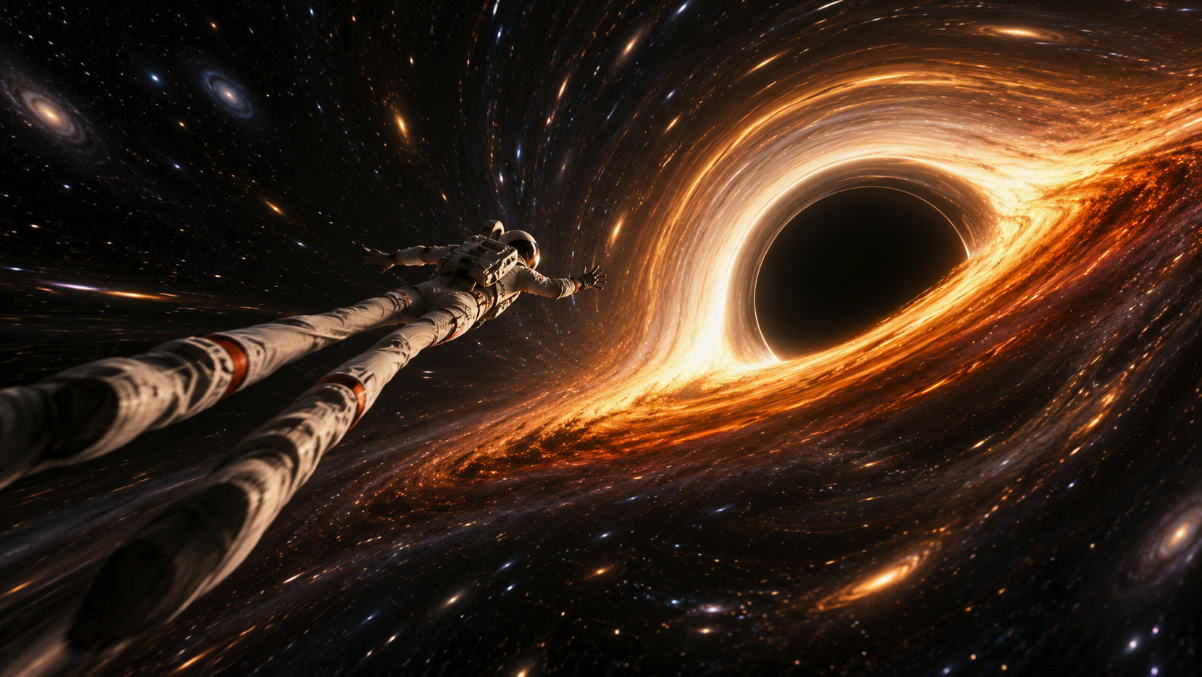
Imagine falling feet-first toward a black hole. At first, if the black hole were isolated and you began far enough away, the experience would not feel supernatural. You would be in free fall. There is no invisible cosmic hand suddenly grabbing you simply because the object ahead is a black hole.
Then the difference between the gravity at your feet and the gravity at your head would begin to matter.
Your feet, being closer to the black hole, would be pulled more strongly than your head. At the same time, the geometry of the gravitational field would squeeze you from the sides. The difference would grow rapidly as you fell inward until your body was stretched lengthwise and compressed sideways.
Astrophysicists really do call this spaghettification.
The name sounds whimsical. The process is anything but.
Why a black hole stretches you instead of simply pulling you in
Gravity does not act with exactly the same strength across an extended object. The Moon pulls slightly more strongly on the side of Earth facing it than on the opposite side, helping produce ocean tides. The difference in gravitational pull across an object is therefore called a tidal force.
Near a black hole, that gradient can become extreme. NASA's current explanation of what happens when matter gets too close to a black hole describes the nearer part of an infalling object as experiencing a stronger gravitational pull than the farther part. The result is stretching along the direction of fall and compression across it.
A human body cannot remain intact once that difference becomes sufficiently large. Tissues would be stretched, organs disrupted and eventually matter itself torn into an elongated stream.
Astronomers see the same underlying physics on a far larger scale. Stars that pass too close to supermassive black holes can be torn apart in tidal disruption events, producing streams of stellar material that heat up and radiate enormous amounts of energy. In July 2026, for example, NASA reported observations from the Swift Observatory of a star being disrupted by a massive black hole far from its galaxy's center.
Spaghettification is therefore not merely a science-fiction description of an imaginary astronaut. Tidal destruction is a real astrophysical phenomenon.
The surprising twist: a bigger black hole can be gentler
You might assume that the most massive black holes would tear you apart earliest. Near the event horizon, the opposite can be true.
A stellar-mass black hole may contain only several or a few dozen times the mass of the Sun, compressed behind a relatively small event horizon. The gravitational field changes enormously over the length of a human body near that horizon. The tidal forces can become fatal before you ever cross it.
A supermassive black hole can contain millions or billions of solar masses, but its event horizon is correspondingly enormous. At the horizon of a sufficiently massive black hole, the difference in gravity between your feet and head can actually be much smaller than it would be near a stellar-mass black hole.
NASA astrophysicist Jeremy Schnittman summarized the strange consequence while discussing a 2024 simulation: if you had to choose, you would want to fall into a supermassive black hole. Smaller stellar-mass black holes have stronger tidal forces near their much smaller horizons and can rip approaching objects apart before they get there.
NASA's supercomputer visualization modeled a nonrotating black hole with 4.3 million times the Sun's mass, comparable to Sagittarius A* at the center of the Milky Way. Its event horizon spans about 25 million kilometers.
In that particular simulation, a falling camera crosses the event horizon intact. Only afterward do the tidal forces become destructive: NASA calculates that spaghettification destroys it 12.8 seconds after crossing.
So the familiar statement “you get spaghettified at the event horizon” is not universally correct. Where destruction occurs depends strongly on the black hole's mass and on the details of the trajectory.
Would you notice crossing the event horizon?
The event horizon is often drawn as if it were a hard black surface. It is not.
It is a boundary in spacetime: once something crosses it, no future path can carry that object back to the outside universe without exceeding the speed of light. NASA describes it as the black hole's point of no return.
For a sufficiently large black hole, a freely falling astronaut might cross that boundary without encountering a wall, flash or locally obvious marker announcing the moment. The horizon is globally extraordinary because escape has become impossible, but it need not be locally dramatic.
This creates one of the strangest differences between what the falling astronaut experiences and what a distant observer sees.
According to general relativity, the astronaut's own clock continues normally from their perspective. They reach and cross the horizon in a finite amount of their own time. A distant observer, however, receives light from the falling astronaut that becomes increasingly delayed and redshifted as the astronaut approaches the horizon. The image appears to slow, fade and shift toward longer wavelengths rather than providing an ordinary view of the crossing.
This does not mean the astronaut personally freezes at the edge of the black hole. The apparent freezing belongs to the distant description and to the increasingly difficult escape of signals from near the horizon.
What would you see while falling?
The view would become increasingly bizarre because the black hole bends light and distorts spacetime. Background stars would appear warped by gravitational lensing. Light could follow paths around the black hole that would be impossible in ordinary flat space.
If the black hole were surrounded by a bright accretion disk, the view could be spectacular — and lethally hostile. Gas spiraling around an actively feeding black hole can become extremely hot and emit intense radiation, including X-rays. In a realistic encounter with an active black hole, radiation from the surrounding environment might kill a traveler long before the textbook drama of crossing the event horizon.
Not every black hole has a luminous accretion disk, however. An isolated, quiet black hole could be nearly invisible except for its gravitational effects and the distortion of background light.
And despite the popular image, a black hole does not behave like a vacuum cleaner that sucks everything in from arbitrary distances. NASA points out that if the Sun could somehow be replaced by a black hole of exactly the same mass, the planets would continue along essentially the same orbits. The solar system would become dark and cold, but Earth would not suddenly spiral inward merely because the central mass had become a black hole.
What happens after you cross?
Once inside the event horizon, the outside universe cannot receive a signal carrying information about your later fate. Classical general relativity says that continuing inward ultimately leads toward the black hole's central singularity.
That word needs caution. In the simplest general-relativistic models, the singularity is where quantities such as spacetime curvature become unbounded and the theory stops providing a physically satisfactory description. It is tempting to describe this as a literal point of infinite density, but the breakdown is also a warning that general relativity is incomplete at those extremes.
A successful theory of quantum gravity would be needed to describe what really happens under such conditions. Physics does not yet possess an experimentally established theory that completes that story.
So there is a boundary to the confident answer. We can use general relativity to predict the event horizon, gravitational time dilation and tidal stretching extraordinarily well. We can observe black holes tearing stars apart. But the final interior physics remains one of the places where our best theories cease to give a complete account.
The most realistic answer depends on the black hole
Ask what happens when a person falls into “a black hole,” and the missing detail is its mass.
Approach a stellar-mass black hole and the tidal gradient can become catastrophic outside the event horizon: you are stretched and destroyed before crossing. Fall toward a sufficiently supermassive black hole and you could, in principle, pass through the horizon before the tidal forces become lethal. Either way, there is no route back once the horizon is crossed.
That is what makes spaghettification such a memorable piece of physics. It sounds like a cartoon, yet it follows directly from one of gravity's most familiar effects — the same basic difference in gravitational pull that helps create tides on Earth — pushed into an environment where spacetime is curved to an almost unimaginable degree.
Near a black hole, even the gentle idea of a tide becomes powerful enough to pull a human being, a planet or an entire star apart.