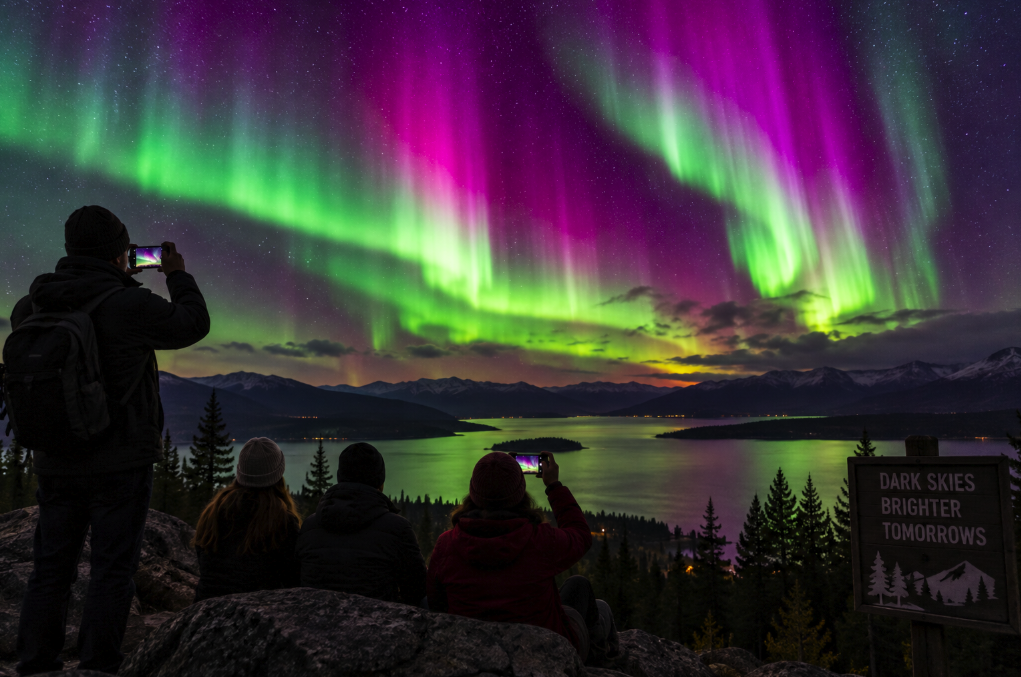
On most nights, Americans who want to see the northern lights need to travel a very long way north. Then the Sun becomes unusually active, NOAA issues a geomagnetic-storm watch or warning, and suddenly people in places that rarely think about auroras are standing in dark fields pointing phones toward the northern horizon.
The event can feel mysterious because its cause begins roughly 93 million miles away. Yet the basic chain is understandable: the Sun releases energy and magnetized material, that disturbance interacts with Earth's magnetic environment, and particles high above us produce light. During a sufficiently strong disturbance, the region where that light appears can expand far enough toward the equator for the aurora borealis to become visible across parts of the contiguous United States.
A geomagnetic storm, despite the dramatic name, is not a storm in Earth's lower atmosphere. There are no space-weather rain clouds or solar winds blowing through your neighborhood. It is a disturbance of the enormous magnetic system surrounding our planet.
What exactly is a geomagnetic storm?
Earth is surrounded by a magnetic field that forms a region called the magnetosphere. The Sun, meanwhile, continuously releases a stream of charged particles known as the solar wind. Usually this interaction is relatively uneventful from the perspective of someone standing on the ground.
A geomagnetic storm begins when conditions in the solar wind allow an unusually efficient transfer of energy into Earth's magnetosphere. NOAA's Space Weather Prediction Center describes these events as major disturbances of the magnetosphere caused by variations in the solar wind.
Some of the largest storms are associated with coronal mass ejections, or CMEs. These are enormous eruptions of plasma and embedded magnetic field launched from the Sun's atmosphere. NOAA notes that a CME can contain on the order of a billion tons of plasma. When an Earth-directed CME arrives with the right magnetic orientation, it can strongly disturb the magnetosphere.
High-speed solar-wind streams from coronal holes can also trigger geomagnetic activity. They are often less dramatic than the most powerful CME-driven storms, but they can keep Earth's magnetic environment disturbed for an extended period.
One especially important detail is magnetic orientation. A sustained southward component of the solar wind's magnetic field can couple efficiently with Earth's field, allowing more energy to enter the magnetosphere. That is one reason forecasters cannot determine the exact strength of every geomagnetic storm simply by seeing an eruption leave the Sun.
So where does the aurora come from?
The northern lights are essentially an enormous natural light display in Earth's upper atmosphere. Energetic electrons guided by Earth's magnetic field travel toward the polar regions and collide with atoms and molecules high above the surface. Those collisions excite atmospheric gases; as they return to lower-energy states, they release light.
NOAA compares the basic principle to a neon light. Different gases and altitudes help produce different colors. Oxygen is strongly associated with familiar green aurora and can also contribute red at higher altitudes, while nitrogen contributes blue, purple and reddish tones under different conditions.
The display occurs far above ordinary weather. NOAA places typical auroral emissions roughly 80 to 500 kilometers above Earth's surface. Clouds can hide an aurora from observers below, but the aurora itself is happening much higher than the clouds.
Under quiet conditions, auroras cluster in oval-shaped regions around Earth's magnetic poles. That is why Alaska and high-latitude Canada routinely see displays that would be extraordinary in Illinois, Pennsylvania or Missouri.
During stronger geomagnetic activity, however, the auroral oval expands away from the pole. That expansion is the key to understanding those nights when the northern lights suddenly become an American national event.
Why can the northern lights appear unusually far south?
The stronger the disturbance of Earth's magnetosphere, the farther toward lower latitudes the auroral oval can extend. NOAA uses a G-scale from G1, minor, through G5, extreme, to describe geomagnetic storms.
The planetary Kp index, ranging from 0 to 9, is another widely watched measure of geomagnetic activity. NOAA notes that when Kp reaches roughly 6 or 7, aurora may become visible from the northern edge of the United States. At Kp 7 to 9, the auroral oval can expand farther and displays can become brighter and more active.
During the most exceptional storms, the viewing range can be astonishing. NOAA's G5 description notes that aurora has been observed as far south as Florida and southern Texas. That does not mean every G5 storm will produce a spectacular overhead display in Miami or Houston. Clouds, light pollution, timing, the storm's evolution and the observer's position relative to the auroral oval still matter.
It also explains why social-media maps saying “aurora visible this far south” should be interpreted carefully. The edge of a forecast viewing line does not promise that everyone beneath it will see bright green curtains overhead. At lower latitudes, the aurora may be faint, low on the northern horizon or visible to a phone camera more clearly than to the naked eye.
Where and when should you look?
For a specific night, the answer should come from live space-weather data rather than a static article. The NOAA Space Weather Prediction Center publishes current conditions, watches, warnings, Kp information and aurora forecasts. Conditions can change rapidly as the solar wind arriving at Earth is measured more precisely.
If forecasts favor aurora in your region, darkness is essential. Move away from city lights if possible and find an unobstructed view toward the north, particularly if you are near the southern edge of the predicted viewing area. Check the ordinary weather forecast too: a perfect geomagnetic forecast is useless beneath a solid deck of clouds.
NOAA's viewing guidance says aurora is generally brightest and most active around the late-evening-to-midnight period, although displays can occur at other nighttime hours. Patience matters because auroral activity can intensify and fade over relatively short periods.
Allow your eyes time to adapt to darkness. Avoid staring repeatedly at a bright white phone screen. If you use a smartphone camera, night mode or a several-second exposure can reveal color that appears much weaker to your eyes. Modern cameras are remarkably sensitive, which is why online photographs often look more saturated than the scene did in person.
What do G1, G2, G3, G4 and G5 actually mean?
The NOAA geomagnetic scale is not primarily an aurora-beauty rating. It describes the severity of space-weather conditions and their possible effects on technological systems.
At the lower levels, effects are generally limited, although aurora can move farther from the poles. As storms become stronger, potential impacts increase for satellite operations, high-frequency radio communication, navigation and electrical power systems. Changes in the ionosphere can affect the path of radio signals and introduce errors into satellite-navigation systems such as GPS.
Strong geomagnetic variations can also induce electrical currents in long conductors on Earth, including transmission lines and pipelines. The risk is one reason grid operators and other infrastructure organizations pay close attention when NOAA forecasts a major storm.
History contains dramatic examples. A powerful geomagnetic storm in March 1989 contributed to the collapse of the Hydro-Québec power grid, leaving millions without electricity. The famous “Halloween storms” of 2003 disrupted satellite and aviation operations and affected electrical systems in several places.
Most people watching an aurora from their backyard, however, are not personally endangered by the colorful light overhead. The concern is primarily the effect of space weather on technological infrastructure and, in certain circumstances, radiation exposure for spacecraft operations, astronauts and high-altitude aviation—not the visible aurora shining on someone standing on the ground.
A solar flare and a geomagnetic storm are not the same thing
These terms are often mixed together in headlines. A solar flare is an intense burst of electromagnetic radiation from the Sun. A coronal mass ejection is a large eruption of plasma and magnetic field. A geomagnetic storm is the disturbance that occurs near Earth when solar-wind conditions interact strongly with our magnetosphere.
A flare can affect radio communications on Earth's sunlit side very quickly because electromagnetic radiation travels at the speed of light. A CME, by contrast, physically travels through interplanetary space and generally takes much longer to reach Earth. The two phenomena can occur together, but they are not interchangeable.
That distinction is useful when a dramatic solar eruption appears in the news. An impressive event on the Sun does not automatically guarantee a severe geomagnetic storm or a visible aurora over the United States. Direction, speed and magnetic structure all matter.
Why aurora forecasts remain difficult
Space-weather forecasters can observe a CME leaving the Sun and estimate whether it is headed toward Earth, but important uncertainty remains until the disturbance gets much closer. Spacecraft positioned upstream of Earth measure the arriving solar wind and its magnetic field, giving forecasters crucial information before it reaches the planet.
This can make aurora chasing frustrating. A forecast may look promising hours in advance, then the magnetic orientation becomes less favorable. The opposite can happen too: conditions intensify and aurora reaches farther south than casual observers expected.
That uncertainty is not a flaw unique to space weather. It reflects the physics of trying to forecast a changing stream of magnetized plasma moving through space.
When the sky turns into evidence of the Sun
The northern lights are often described as beautiful atmospheric phenomena, but that description misses something profound. An aurora is visible evidence that Earth and the Sun are physically connected across an enormous distance.
The colors above a dark field in Minnesota, Michigan or even farther south began with energy from our star. That energy traveled through interplanetary space, disturbed Earth's magnetic environment and accelerated particles that finally collided with the upper atmosphere, producing photons that entered someone's eyes—or phone camera—on the ground.
That is why an unusual U.S. aurora can trigger millions of searches in a few hours. People want to know where to look and when to go outside. But what they are actually waiting to see is something much larger: the magnetic afterglow of a disturbance that began on the Sun.