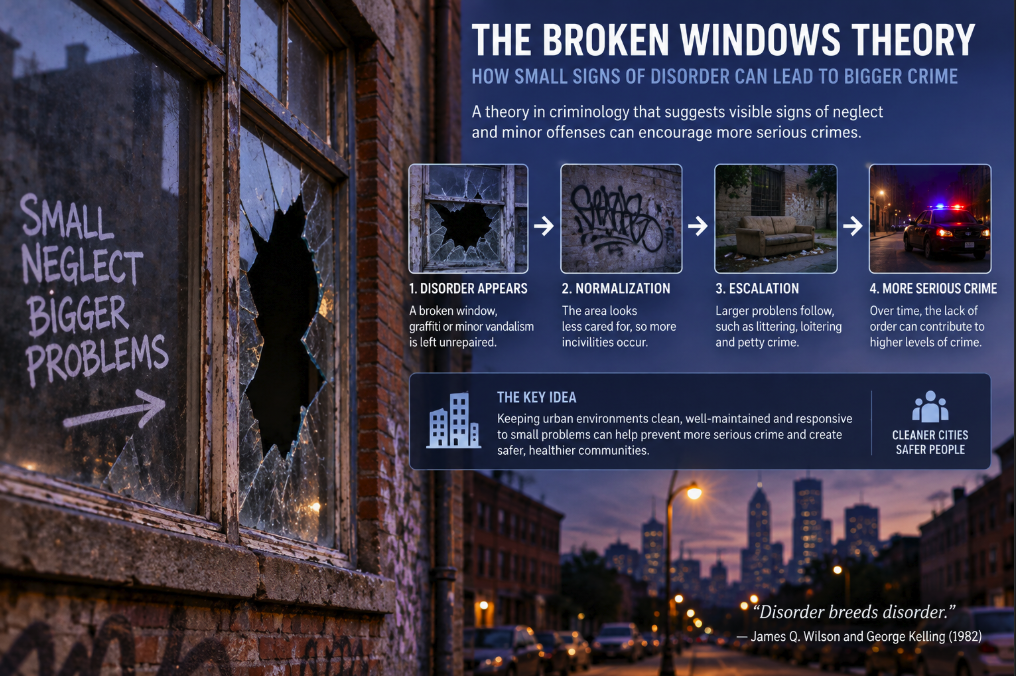
Imagine two identical buildings on the same street. One has a broken window that is repaired the next morning. The other has a broken window that remains shattered for weeks. Graffiti appears nearby. Trash accumulates. People begin treating the property as though nobody is watching and nobody cares. Could that visible neglect eventually make more serious crime more likely?
That is the intuition behind one of the most influential — and controversial — ideas in modern criminology: the broken windows theory. The phrase comes from a 1982 essay by political scientist James Q. Wilson and criminologist George L. Kelling, who argued that seemingly minor signs of physical and social disorder could set in motion a process of neighborhood decline.
The idea is frequently compressed into a simple slogan: leave one window broken and eventually criminals will take over. Wilson and Kelling's actual argument was more complicated. It involved fear, community behavior, informal social control and the signals that an environment sends about whether rules are being enforced. Four decades of research have also made the picture considerably less certain than the slogan suggests.
What does a broken window have to do with crime?
Wilson and Kelling published “Broken Windows: The Police and Neighborhood Safety” in The Atlantic in March 1982. Their argument began partly with research on foot patrol in New Jersey. An evaluation found that adding foot patrol officers had not reduced crime rates, yet residents in areas with foot patrols felt safer and tended to take fewer defensive precautions. Wilson and Kelling saw something important in that result: policing might affect a neighborhood not only by arresting criminals, but also by maintaining public order and influencing how residents perceive their surroundings.
The broken window became their central metaphor. If a window is smashed and nobody repairs it, the damage may communicate that the property is unattended. More windows may then be broken. In the same way, they argued, persistent graffiti, abandoned buildings, public intoxication, harassment, trash or other visible disorder could signal that social rules are weakly enforced.
The proposed chain does not jump directly from graffiti to armed robbery. Instead, disorder is supposed to increase fear. Residents become less comfortable using streets and public spaces, withdraw from one another and become less willing or able to intervene when problems arise. Informal social control — neighbors watching the street, challenging inappropriate behavior or simply being present — weakens. The neighborhood can then appear increasingly anonymous and unregulated, potentially creating more opportunities for offending.
In that sense, broken windows theory is partly a theory about information. People constantly read environments for clues about acceptable behavior. A clean subway platform, repaired streetlight and well-used park communicate something different from an abandoned lot covered in trash. The controversial step is the claim that these signals themselves help cause an escalation toward serious crime.
How New York turned the theory into a political phenomenon
Broken windows became internationally famous through policing debates in New York City during the 1990s. Police strategies increasingly targeted visible disorder and low-level offenses, including fare evasion in the subway, public drinking and other quality-of-life violations. The city's dramatic decline in crime during the decade made broken windows one of the most discussed explanations for what had happened.
The timing was politically powerful, but it did not settle the scientific question. Crime fell in many American cities during the same broad period, including places that used different policing strategies. Researchers have debated the roles of demographics, incarceration, economic conditions, changes in drug markets, policing innovations and other factors. Isolating the contribution of any single policy from a citywide crime trend is notoriously difficult.
Broken windows also became closely associated with “zero tolerance” policing: aggressive enforcement of minor violations, often through stops, citations or arrests. That association is important because Wilson and Kelling did not originally use the term zero tolerance, and later advocates argued that indiscriminate mass enforcement was not what the theory required. Their broader vision emphasized police working with communities to reinforce informal order.
The distinction is not merely semantic. A city can address a disorderly park by improving lighting, removing abandoned objects, repairing damage, working with residents and concentrating attention on a specific recurring problem. Or it can respond by making large numbers of arrests for minor conduct. Both have at times been labeled “broken windows,” but they are very different interventions with different consequences.
Does the theory actually work?
The evidence requires a careful answer: parts of the broken-windows story have empirical support, but the simple claim that visible disorder automatically causes serious crime has not been conclusively demonstrated.
Research strongly suggests that disorder can affect how people feel about a neighborhood. Visible incivilities are associated with fear, perceptions of danger and judgments about neighborhood quality. But whether disorder itself independently produces serious crime is harder to establish because disorder and crime often share deeper causes.
A major study by sociologists Robert Sampson and Stephen Raudenbush examined Chicago neighborhoods and found that once factors such as concentrated disadvantage and “collective efficacy” were taken into account, visible disorder did not straightforwardly predict higher crime in the way a simple broken-windows model would suggest. Collective efficacy refers roughly to social cohesion combined with residents' willingness to intervene for the common good. Their findings suggested that disorder and crime can both emerge from underlying neighborhood conditions rather than one necessarily causing the other.
An updated 2024 systematic review and meta-analysis of disorder policing likewise describes the theoretical evidence as mixed. Some studies find support for links between initial disorder and later crime, while others find little or no support for the proposed sequence from disorder to fear, weakened informal control and serious offending.
Yet this does not mean that addressing disorder is useless. The same research literature finds that some disorder-focused interventions can reduce crime, particularly when they use community-oriented and problem-solving approaches concentrated on specific places. Earlier systematic reviews found that aggressive order-maintenance strategies relying heavily on arrests were not the approaches driving the strongest effects. Programs that identified concrete local problems and worked with communities tended to perform better.
This creates an intriguing possibility: fixing disorder may sometimes improve safety even if the original causal theory is incomplete. Cleaning an abandoned lot can change how a space is used. Better lighting can increase visibility. Repairing buildings can attract legitimate activity. Removing a recurring environmental opportunity for crime can have direct practical effects without requiring a psychological cascade from one broken window to violent offending.
Why the theory remains so controversial
The biggest controversy is not really about whether broken windows should be repaired. Few people argue that neighborhoods benefit from abandoned buildings, dangerous lighting, uncontrolled dumping or unusable public spaces. The conflict concerns what authorities should do about disorder and whom they treat as the disorder.
When broken windows is translated into aggressive enforcement of minor offenses, critics argue that police discretion can fall disproportionately on poor communities and racial minorities. Behaviors that might be ignored in one neighborhood can generate stops, searches or arrests in another. A strategy intended to make residents feel safer can therefore damage trust if residents experience the police themselves as unpredictable or unfair.
Even Wilson and Kelling recognized this danger in their original essay, warning about the difficulty of balancing community order with individual rights and the possibility that police could enforce neighborhood prejudices. The policy debate that followed often became much harsher than the metaphor with which it began.
Modern research has consequently pushed the discussion toward a more useful question than “Is broken windows true?” A city contains many different forms of disorder, and responses range from environmental design to sanitation, social services, community organization and law enforcement. The effects depend on the problem, the place and the intervention.
A vacant building that becomes a site for repeated violence may genuinely require intervention. A teenager lingering on a sidewalk is not a broken window. Treating both as equivalent forms of disorder can turn a theory about neighborhood stewardship into a justification for indiscriminate enforcement.
The broken windows theory endures because its central image is almost impossible to forget. A single unrepaired window seems to tell a story about what happens when neglect becomes normal. But cities are not buildings, and crime is not broken glass. Neighborhoods are shaped by poverty, opportunity, social networks, housing, public services, policing, architecture and countless other forces.
Repairing the window may still be worthwhile. The evidence simply warns us not to assume that the glass itself was the cause of everything that happened around it.