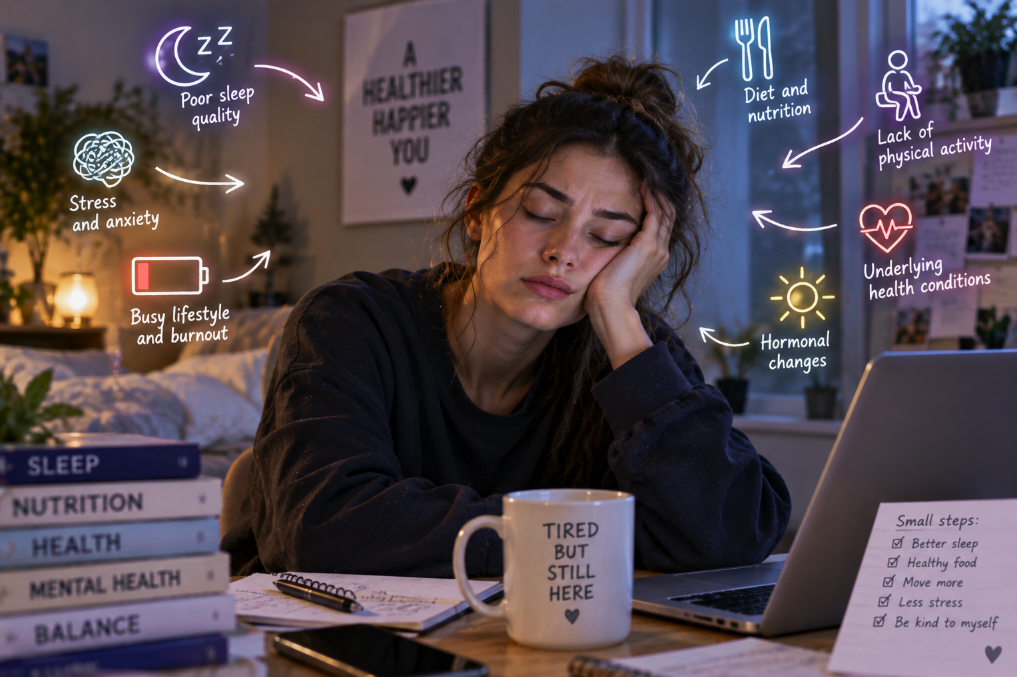
There is ordinary tiredness—the heavy-eyed feeling after a late night, a long flight or an exhausting week—and then there is the more puzzling question: Why am I tired all the time? You sleep, drink coffee, get through the day, sleep again, and still wake up feeling as though the battery never fully charged.
Medicine calls that broader lack of energy fatigue. It is not a disease in itself but a symptom, and that is why the answer can range from extremely ordinary to medically important. Too little sleep, stress and an irregular schedule can cause it. So can anemia, sleep apnea, thyroid disorders, diabetes, infections, depression, chronic pain and certain medications.
The useful question is therefore not simply whether you feel tired, but what kind of tiredness you have, how long it has lasted and what else has changed.
Fatigue is not exactly the same as being sleepy
We use “tired” to describe several different sensations. Sleepiness means you are struggling to stay awake and could easily fall asleep. Fatigue is more often a lack of physical or mental energy: everything feels harder, motivation drops, concentration becomes difficult and normal tasks can seem disproportionately demanding.
The two frequently overlap, especially when sleep is poor, but the distinction can provide an important clue. Someone repeatedly nodding off during the day may need to investigate sleep quantity or a sleep disorder. Someone who sleeps for a normal duration yet feels persistently drained may require a broader look at sleep quality, health, medications, mood and lifestyle.
MedlinePlus, from the U.S. National Library of Medicine, describes fatigue as weariness, tiredness or lack of energy and emphasizes that it can be a normal response to physical activity, emotional stress or insufficient sleep. When it persists for weeks, however, medical evaluation can help identify the cause.
The most obvious cause is also easy to underestimate: sleep
Adults generally need at least seven hours of sleep, and many need closer to seven to nine. Yet insufficient sleep remains common in the United States. A 2026 report from the CDC's National Center for Health Statistics found that 30.5 percent of U.S. adults surveyed in 2024 averaged less than seven hours of sleep in a 24-hour period.
Time in bed is only part of the equation. Seven or eight hours of repeatedly interrupted sleep can leave someone exhausted. Alcohol may make falling asleep easier while disrupting sleep later in the night. Caffeine consumed too late can interfere with sleep in susceptible people. Shift work, caring for a baby, pain, noise, irregular bedtimes and late-night screen habits can all reduce either the duration or quality of rest.
Sleep debt can also become normal enough that people stop recognizing it. If alarms are required every morning, weekends involve sleeping dramatically later and several coffees feel necessary simply to function, insufficient sleep deserves consideration before searching for an exotic explanation.
Sleep apnea can hide inside a full night's sleep
One reason “I sleep eight hours” does not always settle the issue is obstructive sleep apnea. In this disorder, breathing repeatedly stops or becomes restricted during sleep, fragmenting rest even when the person does not consciously remember waking.
Loud snoring, gasping or choking during sleep, morning headaches and pronounced daytime tiredness can be clues. A bed partner may notice the breathing disturbances before the person experiencing them does. Sleep apnea is treatable and is important to identify because it affects more than energy levels.
Persistent excessive daytime sleepiness can also occur with other sleep disorders. If adequate time for sleep does not produce restorative sleep, the quality and structure of sleep may matter as much as the clock.
Stress can exhaust you without making you fall asleep
Stress is energetically expensive. A difficult job, financial pressure, caregiving, grief, relationship problems or sustained anxiety can leave someone feeling physically depleted even if they are technically spending enough hours in bed. Stress can also damage sleep quality, creating a loop in which exhaustion makes daily problems harder to manage and those problems make restorative sleep more difficult.
Depression can present with low energy, sleep changes, slowed thinking and loss of motivation. Anxiety can produce fatigue through chronic arousal, muscle tension and disrupted sleep. Neither should be reduced to “it's all in your head.” Mental health conditions involve real symptoms and can coexist with physical causes of fatigue.
Burnout is another commonly used description, particularly when exhaustion is strongly tied to prolonged work or caregiving demands. Whatever label is used, context matters. A sudden drop in energy after months of unsustainable pressure tells a different story from fatigue accompanied by unexplained fever or weight loss.
Sometimes the problem is in the blood, hormones or metabolism
Iron-deficiency anemia is a classic medical cause of fatigue. Hemoglobin in red blood cells carries oxygen, and inadequate iron can reduce the body's ability to make enough healthy hemoglobin. Tiredness may occur alongside shortness of breath, palpitations, weakness or pale skin. People who lose significant blood through menstruation or other causes can be at increased risk.
The thyroid gland is another possible culprit. Too little thyroid hormone can slow many body processes and may be associated with fatigue, feeling cold, constipation, dry skin or weight gain. An overactive thyroid can also produce tiredness, despite speeding metabolism, often alongside symptoms such as palpitations, heat intolerance, nervousness or weight loss.
Diabetes may cause fatigue and can also produce increased thirst, frequent urination and unexplained weight changes. Heart, kidney and liver disease, inflammatory and autoimmune disorders, chronic pain and infections can likewise contribute to persistent low energy. This does not mean a tired person should work through a frightening checklist of diseases. It means fatigue is nonspecific enough that persistent cases sometimes require history, examination and targeted laboratory tests rather than guesswork.
Medicines—and even caffeine—can complicate the picture
Some medications can cause drowsiness or fatigue, including certain antihistamines, pain medicines, psychiatric medications and other treatments. A new prescription, dose change or combination of medicines is therefore worth mentioning to a clinician. Prescribed medication should not be stopped abruptly simply because fatigue appears on a list of possible side effects.
Caffeine presents a more ironic problem. It can temporarily increase alertness, but using large amounts to compensate for poor sleep may make later sleep harder, perpetuating the cycle. MedlinePlus notes that too much caffeine can interfere with a good night's sleep. More stimulation is not necessarily the same as more energy.
What about ME/CFS?
Myalgic encephalomyelitis/chronic fatigue syndrome, usually abbreviated ME/CFS, is not simply the medical name for being tired for a long time. It is a complex chronic illness with a particular pattern of symptoms. Severe impairment, unrefreshing sleep and cognitive problems can occur, and a defining feature is often post-exertional malaise: symptoms become significantly worse after physical or mental activity that might previously have been manageable.
Rest does not simply cure the fatigue. Diagnosis requires medical evaluation and consideration of other possible causes. Someone who has been tired for several days after a stressful month should therefore not assume they have ME/CFS based on the word “fatigue” alone.
When should persistent tiredness be checked?
If fatigue lasts for several weeks, has no obvious explanation, is getting worse or interferes with ordinary life, it is reasonable to speak with a healthcare professional. MedlinePlus notes that evaluation may include questions about sleep, daily activities, diet, exercise, medications and mood, along with a physical examination and, when appropriate, tests for conditions such as anemia, diabetes, infection or thyroid, kidney and liver problems.
Some accompanying symptoms deserve more prompt attention. Unexplained weight loss, persistent fever or night sweats, unusual weakness, shortness of breath, significant palpitations, repeated nighttime choking or gasping, or other new concerning symptoms should not simply be written off as being “run down.” Confusion, severe dizziness or thoughts of self-harm require urgent help.
For fatigue without warning signs, a simple record can be surprisingly useful. Note when you sleep and wake, how rested you feel, caffeine and alcohol use, exercise, menstrual changes if relevant, medications and the times of day when energy is best or worst. Patterns that are invisible in memory can become obvious on paper.
There may not be one single reason
The most realistic explanation for persistent tiredness is often less satisfying than a single diagnosis: several small problems can stack together. A person may be sleeping 45 minutes less than they need, working under chronic stress, exercising less because they feel tired, relying on afternoon caffeine and waking several times at night. None of those factors alone looks dramatic, but together they can create a powerful sense of exhaustion.
That is also why basic changes can matter when there is no underlying medical condition: regular sleep, physical activity appropriate to your health, balanced nutrition, less alcohol, sensible caffeine use and stress management. These are not universal cures, and persistent fatigue should not be blamed on lifestyle when a medical problem has not been considered.
“Why am I always tired?” is ultimately a question about recovery. Sometimes the body simply is not getting enough of it. Sometimes sleep is present but not restorative. Sometimes the body is spending energy dealing with an illness, medication effect or psychological strain. The symptom is common precisely because so many systems can produce it—and when it refuses to go away, that persistence is itself useful information worth taking seriously.