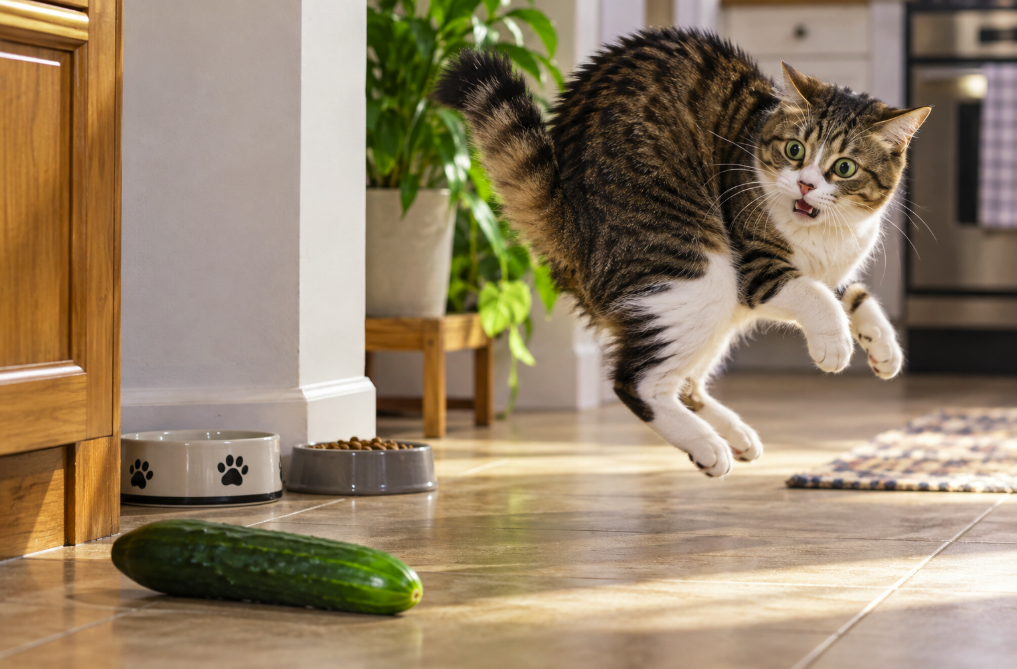
A cat is calmly eating from its bowl. While its attention is elsewhere, someone quietly places a cucumber on the floor behind it. The cat turns, sees the vegetable and suddenly launches itself into the air as though it has discovered a predator in the kitchen. Videos built around exactly this setup became an internet phenomenon, producing an irresistible question: why are cats so afraid of cucumbers?
The most famous explanation is that the long, green object resembles a snake and triggers an ancient defensive instinct. It is a wonderfully tidy story, but feline behavior experts are considerably more cautious. Some have suggested that snake resemblance could contribute to the reaction, yet there is no good evidence that cats possess a special cucumber phobia. The more convincing explanation is simpler: the cat has been deliberately surprised by an unfamiliar object that appeared without warning in a place it considered safe.
It is probably the surprise, not the salad
The crucial detail in the viral videos is not what the object is but how it gets there. The cucumber is usually placed behind the cat while the animal is eating. When the cat eventually turns around, a large object has suddenly appeared within its personal space even though it was not there moments earlier.
Dr. Pamela Perry, a behavior specialist at the Cornell Feline Health Center, has explained that the cats in these videos may simply be responding to the sudden appearance of a novel object. Individual temperament matters too: a cautious or fearful cat is more likely to react dramatically than a relaxed animal that investigates unfamiliar things readily.
This fits a basic survival strategy. Cats are predators, but they are also small enough to be prey for larger animals. When something unexpected appears very close to them, immediately creating distance can be safer than standing still to identify it. The spectacular leap seen in the videos is essentially an exaggerated startle-and-escape response: get away first, reassess afterward.
That is also why not every cat performs the famous jump. Some sniff the cucumber, stare at it or ignore it completely. If cucumbers themselves triggered a universal hard-wired terror response, the reaction should be much more consistent.
But doesn't a cucumber look like a snake?
This is the theory that made the phenomenon famous. A cucumber lying lengthwise on the floor is green, elongated and low to the ground, so it is easy for humans to imagine that a startled cat briefly interprets it as a snake.
The possibility cannot be completely dismissed. In interviews reported by National Geographic, animal behaviorist Jill Goldman suggested that resemblance to a snake might be one factor, while emphasizing the natural startle response caused by an unexpected object. But the snake explanation should not be presented as settled science.
Perry is notably skeptical of it. She points out that cats do not simply possess a universal natural terror of snakes; some cats actually hunt them. The broader evolutionary principle is therefore more useful than the specific “cucumber equals snake” story. A strange shape that suddenly materializes at close range may represent a potential threat, and a cautious animal does not need to identify the threat perfectly before escaping from it.
The location of the prank makes the reaction even more understandable. Viral cucumber videos frequently involve cats eating or drinking. Feeding areas are normally predictable, familiar places where a domestic cat has reason to feel secure. Sneaking an unfamiliar object into that safe zone while the animal is distracted creates precisely the sort of abrupt environmental change that can provoke a strong response.
Why deliberately frightening a cat is a bad experiment
The videos may look comic because the cat's reaction is so sudden and athletic, but from the animal's perspective the event is not a joke. Fear prepares the body for rapid action. Veterinary behavior guidance from VCA Animal Hospitals describes escape and hiding as common responses in frightened cats, alongside behaviors such as freezing, crouching, flattening the ears, puffing the tail, hissing or striking when escape is difficult.
A panicked leap can also cause immediate physical harm. A cat could collide with furniture, knock over an object or land badly. More subtly, repeatedly frightening an animal can alter how safe it feels in its environment. Cornell warns that a timid cat may associate the frightening experience not only with the cucumber but also with the feeding area, other surrounding stimuli or even the person responsible for the prank.
This is an important distinction because unfamiliar objects themselves are not necessarily bad for cats. Novel objects can provide enrichment when introduced in a way that allows the animal to approach, sniff and investigate voluntarily. The problem is engineering a surprise specifically to trigger fear.
The viral experiment also tells us surprisingly little about what the cat believes it has seen. A huge leap does not prove that the animal mentally categorized the cucumber as a snake. It demonstrates that something unexpected appeared close enough to provoke an emergency response. The cat's nervous system has already acted before a human viewer can confidently assign a story to the reaction.
The cucumber myth reveals something real about cats
So are cats afraid of cucumbers? Not in the simple sense implied by the videos. There is no established feline aversion to the vegetable itself, and many cats confronted with one under ordinary circumstances show little concern. What frightens some cats is the sudden discovery of a strange object positioned behind them without their knowledge.
The snake hypothesis remains plausible as an additional visual cue, but calling it an “ancestral fear of snakes” overstates what the evidence shows. The more defensible explanation combines surprise, proximity, individual temperament and the cat's powerful instinct to create distance from a possible threat.
That makes the viral videos interesting for a reason their creators may not have intended. They do not reveal a secret war between cats and cucumbers. They reveal how quickly an animal built to survive uncertainty can move when the familiar world changes behind its back.