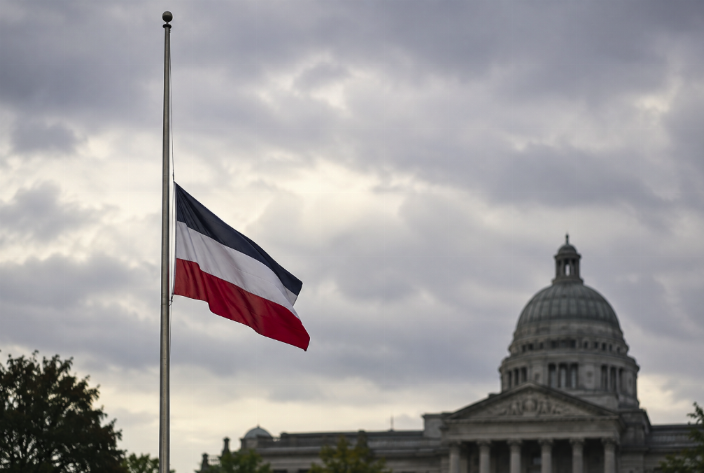
You are walking past a town hall, courthouse, school or government building when something looks slightly wrong: the flag is not at the top of its pole. It is hanging lower, leaving an unmistakable space above it. For many people, the next reaction is immediate: why are the flags at half-mast today?
There is no single worldwide answer to that question, because half-masting is not tied to one universal calendar. A national government may order it after the death of a head of state, a region may lower flags after a local tragedy, a city may honor a public servant, and an individual institution may mark a death or commemorative event of its own. That means two buildings in different places — and sometimes even two buildings in the same city — can follow different instructions on the same day.
What a flag at half-mast means
Flying a flag below the top of its pole is one of the most recognizable public symbols of mourning, remembrance and respect. The practice is generally used after the death of an important public figure, following a disaster or attack, during a funeral or memorial, or on a formally designated day of remembrance. The precise rules, however, depend on the country and the authority responsible for the flag.
Even the terminology changes. In American usage, a flag on a land-based pole is commonly said to be at “half-staff,” while “half-mast” has traditionally been associated with ships, although ordinary conversation frequently uses half-mast for both. In Britain and many other countries, “half-mast” is the standard expression.
The name can also be misleading if you imagine the flag positioned at the mathematical midpoint of the pole. British guidance from the College of Arms, for example, describes half-mast as flying the flag two-thirds of the way up the flagpole, leaving at least the height of the flag between its upper edge and the top of the pole. Official protocols can differ, but the important visual idea is the empty space above the flag: a conspicuous absence where the flag would normally fly.
There is ceremony in the movement itself. Under established British and American protocols, a flag being placed at half-mast or half-staff is first raised fully to the top before being lowered to its mourning position. When it is taken down, it is raised to the top again briefly before being lowered completely. The gesture therefore is not simply a flag that was never hoisted all the way.
So why are the flags lowered today?
The fastest reliable answer is local. Look first at which building is flying the flag and which authority controls it. If several national government buildings are doing the same thing, the cause is likely to be an official national instruction. If only a city hall, university, fire station or company headquarters has lowered its flags, the reason may be local or institutional rather than national.
Official government websites, presidential or royal household announcements, ministries responsible for protocol, state or regional government pages and municipal notices are the best places to check. This matters because social media posts often recycle photographs from previous mourning periods, while search results can surface old proclamations whose dates are easy to miss.
The distinction is especially important in countries where different authorities can issue their own orders. The U.S. Department of Veterans Affairs explains that periods of half-staff display can be proclaimed by the president for national observance or by governors for state or territorial observance; federal department and agency heads also have authority over flags under their jurisdiction in specified circumstances. A person in one U.S. state can therefore see flags lowered when someone elsewhere in the country does not.
Britain similarly combines established protocol with special instructions. The College of Arms lists occasions connected with the death of the Sovereign and notes that other half-masting can follow special command, while local government bodies may also lower flags for local commemorations or losses. After the death of Prince Philip in 2021, for example, official UK guidance directed flags on government buildings to be lowered until the morning after his funeral.
A surprisingly powerful piece of visual language
The effectiveness of half-masting comes from its simplicity. A flag normally occupies the highest available point, a position associated with sovereignty, identity and visibility. Lowering it creates an intentional void above the national symbol. Even without a sign, speech or ceremony, passers-by understand that something exceptional has happened.
That visual language is flexible enough to express both national and intensely local grief. It can mark the death of a monarch or president, but it can also appear outside a municipal building after the death of a mayor, outside a fire station after the loss of a firefighter, or on a campus after a tragedy affecting its community. The same gesture can therefore carry very different meanings depending on where you see it.
There are also unusual exceptions. In British royal protocol, the Royal Standard is not flown at half-mast because it represents the Sovereign and, under the constitutional idea that the monarchy continues immediately from one sovereign to the next, there is always a reigning monarch. Such details reveal that flag etiquette is not merely decorative tradition; it can encode ideas about government, continuity and public memory.
So when you notice a flag lowered today, the observation itself tells you only part of the story. It signals mourning, respect or commemoration, but the specific reason belongs to a particular place and authority. Check the date, identify the building and consult its official national, regional or local source. That small empty space at the top of a flagpole is designed to attract attention — and often it is the first public clue that a community is remembering someone or something together.