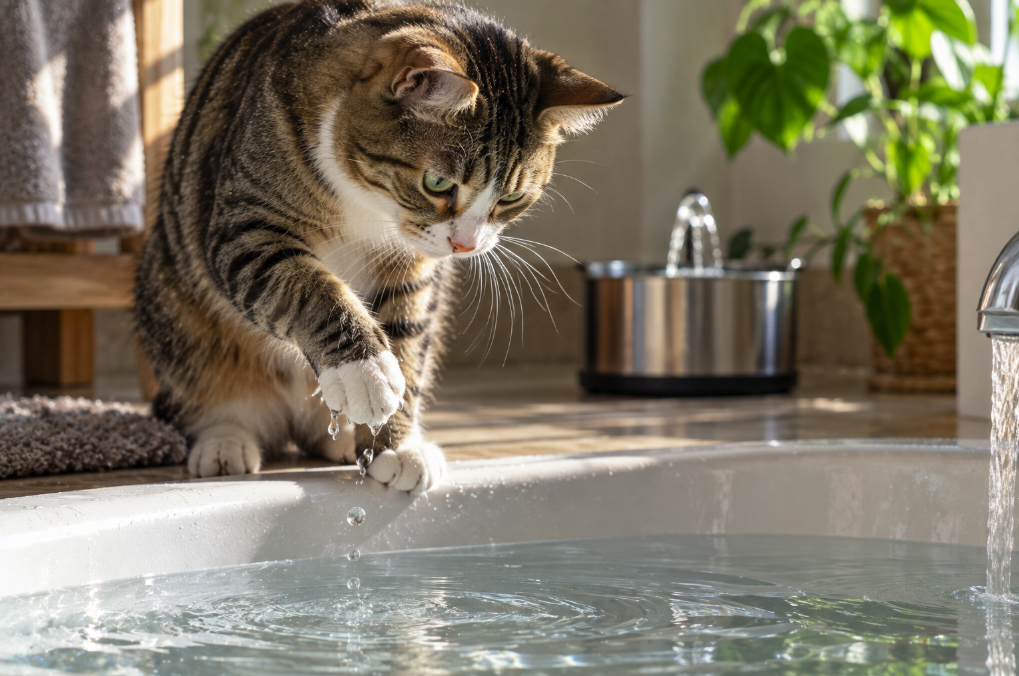
Put a glass of water near a cat and it may drink calmly. Turn on a faucet and the same cat might become fascinated, batting at droplets for minutes. Lower it into a bathtub, however, and you may suddenly discover just how many claws one small animal possesses.
This contradiction is why the familiar question — why do cats hate water? — needs a qualification. Cats do not universally hate water. What many domestic cats strongly dislike is being immersed, soaked or restrained while water is poured over them.
There is no single scientifically established reason for that reaction. Wet fur is uncomfortable, bathing removes control over the situation, unfamiliar sensations can trigger caution, and individual experience matters enormously. The domestic cat's desert ancestry probably provides part of the evolutionary background, but it does not by itself prove why a modern house cat bolts from the bath.
A wet coat is very different from a wet paw
A cat cautiously dipping one paw into a water bowl is experiencing something completely different from having its entire coat saturated.
Cat fur traps air and contributes to insulation. Once the coat becomes thoroughly wet, water penetrates between the hairs and changes its weight, texture and insulating properties until it dries. Thick fur can hold a substantial amount of water relative to the animal's size, leaving the cat feeling physically different and potentially making movement less comfortable.
This popular explanation makes intuitive sense, but it should not be treated as the one proven cause of feline water avoidance. Veterinary behavior is rarely that simple. A bath simultaneously changes temperature, footing, smell, sound and freedom of movement, so isolating one factor is difficult.
What veterinary sources do confirm is that bathing is frequently stressful for cats. VCA Animal Hospitals notes in its guide to feline coat care that few cats enjoy the experience and that some become frantic when placed under running water.
The reaction may therefore have less to do with the chemical substance H2O than with what suddenly being soaked does to a cat's body and surroundings.
Cats like to control their own movements
Watch a cat encounter something unfamiliar and a pattern quickly emerges. It often approaches slowly, stretches forward while keeping its rear legs ready to retreat, sniffs, touches with a paw and decides whether to proceed.
A forced bath removes that option.
The bottom of a sink or bathtub can be slippery. Water moves unpredictably around the legs. A faucet makes noise. A human may be holding the animal in place. Shampoo adds an unfamiliar smell. The cat cannot simply step backward whenever it chooses.
Those features can transform an otherwise harmless situation into one that feels threatening.
VCA's current kitten-bathing guidance recommends gradual acclimation rather than simply putting a frightened kitten into water. The suggested process begins with rewarding the kitten for entering an empty tub and then slowly introducing water while continuing positive reinforcement. A nonslip mat can also help the animal feel physically secure.
The fact that tolerance can be learned is important. If water avoidance were an absolute, hard-wired feline prohibition, early positive experiences would make little difference. In reality, experience clearly matters.
What does desert ancestry have to do with it?
Domestic cats descend from wildcat populations adapted to relatively arid environments. That evolutionary history left a particularly clear mark on how cats manage drinking water.
International Cat Care explains in its feline hydration guidance that the ancestors of domestic cats were desert dwellers that obtained much of their water from prey. Modern cats have retained an ability to produce highly concentrated urine and often drink less than dogs, depending on their diet.
VCA makes the same point in its nutritional guidance: cats are efficient at conserving water because of their desert ancestry. Cornell University's Feline Health Center notes that wet food can contain up to about 80 percent water, so cats eating moisture-rich food may obtain much of their daily water requirement from meals rather than from a bowl.
It is tempting to turn those facts into a neat evolutionary story: cats evolved in deserts, therefore they never learned to swim and consequently hate getting wet.
That goes farther than the evidence supports.
Desert ancestry clearly helps explain feline water-conservation physiology. It may also mean that the ancestral domestic-cat lineage faced less evolutionary pressure to become comfortable spending time in water than animals associated with wetlands, rivers or aquatic hunting. But that is not the same as demonstrating that desert evolution directly created the bath-avoidance behavior seen in today's pet cats.
Evolution supplies context, not a complete behavioral diagnosis.
Some cats are fascinated by water
If cats truly hated water as a category, pet drinking fountains would be a very strange product.
Yet veterinary organizations routinely recommend them because some cats prefer moving water. Cornell says fountains may encourage certain cats to drink more, although preferences vary between individuals. VCA likewise notes that some cats enjoy drinking from running taps and recommends trying a filtered fountain for cats attracted to moving water.
Many owners have also watched cats investigate dripping faucets, paw at water glasses or sit mesmerized beside a shower without wanting to step inside it.
There is no contradiction. Watching, touching or drinking water preserves the cat's control. Full immersion does not.
Individual cats also differ dramatically. Breed, coat type, early exposure and personality can all affect behavior, and anecdotes abound of cats voluntarily swimming or entering shallow water. Cats are physically capable of swimming when necessary. The stereotype describes a common preference, not a biological inability.
Why smell may matter too
A cat experiences its environment heavily through scent. Tap water can contain odors from treatment chemicals, pipes or the container holding it that humans barely notice. A bathtub may smell of cleaning products, soap or shampoo.
Cats can also be particular about drinking-water freshness and bowl material. Cornell recommends keeping fresh water available and notes that individual preferences influence whether cats use fountains. VCA advises owners to experiment with clean bowls made from materials such as glass, metal or ceramic and to change the water frequently.
This does not prove that chlorine or shampoo scent is why cats avoid baths, but it illustrates the larger sensory issue: a human sees “some clean water,” while a cat may be processing an unfamiliar combination of smell, sound, temperature, reflections, movement and footing.
What feels ordinary to us can be an intense sensory event to another species.
Do cats actually need baths?
Most healthy cats do not need routine baths. Cats are meticulous self-groomers, using their tongues and paws to maintain their coats.
There are exceptions. A veterinarian may recommend bathing for certain skin conditions, infections or parasites. A cat may also need cleaning after getting into a substance that should not be licked from its fur. Long-haired, elderly, obese or medically compromised cats can sometimes require extra grooming assistance.
If bathing is necessary, forcing a terrified animal into deep water is likely to make future baths harder. Veterinary guidance favors warm water, stable nonslip footing, cat-appropriate products and gradual positive conditioning. Human shampoo should not be used routinely on cats because their skin has different requirements.
A sudden, extreme reaction can also be intensified by a previous frightening experience. One bad encounter with a slippery sink, loud showerhead or forced restraint can create a strong learned association between the bathroom and danger.
So why do so many cats avoid getting wet?
The best answer is a combination rather than a single evolutionary trick.
A soaked coat changes how a cat feels and moves. A bath can create unstable footing and unfamiliar sensations. Restraint removes the animal's ability to retreat. Early experience can determine whether water feels routine or threatening. And the domestic cat's ancestry did not produce an animal whose lifestyle depended on regular immersion in water.
But “cats hate water” is still too broad. Cats need water, drink it, often play with it and sometimes voluntarily enter it. What many of them dislike is losing control while their carefully maintained coat becomes saturated.
That distinction explains why the same cat can flee from a bathtub at astonishing speed, then return five minutes later to spend the afternoon trying to catch droplets from a faucet.