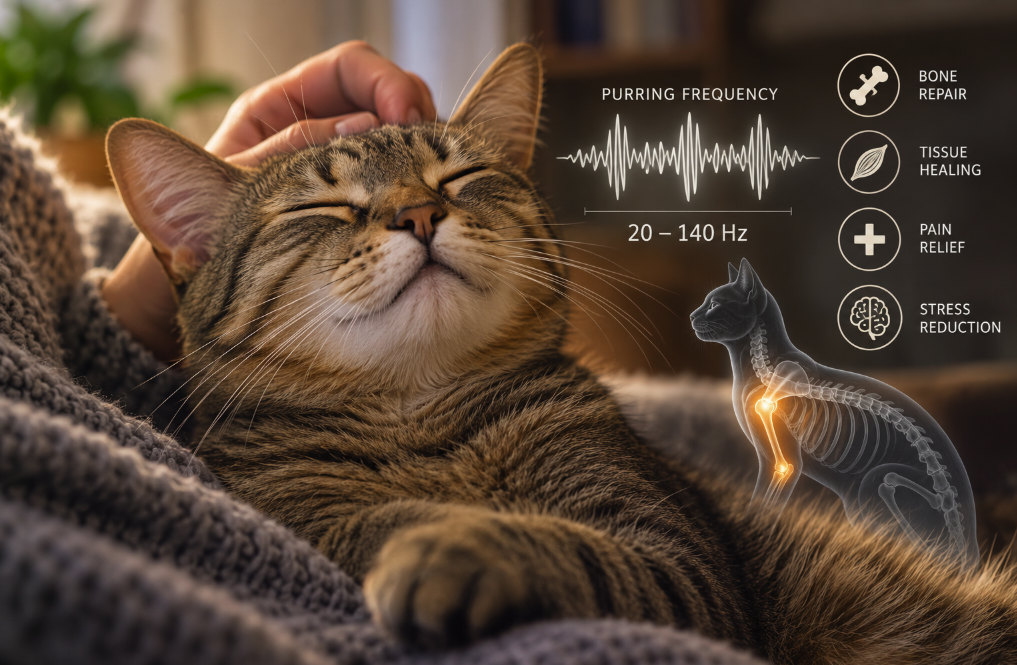
Few animal sounds are as instantly recognizable as a cat’s purr. A hand reaches toward a warm patch of fur, the cat closes its eyes, and a low vibration begins somewhere inside its body. To humans, the message seems obvious: contentment.
Except cats do not purr only when they are content.
They can purr while nursing, during social contact, when frightened or stressed, and sometimes when sick or injured. Female cats may purr while giving birth. Kittens begin producing purr-like vocalizations very early in life. The same sound that accompanies a comfortable afternoon on a sofa can therefore appear in circumstances that seem to have little to do with pleasure.
That has encouraged one of the most intriguing ideas in popular animal science: perhaps purring is not merely communication but also has a physiological function. Cat purrs occupy low frequencies, and laboratory research in other contexts shows that mechanical vibration and acoustic stimulation can influence cells, bone and tissue. From there comes the seductive claim that cats possess a built-in healing machine.
The reality is more interesting — and more uncertain. There is good reason to investigate the idea, but science has not established that cats deliberately purr in order to repair their own bones and tissues.
How does a cat make such a low sound?
For decades, the standard explanation was that cats produced purring through rapid, neurally controlled contractions of muscles in the larynx. The muscles were thought to repeatedly narrow and widen the opening around the vocal folds as the cat breathed, creating the characteristic rhythmic sound during both inhalation and exhalation.
Then an experiment published in Current Biology in 2023 complicated the story. Researchers examined the excised larynges of eight domestic cats. Because the larynges were no longer connected to living nervous systems, the traditional model predicted that true purr-frequency oscillations should not occur without active neuromuscular contractions.
They did.
All eight larynges produced self-sustaining oscillations in the typical purring range, with fundamental frequencies around 25 to 30 Hz, when air was passed through them. Histological examination revealed unusual connective-tissue structures embedded in the vocal folds, up to about four millimeters across. These structures appear to increase the effective mass of the folds, helping such a small animal generate unusually low frequencies. The study is indexed by PubMed.
The experiment did not prove that neural muscle control plays no role in a living cat. The authors explicitly stopped short of completely rejecting the older model. What it demonstrated was that the feline larynx is physically capable of producing purr-range vibrations without a nervous system rhythmically contracting the laryngeal muscles for every pulse. In other words, the anatomy itself may do more of the acoustic work than scientists once assumed.
A purr is not simply a feline smile
Owners usually encounter purring during positive interactions, so it is natural to interpret it as the equivalent of a smile. Often that interpretation is probably reasonable. Cats purr while resting comfortably, receiving physical contact or interacting with familiar individuals.
But a purr should be read in context. Cats also produce it under conditions of pain, anxiety and physiological stress. This suggests that purring may have several functions rather than carrying one fixed emotional meaning.
One possibility is communication. Purring begins early between kittens and their mother, making it useful in close-range interactions. Unlike a loud meow, a purr can communicate without requiring a tiny kitten to produce a powerful call. Adult domestic cats can also modify purring in ways that affect humans. Research has described a so-called solicitation purr that incorporates a higher-frequency vocal component and can be particularly difficult for people to ignore — useful behavior when breakfast depends on a human opening a cupboard.
Another possibility is self-soothing. Humans hum, rock, breathe rhythmically and engage in repetitive movements under emotional strain. A cat’s purr could similarly participate in regulating arousal or discomfort. That interpretation would help explain why the same behavior occurs both on a peaceful lap and during stressful situations without requiring the two circumstances to mean the same thing.
Can purring really heal bones?
This is the claim that has given the purr an almost mythical reputation. Figures such as 20–140 Hz are frequently quoted online as the healing range of feline purring, followed by claims that these frequencies stimulate bone growth, repair tendons, reduce pain or heal wounds.
There is a genuine scientific idea buried inside those claims. Biological tissues respond to mechanical forces, and researchers have investigated vibration, ultrasound and other biophysical stimuli as ways to influence tissue regeneration. A 2025 systematic review of infrasound and audible acoustic stimulation, for example, found preclinical evidence that certain low-frequency acoustic exposures can affect processes relevant to bone growth, fibroblast migration and wound repair. The authors also emphasized the need for further research and better-defined therapeutic parameters.
Likewise, experimental studies have shown that mechanical vibration at particular frequencies can affect bone regeneration. In one animal experiment, low-magnitude oscillatory acceleration at 45 Hz enhanced measures of bone formation in skull defects in rats. Modern reviews of biophysical bone-healing technologies describe vibrational approaches as promising but still largely preclinical or early in translation, while other modalities such as electrical stimulation and low-intensity pulsed ultrasound have a more developed clinical evidence base.
What does this tell us about cats? It establishes biological plausibility for a broad proposition: low-frequency mechanical stimulation can influence living tissue under some conditions. It does not establish the much stronger proposition that natural purring delivers the right intensity, duration and mechanical energy to heal a cat’s fractures or wounds, or that evolution selected purring for that purpose.
Frequency alone is not enough. Two signals can share the same number of cycles per second while differing enormously in amplitude, energy, duration and how that energy reaches tissue. A laboratory vibration treatment and a purring cat are therefore not medically equivalent simply because their frequency ranges overlap.
The self-healing hypothesis remains fascinating
Why, then, does the idea refuse to disappear? Partly because it fits several observations surprisingly well. Cats spend substantial portions of the day resting, so a low-energy mechanism that could provide gentle mechanical stimulation without vigorous movement would be evolutionarily intriguing. Purring also occurs during injury, illness and other stressful states, exactly when a self-soothing or physiological benefit might be useful.
But those observations permit several explanations. A sick cat may purr because the behavior reduces stress, communicates vulnerability, seeks social contact or accompanies a change in nervous-system state. Any mechanical effect on tissues could be beneficial, incidental or negligible. Demonstrating that vibration can promote bone growth elsewhere does not tell us which explanation is correct.
Testing the self-healing hypothesis directly is also difficult. Researchers would need to characterize the actual vibrations transmitted through living feline tissues, determine their dose and distribution, compare healing outcomes while controlling for purring and separate physiological effects from stress and behavior. Ethical and practical constraints make such experiments far more complicated than placing cells or experimental models on a vibration platform.
A sound with more than one job
The most sensible picture emerging from research is not that purring has one secret purpose. Biological behaviors frequently perform several jobs. A purr can be a social signal between kitten and mother, an expression associated with comfort, a way of influencing humans and potentially part of a cat’s response to stress or discomfort.
Its physical mechanism is itself still being refined. The 2023 larynx experiments challenged a long-standing textbook explanation and suggested that specialized structures in feline vocal folds help make the low rumble possible. That discovery is a reminder that even a sound humans have lived alongside for thousands of years can still contain basic scientific surprises.
As for the famous healing purr, the careful conclusion is more modest than the internet legend. Low-frequency vibration can affect biological tissues, and that makes the hypothesis scientifically interesting. But there is currently no compelling evidence that a cat’s natural purr functions as a proven therapeutic system that repairs its own bones and tissues.
The purr does not need a supernatural healing power to be remarkable. It is an unusual acoustic feat produced by specialized anatomy, a flexible social signal and a behavior that appears in both comfort and distress. The vibration beneath your hand may tell you that a cat feels safe — or that it is trying to cope with something. Either way, one of the most familiar sounds in our homes remains one of the more intriguing voices in mammalian biology.