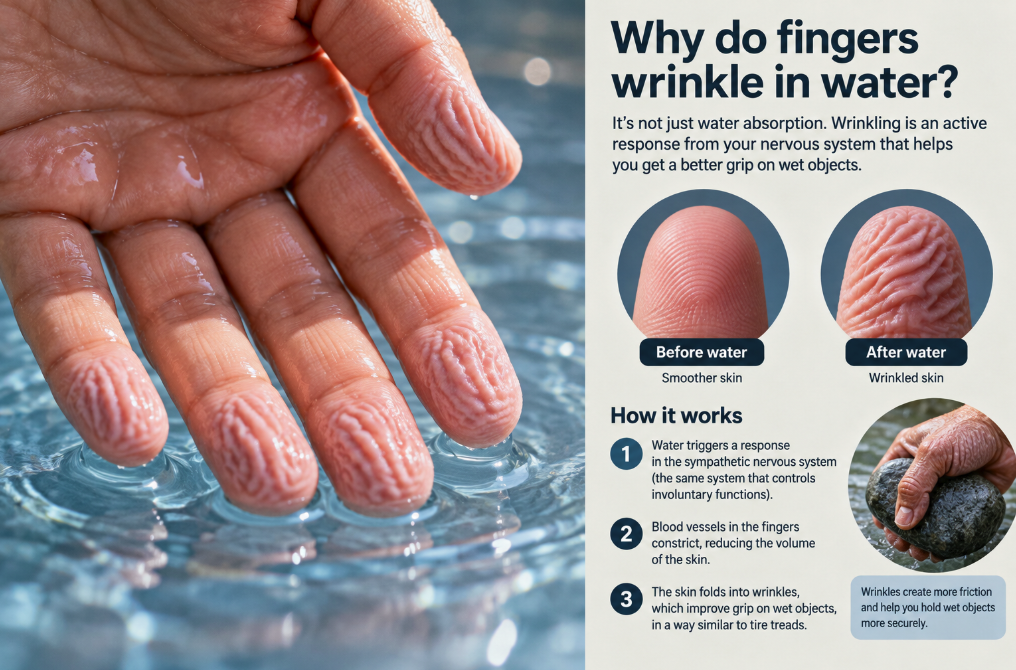
Stay in a swimming pool or bathtub long enough and something peculiar happens to your hands. The smooth pads of your fingers turn into a landscape of ridges and valleys, as if the skin has suddenly aged decades in a few minutes. For generations, the obvious explanation seemed to be that the skin simply soaked up water and swelled.
That explanation is incomplete. Water-induced wrinkling of the fingers and toes is largely an active response involving the autonomic nervous system. Tiny blood vessels beneath the skin constrict, reducing the volume of tissue in the fingertips. The overlying skin then buckles into the familiar wrinkles. Even stranger, researchers have found evidence that those temporary grooves may make it easier to handle wet objects.
So your bath-time “prune fingers” are not merely waterlogged skin. They are the visible result of nerves changing blood flow beneath the surface.
The clue came from damaged nerves
If wrinkling were caused only by water being absorbed into the outer skin, every sufficiently soaked finger should wrinkle in roughly the same way. But doctors noticed something that did not fit that idea: areas of the hand with certain nerve injuries sometimes failed to wrinkle after immersion.
That observation turned wrinkled fingers into a useful window on the autonomic nervous system — the network that controls involuntary processes such as blood-vessel diameter, sweating and heart rate. A classic 1979 clinical study found that warm-water wrinkling depended on intact sympathetic nerve pathways and could therefore be used as a test of sympathetic function.
Later experiments clarified what was happening underneath the skin. In 2003, neurologists Einar Wilder-Smith and Adeline Chow measured blood flow in the hands of healthy volunteers while their fingers wrinkled in water. They found a significant reduction in digital blood flow, supporting the conclusion that water-immersion wrinkling is driven by vasoconstriction.
The basic sequence is now well supported. Water exposure triggers activity in sympathetic nerves. Small blood vessels in the fingertips constrict, blood volume in the tissue falls, and the fleshy pad beneath the skin becomes slightly smaller. Because the skin does not shrink in exactly the same way, it folds inward and produces wrinkles.
A recent review of the clinical skin-wrinkling test describes the phenomenon as a reversible neurovascular response rather than simple absorption. The connection is strong enough that abnormal or absent wrinkling has been investigated as a bedside clue to disorders affecting small sympathetic nerve fibers.
Why only fingers and toes become so dramatically wrinkled
The effect is most obvious on glabrous skin — the hairless, specialized skin covering the palms, fingertips and soles. These areas contain dense networks of sweat glands and nerves and have mechanical properties designed for contact and grip.
Water does interact with the outer layer of skin, so the old absorption explanation was not absurd. But absorption by itself cannot explain why cutting or damaging sympathetic nerve pathways can prevent the characteristic wrinkles. Current physiological models suggest that water entering sweat ducts alters the local environment enough to initiate sympathetic signaling, which then produces vasoconstriction deeper in the fingertip.
That also explains why the transformation is temporary. Leave the water, the trigger disappears, circulation returns toward its usual state and the tissue beneath the skin regains its normal volume. The grooves gradually flatten.
Are the wrinkles really built-in rain tires?
Once scientists realized that finger wrinkling was actively controlled by nerves, a fascinating question followed: why would the body bother doing it?
One influential idea is that the channels work somewhat like drainage grooves. On a wet surface, they may help move water away from the points where fingertip skin contacts an object, improving traction. If so, wrinkled fingers could have given our ancestors an advantage when gathering food from streams, handling wet vegetation or moving across slippery environments.
A 2013 experiment published by the Royal Society provided striking support. Participants transferred wet objects with either wrinkled or unwrinkled fingers. They handled submerged objects faster after their fingers had wrinkled, while wrinkling produced no comparable advantage with dry objects. The researchers concluded that the result supported the hypothesis that water-induced wrinkles improve the handling of wet objects.
A much larger 2021 experiment approached the question differently by measuring grip efficiency. It found that wrinkled fingers reduced the amount of grip force needed to control a wet object, bringing performance closer to that seen when handling something dry. The authors argued that improved grip efficiency in wet conditions is a plausible adaptive reason for the response.
But there is an important scientific caution. The “wet grip” explanation is compelling, not conclusively settled. A separate study published in 2014 failed to find improved dexterity or touch sensitivity when participants handled wet objects with wrinkled fingers. Experiments therefore agree more strongly about how fingers wrinkle than about exactly why evolution retained the response.
It is safest to say that enhanced wet grip is a well-supported functional hypothesis. Calling it the proven evolutionary purpose of wrinkling goes beyond the evidence.
Why don't our fingers stay wrinkled all the time?
If wrinkles can improve grip in water, permanent grooves might seem useful. But biological adaptations often involve trade-offs. A feature advantageous in one environment can be unnecessary or costly in another.
The 2013 wet-object experiment found no advantage for wrinkled fingers when objects were dry. Researchers have proposed that permanent wrinkling might reduce sensitivity, alter friction or make the skin more vulnerable, although the precise cost that favors a temporary response remains uncertain. An on-demand system would make evolutionary sense if the benefit mainly appeared in prolonged wet conditions.
The pattern itself is also intriguing. Rather than producing random creases, water creates branching channels across the fingertips. Researchers have compared their geometry with drainage networks, another reason the rain-tire analogy has become so attractive.
What began as a trivial bathtub observation therefore reveals an unexpectedly sophisticated interaction between skin, circulation and nerves. The water is the trigger, but the nervous system does much of the work.
The next time your fingertips turn wrinkly after a swim, look closely. You are not simply watching skin swell with water. Beneath those temporary ridges, sympathetic nerves have instructed blood vessels to narrow, fingertip volume has changed, and your skin has reshaped itself within minutes. Whether evolution perfected those grooves specifically to help our ancestors hold slippery objects is still being tested — but the mechanism itself is far more remarkable than the old explanation of soggy skin.