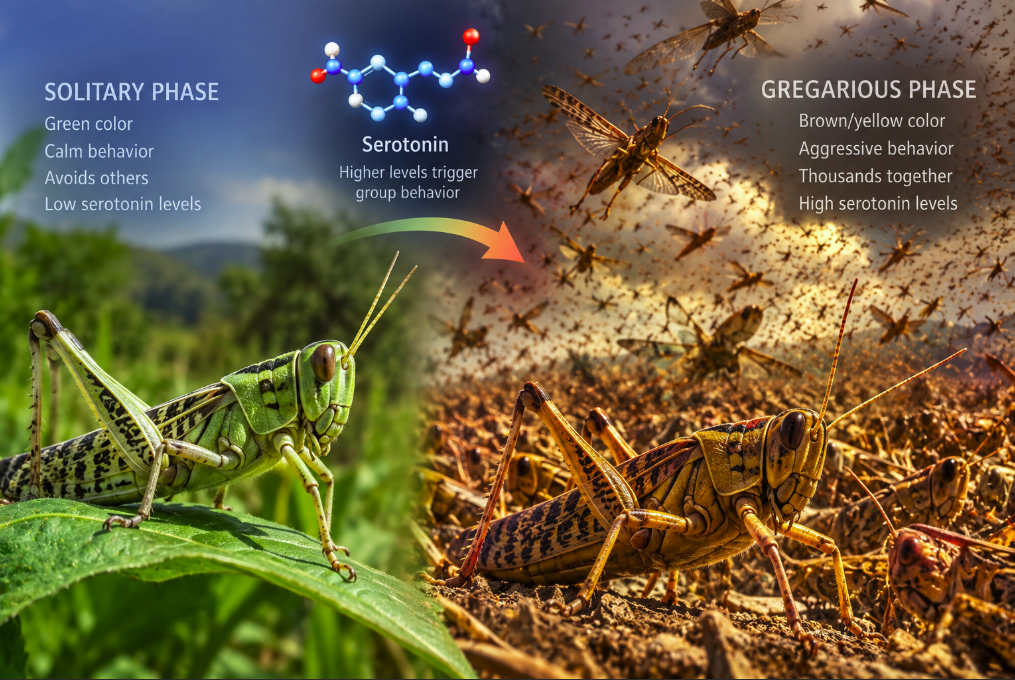
A solitary desert locust can spend its life trying to avoid other locusts. Put enough of them together, however, and something extraordinary begins to happen. The insects become more active, stop repelling one another, start seeking company and eventually participate in cohesive marching bands and flying swarms. Their coloration, physiology, muscles and even aspects of their nervous system can change as the transformation progresses.
This is one of nature's most dramatic examples of phenotypic plasticity: the ability of the same species, with essentially the same genome, to produce very different forms in response to environmental conditions. It has also generated a wonderfully viral explanation — that serotonin turns harmless grasshoppers into ravenous locusts. There is important truth behind that story, but the real biology is more interesting and more complicated.
First, locusts are grasshoppers, but not every grasshopper is a locust. The word “locust” is used for certain grasshopper species capable of a density-dependent transformation between a relatively solitary phase and a gregarious phase associated with mass aggregation and migration. One of the best-studied examples is the desert locust, Schistocerca gregaria.
The transformation begins with too many neighbors
When desert locust populations are sparse, individuals in the solitarious phase tend to avoid one another. They are comparatively inactive and cryptically colored, an excellent strategy for an insect living alone. Environmental conditions can change that equation. Rain may produce abundant vegetation and allow populations to grow. Later, as suitable habitat shrinks or food becomes concentrated into smaller areas, locusts are forced into increasingly frequent contact.
For the desert locust, physical jostling is not merely an inconvenience. Experiments have shown that repeated stimulation of mechanoreceptors on the outer surface of the hind femur can trigger rapid behavioral gregarization. Researchers have even reproduced the effect by repeatedly touching the relevant region of a solitary locust's hind leg. Sight and smell of other locusts can provide another route when the appropriate sensory cues occur together.
Within a few hours, the animal's social logic can reverse. Instead of moving away from its neighbors, it becomes attracted to them. Activity increases. Newly gregarious insects remain close to others, which exposes them to still more crowding, creating a biological positive-feedback loop. More contact encourages gregarious behavior; gregarious behavior creates more contact.
That initial behavioral switch is crucial because a swarm cannot form if every individual is determined to escape from every other individual.
Where serotonin enters the story
The famous serotonin connection comes largely from work on the desert locust. In a landmark 2009 study published in Science, Michael Anstey and colleagues showed that serotonin is a key mediator of the rapid behavioral transition from the solitarious to the gregarious state in Schistocerca gregaria. Blocking serotonin synthesis or action prevented normal behavioral gregarization under experimental conditions, while increasing serotonergic signaling could promote gregarious behavior.
Earlier measurements had found a striking transient rise in serotonin in the thoracic nervous system during the critical first hours of crowding. The result supplied a mechanistic bridge between a social experience — being repeatedly exposed to other locusts — and a radical change in behavior.
But serotonin should not be imagined as a permanent “swarm chemical” flooding every gregarious locust. Research shows that the early serotonergic surge is associated with initiating the switch; long-established gregarious animals do not simply maintain unusually high serotonin forever. The nervous system changes as the phase transition develops.
There is another major qualification. The serotonin story is not identical across all locust species. A recent systematic review of locust phase polyphenism notes that serotonin's role differs between the desert locust and the migratory locust, Locusta migratoria. Other neurotransmitters and molecular pathways, including dopamine-related signaling, also participate in phase biology. Saying “serotonin turns grasshoppers into locusts” therefore compresses a species-specific and multi-stage process into a slogan.
Why do they change color?
Behavior can change rapidly, but the visible transformation is slower. This is one of the easiest details to miss in dramatic before-and-after photographs. A locust does not get bumped by its neighbors, receive a serotonin signal and instantly repaint its body.
Different phase traits operate on different clocks. Reviews of desert locust biology describe behavioral gregarization occurring within hours, while coloration and anatomical characteristics can take much longer to develop, sometimes across molts and generations. Long-term phase change includes differences in body proportions, physiology, metabolism, sensory processing and brain structure as well as appearance.
Color itself is influenced by species, developmental stage and maturity. Gregarious desert-locust nymphs can develop conspicuous contrasting coloration, whereas solitary individuals tend to be more cryptic. Adult coloration changes again with sexual maturation. The familiar yellow males seen in photographs of mature desert-locust swarms are therefore not simply insects whose bodies turned yellow because they became crowded that morning.
Why evolve such conspicuous colors? One important idea is warning coloration. Dense groups of gregarious locusts can contain defensive plant-derived compounds or otherwise present an unpleasant meal, and conspicuous coloration can advertise that fact to predators. The details vary with life stage and ecological conditions, but the larger lesson is that phase change coordinates many traits suited to radically different lifestyles.
Does crowding also make locusts voracious?
Locust swarms are devastating because an enormous number of mobile insects can consume vegetation across a wide area. Yet it is misleading to picture serotonin as directly flipping a “hunger” switch that makes one insect suddenly eat everything in sight. Gregarious and solitary phases differ in feeding ecology and dietary behavior, but swarm destruction is also fundamentally a problem of scale, movement and concentration.
A single grasshopper chewing leaves is unremarkable. Millions of locusts moving together are an agricultural emergency.
Group life also creates intense competition. Locusts in marching bands must keep moving as resources are depleted and as neighboring insects press around them. Research on locust behavior has revealed that the dynamics of a group are shaped not only by attraction but also by competition and the risk posed by other hungry locusts. A swarm is therefore not a perfectly harmonious society. It is a moving population held together by powerful behavioral rules under ecological pressure.
The transformation is reversible, too. If conditions change and locust density falls, gregarious behavior can shift back toward solitarious behavior. How quickly this occurs depends on how long the insects and their ancestors have been in a particular phase. An individual recently induced to become gregarious can lose aspects of that behavior relatively quickly after isolation, while a lineage that has remained gregarious for generations undergoes a more gradual reversal.
One genome, two remarkably different lives
The most astonishing part of the locust story is that it does not require one species to evolve into another. The capacity for both lifestyles is already built into the animal. Environmental information determines which suite of traits becomes useful.
At low density, avoiding other locusts, remaining inconspicuous and exploiting scattered resources can make sense. At high density, when encounters become unavoidable, a nervous system that switches toward attraction and coordinated movement produces an entirely different ecological strategy. Serotonin is a crucial early signal in that transition in the desert locust, but it is one component of a much larger cascade involving sensory input, neural circuits, gene regulation, physiology and development.
That is why a locust swarm is more than a spectacular mass of insects. It is a visible consequence of biological plasticity. The crowd changes the individual, the changed individual strengthens the crowd, and a feedback loop that begins with a few repeated touches can ultimately contribute to one of the largest collective movements in the animal world.