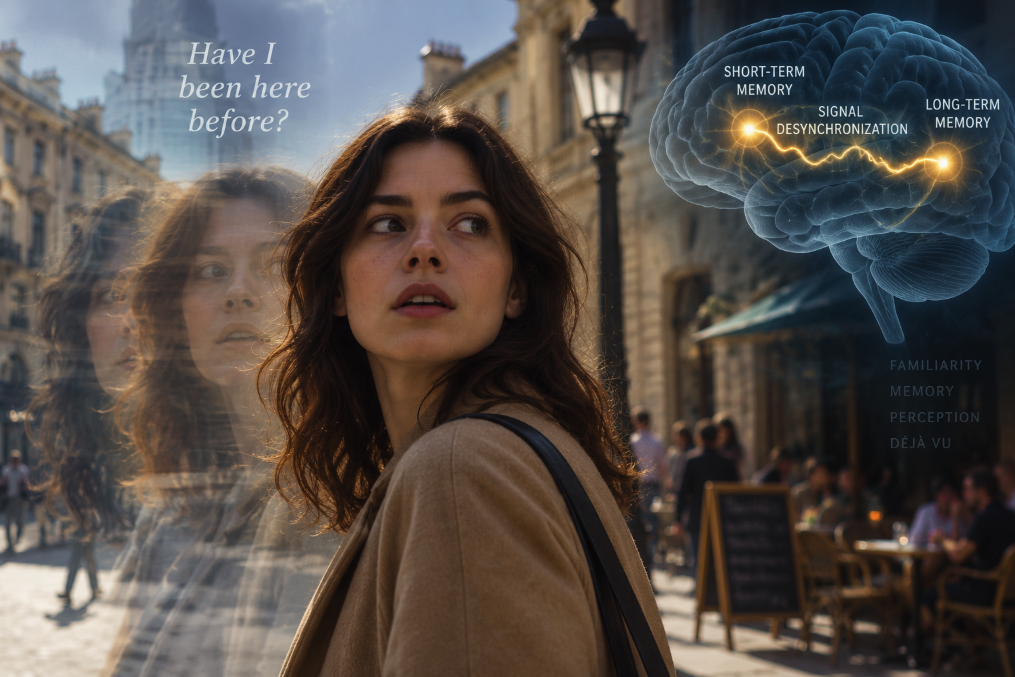
You walk into a café you have never visited. The tables, the light from the window and the conversation at the next table suddenly feel uncannily familiar. For a few seconds, there is an overwhelming conviction that this exact moment has happened before. Yet you also know that it has not.
That contradiction is the essence of déjà vu, the French expression for “already seen.” It is not simply remembering something. In an ordinary memory, familiarity comes with a plausible past event: you recognize a street because you walked down it last year. During déjà vu, familiarity arrives without a matching memory. The present feels remembered even while another part of the mind recognizes that the feeling makes no sense.
A popular explanation describes the phenomenon as a momentary desynchronization between short-term and long-term memory, as though the brain accidentally files a new event into long-term storage a fraction of a second too early. It is an appealing metaphor, but contemporary neuroscience does not support such a simple mechanism as the established explanation. Research instead points toward something subtler: the brain systems that generate a feeling of familiarity can briefly become disconnected from the systems that determine whether there is an actual episode to remember.
Familiarity is not the same as remembering
Recognition memory is not a single mental operation. Scientists commonly distinguish between at least two experiences: familiarity and recollection. Familiarity is the feeling that something has been encountered before without necessarily knowing where or when. Recollection is richer: it retrieves contextual details associated with a previous event.
Imagine seeing a face at a railway station. You may immediately know that you have seen the person before but be unable to identify them. That is familiarity. A moment later, you remember that the person works at a café near your office. Now you have recollection.
These processes rely on overlapping but partly distinguishable networks in the medial temporal lobe. Research reviewed in the scientific literature on recognition memory has linked the hippocampus particularly strongly with recollection, while nearby regions including the perirhinal cortex contribute to familiarity-based recognition. The exact division of labor remains debated, but the distinction gives researchers a useful way to think about déjà vu.
During a typical déjà vu experience, the familiarity signal appears to fire when it should not. The brain says, in effect, “I know this,” while failing to retrieve any legitimate previous episode explaining why.
This is sometimes called erroneous or decoupled familiarity. A review of déjà vu research described the phenomenon as a memory illusion in which familiarity becomes detached from the cognitive evidence that should normally justify it. The result is precisely the strange combination that defines déjà vu: powerful recognition accompanied by the knowledge that the recognition is inappropriate.
Where in the brain does déjà vu happen?
Much of what neuroscientists know about the neural machinery of déjà vu comes from an unusual source: temporal lobe epilepsy. Déjà vu is common in healthy people, but it can also occur as part of certain epileptic seizures. Because some patients undergoing evaluation for epilepsy have electrodes placed inside the brain, researchers have occasionally been able to observe — and even provoke — déjà-like experiences while stimulating specific regions.
These studies repeatedly implicate structures in the medial temporal lobe, a region deeply involved in memory. The hippocampus, parahippocampal areas and rhinal cortices have all entered scientific models of the experience.
An influential account proposed that abnormal activity in a recognition-memory system involving the parahippocampal region could produce an isolated feeling of familiarity. The rest of the memory system, still functioning normally, would fail to find the corresponding memory. That mismatch could create the characteristic mental jolt: something feels known, but you know that it cannot be known. The hypothesis is described in a neuropsychiatric review of possible parahippocampal mechanisms.
More recent intracranial research has refined the picture. A 2022 review of electrical stimulation studies highlighted interactions between rhinal cortices and the hippocampus, proposing that abnormal synchronization within these perception-memory networks can produce déjà vu in seizure-related circumstances. This is sometimes loosely translated online into a “timing glitch” between memories, but that simplification is misleading. The research concerns specific neural networks involved in familiarity and episodic memory, not evidence that information accidentally jumps from a short-term memory store into a long-term one.
Why can a new place feel familiar?
Not every déjà vu needs spontaneous abnormal neural activity to explain it. Sometimes a genuinely new situation may contain elements that resemble something previously encountered, even when the source of that resemblance cannot be consciously retrieved.
A room might have the same spatial arrangement as another place you visited years ago. A stranger’s face may share features with someone you once knew. A street corner, smell, rhythm of conversation or configuration of objects may activate a weak memory trace without producing full recollection.
The result is recognition without identification: the brain detects similarity but cannot tell you what the current scene resembles. Researchers have explored this concept as one possible bridge between ordinary recognition errors and déjà vu. A review by Akira O’Connor and Chris Moulin emphasizes that typical déjà vu contains both the inappropriate sense of recognition and awareness that the recognition is wrong.
That second component is important. Déjà vu may feel like a memory malfunction, but the fact that you notice the contradiction suggests that part of the brain’s monitoring system is working correctly. You do not normally abandon your plans because you believe you can predict the next five minutes. Instead, you think, “That was strange,” and continue with your day.
In this sense, déjà vu may reveal not just an error but the brain catching its own error.
It is surprisingly common
For such an uncanny experience, ordinary déjà vu is remarkably widespread. A 2024 systematic review and meta-analysis examining déjà vu in healthy people and in epilepsy estimated that roughly 74 percent of healthy participants had experienced non-seizure-related déjà vu. The authors stressed that ordinary, seizure-related and between-seizure déjà experiences should not simply be treated as the same phenomenon. The review is available through PubMed.
Frequency also varies between individuals and across life. Surveys have often found déjà vu reported more commonly by younger people, although the reasons are uncertain. Differences in attention, memory, travel, education, willingness to report unusual experiences and age-related changes in memory systems may all contribute.
Fatigue and stress are frequently mentioned in personal accounts, but identifying reliable triggers is difficult because ordinary déjà vu is brief, unpredictable and impossible to summon on command in most people. That makes it a frustrating subject for laboratory science. Researchers can create situations that resemble aspects of déjà vu, but reproducing the full spontaneous experience while someone happens to be inside a brain scanner is another matter.
When déjà vu can mean something different
Occasional déjà vu in an otherwise healthy person is generally considered a normal experience. Its association with temporal lobe epilepsy, however, means context matters.
Seizure-related déjà vu may occur alongside other unusual symptoms, such as sudden fear, strange smells or tastes, rising sensations in the abdomen, altered awareness, repetitive movements or confusion. It may also be unusually intense, frequent or stereotyped. Neurologists have known about the connection between temporal lobe seizures and “dreamy states” since the nineteenth century.
This does not mean that experiencing déjà vu is evidence of epilepsy. The phenomenon is far too common in healthy people for that. Rather, the clinical literature gives scientists a rare window into the neural circuits capable of producing an abnormal sense of familiarity.
A memory that never existed
The most intriguing feature of déjà vu is that it exposes a part of memory we usually never notice. Familiarity feels like a direct property of the world: a face simply looks familiar, a song simply sounds known, a place simply feels remembered. Neuroscience suggests that familiarity is instead something the brain actively generates.
Usually that signal is extremely useful. It allows us to recognize people, objects and environments quickly without reconstructing every previous encounter. But a system optimized for speed can occasionally produce a false positive. When it does, we experience the normally invisible machinery of recognition as something eerie and almost supernatural.
There is therefore no need to imagine that the brain has accidentally stored the present as a long-term memory milliseconds before we consciously experience it. Nor does déjà vu provide evidence of precognition, reincarnation or a previous version of reality. The leading scientific approaches treat it as a disturbance or mismatch within the systems that calculate familiarity and episodic memory.
For a moment, the brain produces the emotional certainty of remembering without supplying a memory to justify it. Then the contradiction disappears almost as quickly as it arrived.
That may be why déjà vu feels so profound. We normally trust familiarity without thinking about it. Déjà vu is the rare instant when the brain tells us, with complete confidence, “You have been here before” — while we simultaneously know that it is wrong.