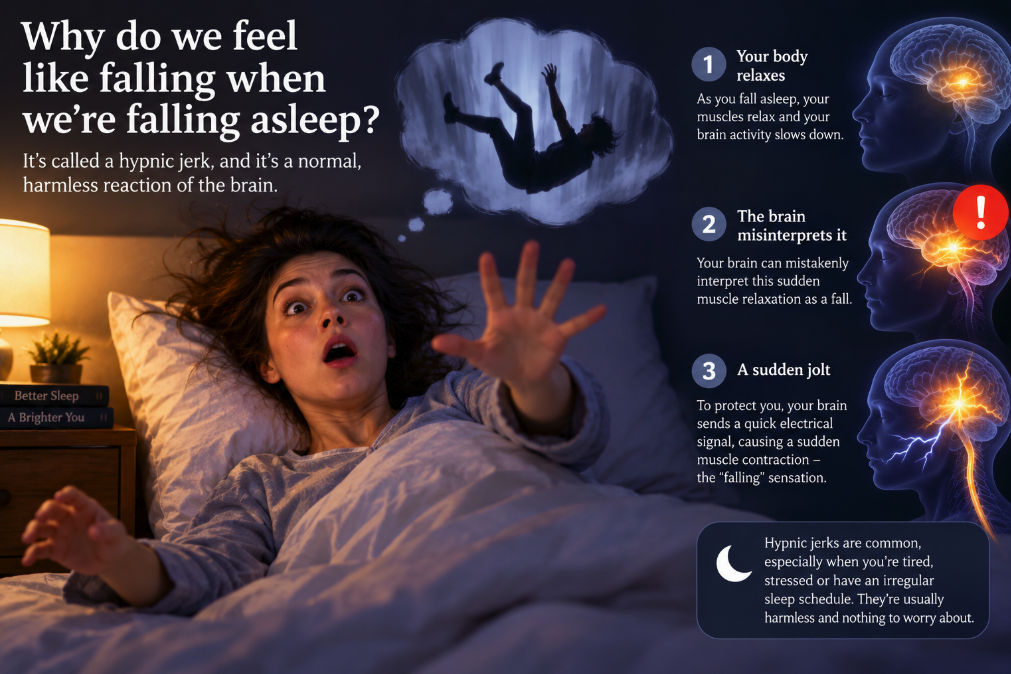
You are almost asleep when the floor seems to disappear. For a fraction of a second, your body feels as though it has stepped off a ledge. A leg kicks, an arm jerks or your whole torso jumps, and suddenly you are awake again with your heart beating faster than it was a moment ago.
The experience has a name: a hypnic jerk, also called a sleep start or hypnagogic jerk. It is a brief, involuntary muscle contraction that occurs around the transition from wakefulness to sleep. It is common, generally harmless and often accompanied by exactly the sensation that makes it so memorable — falling through empty space.
There is a famous explanation for why this happens: as the muscles relax during sleep onset, the brain supposedly mistakes the relaxation for a real fall and fires an emergency signal to tense the body. It is an appealing theory, and versions of it appear all over the internet. The important scientific caveat is that researchers have not established that this is definitively what the brain is doing. We understand the phenomenon better than we understand its ultimate cause.
What happens during a hypnic jerk?
Sleep is not an on-off switch. Falling asleep is a transition during which brain activity, muscle tone, breathing, heart activity and awareness gradually change. A 2023 systematic review of sleep-onset neurophysiology emphasizes just how complex and variable this boundary between wakefulness and sleep actually is.
Hypnic jerks occur in that unstable borderland. They are a form of physiological myoclonus — the medical term for a sudden, brief involuntary muscle movement. A jerk may involve one limb, several muscles or much of the body. It is usually non-rhythmic and over almost immediately.
A review indexed by the U.S. National Library of Medicine classifies hypnic jerks as a sleep-wake transition phenomenon. Other neurological literature describes them as a normal component of sleep onset that can occur at any age. They may arrive alone or together with unusual sensory experiences: a flash, a noise, a vivid fragment of dream imagery or the unmistakable impression of falling into a void.
That last detail creates an interesting chicken-and-egg problem. Does the brain first generate the sensation of falling and then make the body jerk? Does the muscle jerk happen first and the half-dreaming brain rapidly invent a falling story to explain it? Or are both produced by the same underlying transition in neural activity? Science has not completely resolved the sequence.
Does the brain really think you are falling?
The “brain mistakes relaxation for falling” story is plausible enough to survive because it fits the experience perfectly. As a person drifts into sleep, skeletal muscles relax. According to the theory, an ancient vigilance system misreads that sudden loss of muscle tone as evidence that the body is losing support. A protective startle response then contracts the muscles and snaps the sleeper toward wakefulness.
Some popular accounts go further and claim that this reflex evolved specifically to stop our tree-dwelling ancestors from falling from branches. That evolutionary story is even more speculative. There is no established fossil or neurological evidence showing that hypnic jerks evolved as a tree-fall prevention system.
Modern sleep research instead treats the mechanism as incompletely understood. Neurophysiological work suggests that hypnic jerks arise from subcortical brain systems involved in motor control and the sleep-wake transition. The fact that sleep onset itself involves shifting patterns of neural firing offers a less dramatic but scientifically safer explanation: occasional motor discharges can emerge while the nervous system is reorganizing from waking control into sleep.
A 2014 neurophysiological study of hypnic jerks found no single orderly pattern in how the muscle activity spread through the body, while later work has continued to characterize these movements as spontaneous sleep-related motor events. The “false alarm about falling” can therefore be presented as a theory, not as a proven description of a specific electrical message sent by the brain.
Why does it happen more on some nights?
Anyone who experiences sleep starts regularly may notice that they cluster during particular periods. Stress is a common suspect. So are anxiety, fatigue and sleep deprivation. Stimulants such as caffeine and nicotine can also make sleep more fragmented or the nervous system more excitable, potentially increasing the likelihood of a jerk around sleep onset.
Intense exercise late in the evening has also been reported as a possible trigger in some people. None of these factors is required: a perfectly rested person can still experience an occasional sleep start. They simply help explain why the phenomenon may suddenly become noticeable during an exhausting week filled with coffee and poor sleep.
The falling sensation itself can be astonishingly realistic because awareness has not yet fully disengaged. During the hypnagogic period, fragments of imagery and dream-like perception can mingle with real bodily sensations. A twitch in a leg may become a missed stair. A whole-body jerk may be experienced as plunging from a height. The brain is already beginning to construct the strange sensory world of sleep while still retaining enough waking awareness to be startled by it.
Is a hypnic jerk dangerous?
Occasional hypnic jerks are considered benign. Reviews of sleep-related movement disorders distinguish ordinary sleep starts from conditions such as periodic limb movements, some parasomnias and epileptic myoclonus. The timing is an important clue: a typical hypnic jerk happens at sleep onset, is brief and does not repeat in a regular rhythmic pattern.
For most people, no treatment is necessary. Reducing caffeine late in the day, keeping a reasonably regular sleep schedule and avoiding severe sleep deprivation may make episodes less frequent. Addressing stress can help when the jerks seem to appear during anxious periods, although there is no guaranteed trick that prevents every sleep start.
Medical advice becomes more appropriate when jerks are frequent enough to repeatedly prevent sleep, occur extensively while fully awake, become rhythmic or repetitive through the night, or appear alongside other neurological symptoms. Similar-looking movements can have different causes, and unusual cases sometimes require a clinician or sleep specialist to distinguish them.
What makes the ordinary hypnic jerk fascinating is not that something has gone wrong. It is that, for a split second, we notice the machinery of falling asleep. Normally the transition happens without our awareness. With a sleep start, the nervous system announces the boundary with a kick, a flash of sensation and sometimes an imaginary fall that feels completely real.
So when you suddenly plunge through an invisible floor just as sleep arrives, your body probably is not saving you from an actual fall. You are experiencing a common burst of involuntary movement during one of the brain's most complicated transitions. The dramatic “false falling alarm” remains an intriguing explanation — but, like the fleeting dream that often accompanies the jerk, it should not be mistaken for a settled scientific fact.