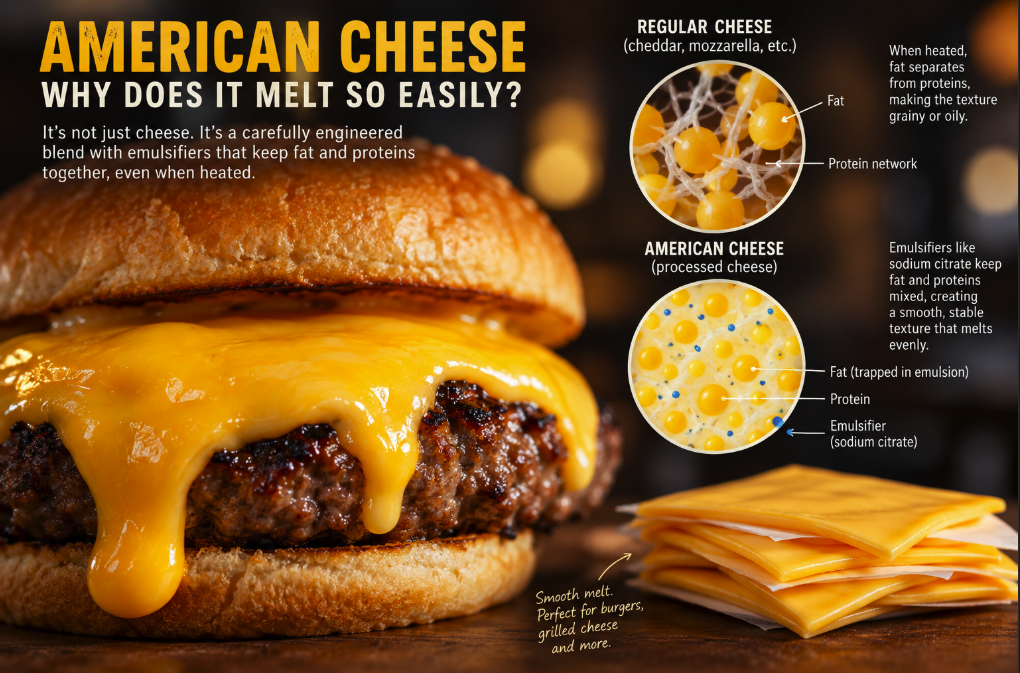
Put a slice of aged cheddar in a hot pan and things can become unpredictable. It may soften beautifully, but push the temperature too far and orange oil can pool around clumps of tightening protein. Put a familiar slice of American cheese on a hot burger, by contrast, and it seems almost engineered for the moment: the square relaxes into a glossy blanket, bends around the meat and remains remarkably smooth.
That is not an accident. American-style processed cheese is one of the clearest everyday demonstrations of food chemistry. Its famous melting behavior comes from manipulating the relationship between three ingredients already fundamental to cheese: protein, fat and water. The quiet heroes are compounds known as emulsifying salts, commonly including sodium citrates and sodium phosphates.
The popular explanation says that sodium citrate “keeps the fat and protein from separating.” That is broadly useful, but chemically it skips the most interesting step. Sodium citrate is not simply acting like a conventional surfactant that grabs oil with one end and water with the other. Instead, it changes the cheese proteins themselves so that those proteins become much better at stabilizing the melted mixture.
Natural cheese is a delicate protein network
To understand American cheese, start with ordinary cheese. Milk contains casein proteins, which assemble into structures associated with calcium and calcium phosphate. During cheesemaking, those proteins form a network that traps fat and water. Aging, acidity, moisture and the amount of calcium associated with the casein all influence how that network behaves when heated.
Heat gives the molecules more energy. Fat melts, water moves and the protein network loosens and reorganizes. In a good melting cheese, those changes can produce a wonderful fluid texture. But heating can also destabilize the system. Fat globules may merge and leak free oil while proteins aggregate into a tougher mass. Anyone who has overheated a cheese sauce and watched it become greasy or grainy has seen this separation happen.
Different natural cheeses behave very differently because their moisture, acidity, calcium balance and degree of protein breakdown differ. A young mozzarella stretches dramatically. A mature cheddar can melt richly but may release oil. A hard, aged cheese such as Parmesan behaves differently again. “Melting” is therefore not one simple property.
Processed cheese was developed partly to make those properties more controllable.
What sodium citrate actually does
Processed cheese is generally made by heating natural cheese and other dairy ingredients while mixing them with water and emulsifying salts. Common salts include sodium citrate, sodium phosphate, pyrophosphates and polyphosphates, often used in combinations selected to produce a particular texture.
The crucial target is calcium. Calcium helps link parts of the casein network together. Emulsifying salts bind, or sequester, some of that calcium and exchange the chemical environment around the proteins. As those calcium-mediated connections are disrupted, casein becomes more hydrated and more dispersed in the water phase.
Now the clever part happens. The dispersed casein proteins themselves can surround and stabilize tiny droplets of fat. Instead of melted fat joining into large oily pools and escaping, it remains distributed through the water-and-protein mixture as an emulsion. The result is a smooth, homogeneous molten cheese.
Food scientists therefore call citrate and phosphate compounds “emulsifying salts,” but they are not necessarily emulsifiers in the narrow sense used for molecules such as lecithin. Their major role is to transform the casein system so that the cheese's own proteins become effective emulsifiers.
A 2025 reference chapter on processed cheese describes this process as a combination of heating, shearing and emulsifying-salt action. Citrate and phosphate salts chelate calcium from the complexes that help crosslink casein in natural cheese. The dispersed proteins can then stabilize fat globules, helping prevent the leakage of free oil during heating.
Why the slice becomes glossy instead of greasy
At microscopic scale, processed cheese can be thought of as fat droplets distributed within a continuous water-and-protein matrix. When its formulation is balanced correctly, heating softens that matrix while the fat remains finely dispersed. Instead of visibly separating into oil, water and protein, the components move together.
This explains several familiar properties at once. American cheese melts at a useful temperature, spreads evenly over irregular surfaces, remains creamy and tends to resist the greasy separation that can occur with some natural cheeses. When it cools, the proteins interact again and the mixture sets back into a sliceable or spreadable structure, depending on its formulation.
The exact result can be engineered by changing the cheese blend, moisture, pH, protein content and type and quantity of emulsifying salts. Research has shown that different citrate and phosphate salts vary in how strongly they bind calcium and how they affect casein dispersion, fat-droplet size, firmness and melt behavior. There is no single universal “American cheese formula.”
This is why two processed cheese products can look almost identical in the refrigerator yet behave differently on a burger. One may flow rapidly into a sauce-like layer; another may remain firmer. Manufacturers can tune the molecular architecture for the intended use.
American cheese was designed, not invented from chemicals
The processed-cheese idea is sometimes described online as though someone took an artificial orange substance and made it resemble cheese. Historically, the process developed in the opposite direction: cheesemakers started with real cheese and searched for ways to make it more stable and consistent.
Swiss experiments with melted cheese and citrate salts appeared in the early twentieth century. In the United States, James L. Kraft developed a process for heating and packaging cheese that received a U.S. patent in 1916. Later advances in emulsifying salts helped create the broad family of processed cheeses familiar today.
Modern products sold as American cheese can have different formulations and regulatory names, so the ingredient list matters. Some contain substantial amounts of natural cheese blended with dairy ingredients and emulsifying salts; others belong to related processed-cheese categories. Sodium citrate is a famous example of an emulsifying salt, but it is not the only one and is not necessarily present in every American cheese slice.
The orange color is a separate issue. Cheese is not naturally fluorescent orange. Colorants such as annatto have long been used in cheeses, including cheddar, and American-style products may be white or orange. The color has essentially nothing to do with why the cheese melts so smoothly.
The same trick works in a home kitchen
The chemistry is useful beyond individually wrapped slices. Cooks can use sodium citrate to make exceptionally smooth cheese sauces from cheeses that might otherwise separate. When dissolved in a suitable amount of liquid and heated with cheese, it modifies the calcium-casein network and helps create a stable emulsion.
That makes it possible to produce a sauce with the flavor of a mature cheddar, for example, while obtaining some of the smoothness associated with processed cheese. The principle is the same one used industrially, although commercial formulations may involve blends of emulsifying salts and tightly controlled processing conditions.
This also explains why simply melting cheddar and adding more fat does not reproduce American cheese. The key is not the amount of fat. It is the organization of fat, water and protein.
American cheese is sometimes mocked precisely because it behaves so predictably, as though reliable melting were evidence that it is somehow less interesting than traditional cheese. From a food-science perspective, the opposite is true. A smooth slice on a cheeseburger is a tiny engineered emulsion whose proteins have been chemically persuaded to hold together ingredients that heat naturally tries to pull apart.
So when an American cheese slice collapses perfectly over a burger without leaving a puddle of orange oil behind, sodium citrate or a related emulsifying salt is not simply “making cheese melt.” It is rearranging the microscopic rules of the cheese. Calcium is sequestered, casein becomes more mobile and hydrated, fat stays dispersed, and an unstable molten mixture becomes a controlled one. The result happens to taste good, but it is also an elegant lesson in chemistry you can eat.