A bitcoin cannot be held in your hand. It does not represent a legal claim on a company, pay a dividend or give its owner a stream of rental income. There is no warehouse containing one bar of gold for every digital coin. Yet people exchange houses, salaries and conventional currencies for units of Bitcoin, and a global market continuously assigns them a price.
So why is Bitcoin worth money?
The shortest answer is not “because of blockchain” and not simply “because there will only be 21 million.” Bitcoin has market value because people are willing to exchange other valuable things for it. Its unusual supply rules, decentralized network, portability, divisibility and ability to transfer value without a central issuer help create demand for it. The price emerges where that demand meets a supply that is deliberately difficult to expand.
That distinction matters. Scarcity can support value, but scarcity by itself does not create it. A unique pebble in your garden may have a supply of exactly one and still be worth almost nothing if nobody wants it.
The 21 million limit changes the supply side
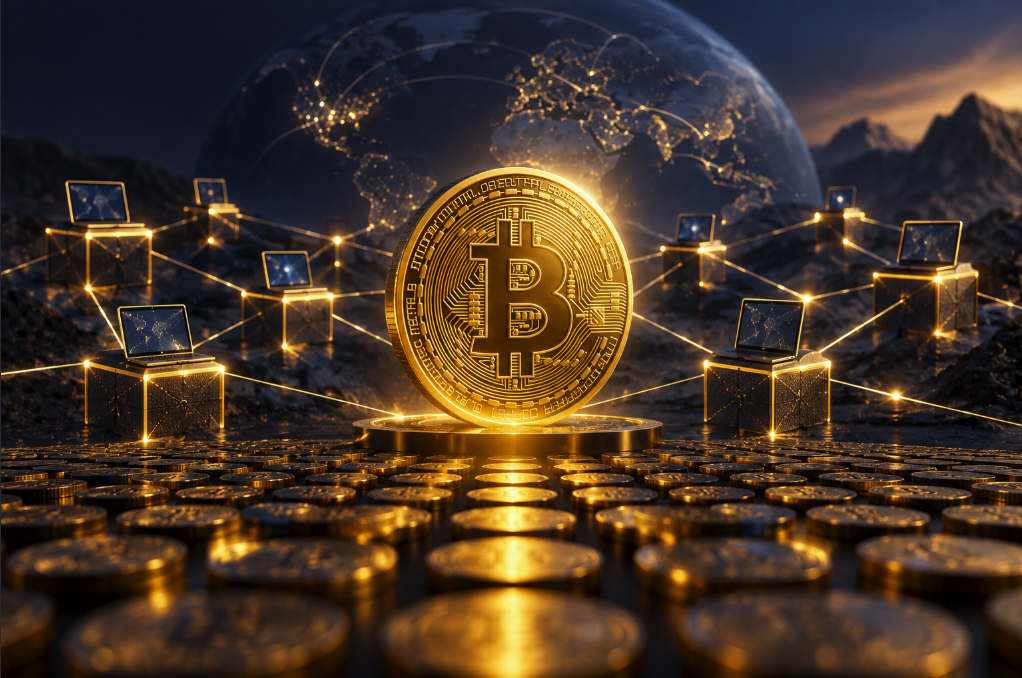
Bitcoin's monetary policy is radically different from that of ordinary national currencies. New bitcoins enter circulation as part of the reward associated with mining blocks, but the subsidy follows a predetermined schedule. Roughly every 210,000 blocks, or about four years, that subsidy is cut in half.
Bitcoin began with a block subsidy of 50 BTC. Successive “halvings” reduced it to 25, 12.5, 6.25 and, in 2024, 3.125 BTC per block. The sequence continues until the issuance of new units effectively ends, producing a maximum supply approaching 21 million bitcoin.
The current Bitcoin.org FAQ describes bitcoins as being created at a decreasing and predictable rate until issuance stops at a total of 21 million. One bitcoin is also divisible into 100 million smaller units commonly called satoshis, so a limited number of whole coins does not prevent tiny payments or fractional ownership.
The supply rule is not merely a promise printed on a company's website. Bitcoin nodes independently check whether blocks obey the network's consensus rules. Bitcoin Core's documentation on full validation specifically notes that full nodes reject blocks that violate rules such as the 21 million limit.
Could people change the software? In principle, software can always be modified. But changing your copy does not force everyone else to accept your new rules. A change to something as fundamental as the monetary supply would need enough network participants to adopt incompatible rules, and those who rejected the change could continue enforcing the existing ones. Bitcoin's scarcity is therefore better understood as a socially coordinated rule enforced by software and independent validation, rather than a magical number that no human could ever alter under any circumstances.
Scarcity means little without demand
This is the part that many explanations skip.
Bitcoin's fixed supply does not mechanically force its price upward. If nobody wanted bitcoin tomorrow, a limit of 21 million would not save its market value. Bitcoin.org states the economic mechanism plainly: its price is determined by supply and demand.
Demand comes from people assigning usefulness or desirability to the asset for different reasons. Some use Bitcoin to transfer value across borders. Some value the ability to hold an asset without depending on a bank account. Some see its predetermined supply as an alternative to currencies whose supply can be expanded by monetary authorities. Others buy it primarily because they expect somebody else to pay more in the future.
Those motivations are not equivalent, and they do not guarantee a particular price. But together they create a market.
Institutional research from Fidelity Digital Assets, for example, describes bitcoin as an emerging monetary asset whose scarcity is reinforced by decentralization and proof of work. That is an investment-industry interpretation rather than a law of economics, but it illustrates why investors often compare Bitcoin with scarce monetary goods such as gold rather than with shares in a business.
Unlike a company, Bitcoin does not generate profits that can be discounted into a conventional valuation. Its monetary value is therefore unusually dependent on what current and prospective users believe its network properties are worth.
What does “decentralized trust” actually mean?
It is common to hear that Bitcoin is valuable because “the blockchain guarantees trust.” That phrase is catchy but misleading. A blockchain cannot guarantee that people will trust Bitcoin, that governments will permit particular uses, that the price will rise or that the software will never encounter problems.
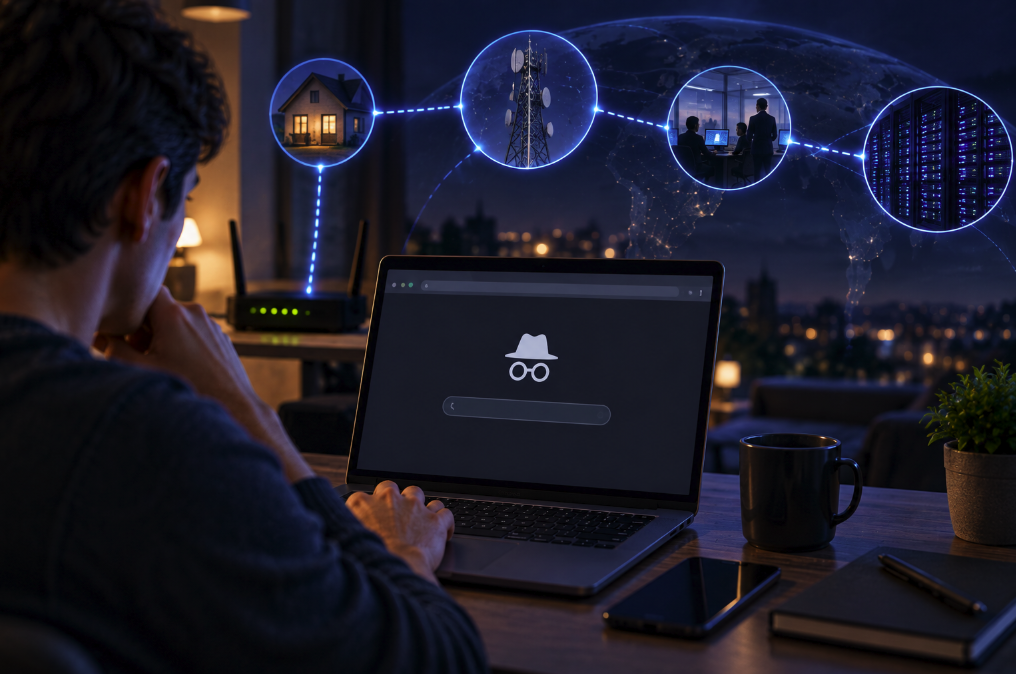
What Bitcoin does is reduce the need to trust a single central record keeper.
In a traditional electronic payment system, a bank or payment company maintains authoritative account records. If Alice sends Bob money, trusted institutions determine whether Alice owns the funds, update balances and prevent the same money from being spent twice.
Bitcoin was designed to solve that coordination problem without one central operator. Satoshi Nakamoto's 2008 Bitcoin white paper proposed a peer-to-peer electronic cash system in which transactions are broadcast to a network and ordered into a chain secured through proof of work.
Nodes verify transactions and blocks against agreed rules. Miners compete to add blocks by performing computational work. Each block references the previous one cryptographically, making attempts to rewrite established history progressively more expensive because an attacker would need to redo proof of work and catch up with the continuing network.
This architecture does not eliminate trust from human life. Users still trust wallet software, hardware, exchanges and their own ability to protect private keys to varying degrees. What it changes is the trust model of the monetary ledger itself: no single bank, company or government is required to maintain the canonical Bitcoin transaction history.
Why digital scarcity was difficult before Bitcoin
Scarcity is easy in the physical world. If you hand someone a gold coin, you no longer possess that particular coin. Digital information behaves differently. A photograph, song or document can be copied almost perfectly at negligible cost.
That creates an obvious problem for digital money. If a digital coin were merely a file, its owner could duplicate it and spend identical copies repeatedly.
Before Bitcoin, electronic money systems generally solved this “double-spending” problem by relying on a trusted central database. Bitcoin's breakthrough was to combine existing ideas — public-key cryptography, peer-to-peer networking, hashing, proof of work and economic incentives — into a system capable of reaching agreement about which transactions count without a central monetary operator.
This is what makes Bitcoin's scarcity economically interesting. The important fact is not that somebody wrote “21 million” into software. Anyone can create a token with a smaller advertised limit. The harder achievement is maintaining a network in which independent participants continue recognizing and enforcing the same ownership and issuance rules.
Network effects matter too
Money is inherently social. A payment asset becomes more useful when more people are prepared to receive it, more infrastructure supports it and markets make it easier to exchange.
Bitcoin benefits from having existed since 2009. Over that period it has accumulated exchanges, wallets, miners, developers, payment services, institutional custody products and a large global user community. This does not make it invulnerable to competitors, but it creates a network effect: an established monetary network can be more useful partly because it is already established.
The same phenomenon appears in ordinary currencies. A U.S. dollar bill is made from inexpensive materials, yet people accept it because they expect other people to accept it too, within a much broader framework that includes the U.S. state, legal system, taxation and monetary institutions. Gold's market value likewise exceeds the value implied by many of its industrial uses because humans have treated it as a monetary and investment asset for centuries.
Bitcoin has neither government backing nor gold's ancient history. Its value rests on a different bundle of expectations: that its rules will continue to be enforced, its network will remain secure and useful, and enough other people will continue to want the asset.
Why the price can move so violently
A scarce supply can amplify changes in demand. Bitcoin's issuance schedule does not respond to price in the way production of many commodities can. If copper prices soar, mining companies have an incentive to develop more copper supply. Bitcoin miners cannot collectively decide to produce 30 million bitcoin because the price rises.
That makes demand changes especially visible in price.
When enthusiasm, adoption or speculative buying increases, buyers compete for the available supply. When confidence falls or holders rush to sell, the reverse occurs. Bitcoin.org explicitly warns that bitcoin's price is volatile and that there is no guarantee it will rise.
The halving is sometimes portrayed as a machine that automatically makes Bitcoin more valuable. It does reduce the rate at which new coins are issued, but the market knows the schedule in advance. What happens to price depends on demand, liquidity, expectations and countless broader economic factors. A smaller flow of new supply is not a guarantee of higher prices.
Could Bitcoin become worthless?
Yes. That possibility is essential to understanding what “value” means here.
Bitcoin.org itself acknowledges that bitcoins could lose their value, citing potential technical failures, competing currencies, political issues and other risks. A catastrophic flaw, collapse in demand, severe loss of confidence or a superior alternative could dramatically reduce what people are willing to pay.
Bitcoin also depends on a continuing security economy. Mining consumes real resources, and miners are compensated through newly issued bitcoin plus transaction fees. As the block subsidy continues to decline over the coming decades, transaction fees are expected to become increasingly important to miner revenue. Whether that long-term security model develops as advocates expect remains a subject of active analysis; Fidelity Digital Assets, for instance, examined the issue in a 2026 report on Bitcoin's future security budget.
None of this means Bitcoin has no value. It means its value is not guaranteed by scarcity, cryptography or mathematics alone.
Bitcoin is worth money because a large market of people currently wants an asset with its particular properties: predictable scarcity, global portability, divisibility, verifiable ownership and a monetary ledger that can operate without a single central issuer. The 21 million limit makes supply unusually rigid. The decentralized network makes the rule credible to participants who choose to verify it. Demand turns those properties into a market price.
The deepest answer, then, is also the simplest. Bitcoin has value for much the same fundamental reason that anything used as money has value: people believe they can use it, hold it or exchange it later. Bitcoin's innovation was not abolishing that human element. It was building an unusual technological system around it.