The internet contains billions of websites, streams enormous quantities of video, connects data centers across continents and crosses oceans through cables thousands of kilometers long. So if you could somehow put “the internet” on a scale, what would it weigh?
One of the web's most enduring science facts gives an irresistible answer: about 50 grams, roughly the mass of a strawberry.
The number is real in the sense that somebody actually calculated it. But it is not the measured weight of the internet, and it is not a settled physical constant. It comes from a particular thought experiment devised two decades ago. Change what you mean by “the internet,” and the answer can shrink by millions — or even quadrillions — of times.
The fascinating question is therefore not whether the internet weighs exactly 50 grams. It is what, exactly, anyone is trying to weigh.
Where the famous 50 grams came from
The strawberry-sized internet traces back to physicist and science writer Russell Seitz. In 2006, Seitz made a rough calculation based on the electrical activity of the machines running the network.
An archived account from the Institute for the Future preserves his reasoning. Seitz estimated that there were roughly 75 million to 100 million servers, each consuming somewhere around 350 to 550 watts. He rounded their combined power to about 40 gigawatts.
He then considered the electrical current involved in silicon electronics, using approximate operating voltage and chip speed. Because electric current involves moving charge, and electrons have a known rest mass, he estimated the instantaneous mass of the electrons participating in that electrical activity.
His result: about 50 grams of electrons in motion.
It is a delightful calculation. It also describes the internet of roughly 2006 using a chain of broad assumptions. Facebook was barely open to the general public, the first iPhone had not yet been released, Netflix had not begun streaming video, and today's cloud and AI infrastructure did not exist at anything like its present scale.
More importantly, Seitz was not placing all of cyberspace on a conceptual scale. He was estimating one particular physical quantity associated with the electricity powering a particular estimate of internet servers.
The servers themselves weigh vastly more. So do routers, switches, storage arrays, buildings, cooling systems, terrestrial fiber, satellites and the enormous submarine cables crossing the oceans. If “the internet” means its physical infrastructure, 50 grams is obviously not the answer.
Another calculation produced about five micrograms
Only months later, Discover magazine asked essentially the same question and chose a completely different definition.
Instead of estimating the electrons associated with the power consumption of internet servers, writer Stephen Cass tried to estimate the physical mass associated with bits of information being handled electronically. His 2007 “How Much Does the Internet Weigh?” calculation used a model in which a bit stored in computer memory involved charge represented by tens of thousands of electrons.
Using an estimate of roughly 40 petabytes of internet traffic per day at the time, the calculation arrived at about 0.2 millionths of an ounce — on the order of five micrograms.
That is around ten million times smaller than 50 grams.
Neither calculation necessarily contains an amusing arithmetic blunder that explains the enormous gap. They are largely answering different questions. Seitz considered the electrical activity associated with operating servers. Discover focused on electrons associated with representing the information flowing through the network.
Ask “What does the internet weigh?” without defining “internet” or “weigh,” and physics has plenty of room to produce wildly different answers.
Does digital information itself have weight?
This is where the question becomes deeper than internet trivia.
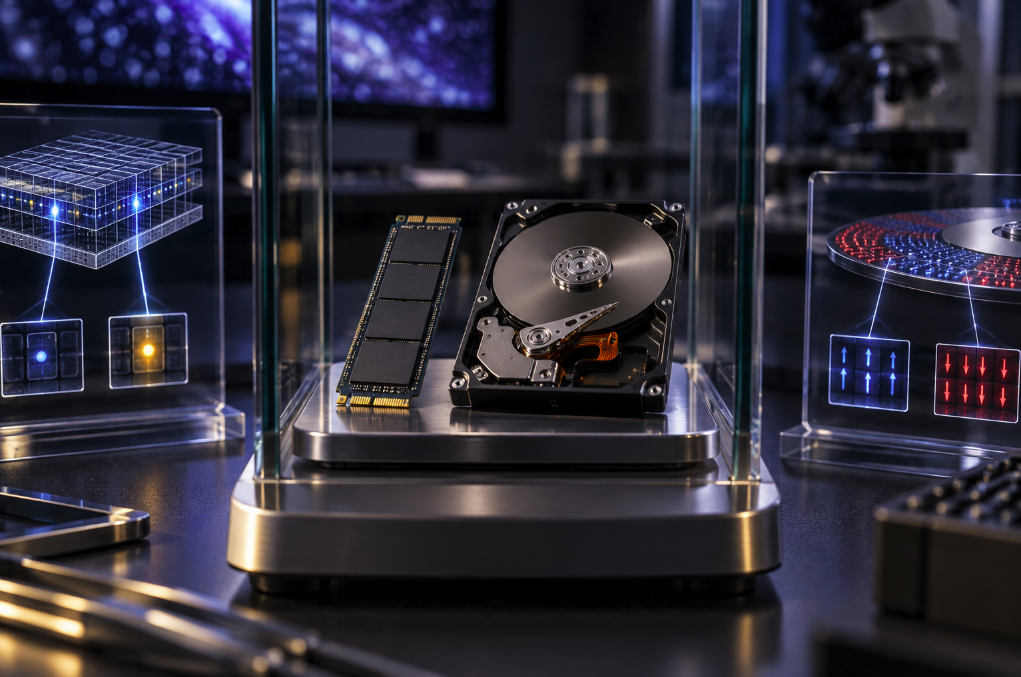
Information is abstract, but every real computer must encode it in a physical system. An SSD can represent data through different charge states in flash-memory cells. A magnetic hard drive uses microscopic magnetic configurations. Fiber-optic networks send information through pulses of light. Electrical links use changing voltages and currents.
Those physical states involve energy, and Einstein's relation E = mc² tells us that energy contributes to the mass-energy of a system. That makes it tempting to say that every bit of information must have a specific tiny mass.
The problem is that the same bit can be represented physically in completely different ways.
A 1 could be a charged memory state, a particular magnetic orientation, a high voltage, a pulse of light or even a black mark on paper. There is no requirement that each representation involve the same amount of energy or the same number of electrons.
Physicists Laszlo Kish and Claes-Göran Granqvist examined this problem in their paper “Does Information Have Mass?” They were skeptical of simple estimates based on counting the mass of electrons used by computers, arguing that the answer depends on the physical situation and that electron rest mass does not provide a universal mass-per-bit rule.
In other words, information must be physically embodied somewhere, but that does not make an abstract gigabyte a standardized packet of matter.
In 2025, the internet became even “lighter”
The old strawberry comparison proved too memorable to disappear, so WIRED revisited the question in 2025. Its investigation highlighted how much the assumptions matter.
The article discussed an approach based not on counting electrons but on the thermodynamic minimum energy associated with encoding information. Converting such energy to a mass equivalent produces an extraordinarily small result: roughly 53 quadrillionths of a gram under the assumptions used in the calculation.
That number is so far below 50 grams that ordinary intuition becomes almost useless.
But once again, this does not mean scientists finally put the internet on a more accurate scale. It is another definition of the problem. The calculation concerns a theoretical mass equivalent associated with information and energy, not the literal total mass of every electron, photon, computer and cable involved in keeping the global network alive.
The progression from 50 grams to micrograms to quadrillionths of a gram is not a story of physicists repeatedly discovering that the internet got lighter. It is a story of people weighing different concepts under the same catchy headline.
What about the photons in fiber-optic cables?
Much of long-distance internet traffic travels as light through optical fiber. Photons have no rest mass, but they carry energy and momentum. A system containing more energy has correspondingly greater mass-energy than the same system with less energy.
Again, however, turning that fact into “the weight of the internet” requires deciding which photons to count and for how long. The internet is not a static object. Signals are constantly being generated, absorbed and replaced. Electrical states change billions of times per second. Data is copied, cached and deleted. Servers switch workloads. Storage devices retain information while network packets race around the planet.
There is no single boundary around this activity comparable to the skin of an apple that can simply be placed on a scale.
The internet's real hardware is enormously heavy
If we abandon the thought experiment and count physical infrastructure, the playful strawberry comparison collapses completely.
The internet depends on hyperscale data centers containing racks of servers and storage equipment, power-distribution systems, backup generators and industrial cooling infrastructure. It includes millions of kilometers of terrestrial telecommunications cable and a global web of submarine fiber-optic systems resting on the seabed. There are mobile base stations, Wi-Fi access points, routers, modems, satellites and billions of phones and computers connected at the edges.
Even defining which of those objects “belongs” to the internet is difficult. Does your laptop count? Does the electrical grid supplying a data center count? What about a smartphone that spends half its day offline? The internet is a network of networks, not one machine.
That is precisely why the tiny-mass calculations are interesting. They deliberately ignore the obvious mountain of hardware and ask a stranger question: what physical trace can we associate with the information or electrical activity itself?
So how much does the internet weigh? If you mean the entire physical infrastructure, the answer is immense and practically impossible to define precisely. If you mean the mass associated with information or the electrons involved in operating the network, there is no single accepted number.
The famous 50 grams is best understood as a clever 2006 back-of-the-envelope estimate, not a measurement of cyberspace. Other plausible definitions have produced answers millions or quadrillions of times smaller.
And that may be the most satisfying answer of all. The internet is physically real — every message ultimately becomes electrons, photons, magnetic states or some other arrangement of matter and energy — yet the thing we casually call “the internet” has no edge, no fixed contents and no unique weight.
The strawberry was never really the internet. It was a way of making an invisible world briefly fit on a kitchen scale.