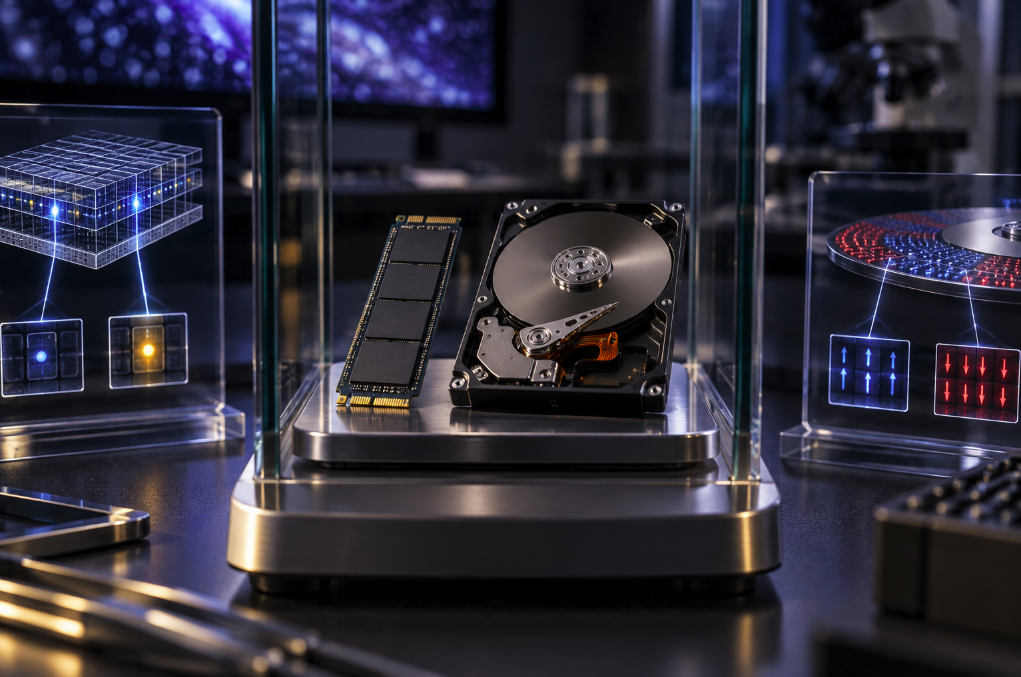
Suppose you buy a brand-new one-terabyte SSD and place it on an impossibly precise scale. Then you fill every available byte with photographs, films, documents and music. Has the drive become heavier?
It sounds like a joke about the digital age, but the question leads straight into some surprisingly deep physics. Information may feel abstract, yet every bit stored by a real computer must be represented by a physical state. Changing those states can change the energy of the storage device, and because energy and mass are related by Einstein's E = mc², different stored states can in principle correspond to extraordinarily tiny differences in mass.
But the popular answer — “yes, because a full drive contains more electrons” — is much too simple. An SSD and a magnetic hard disk store data in fundamentally different ways, and even the idea that information itself possesses a universal mass remains scientifically disputed.
An SSD does not fill up like a bucket
The word “full” encourages the wrong mental picture. Saving 500 gigabytes does not pour a physical substance called data into empty space inside the computer.
An SSD stores information by changing electrical states in enormous arrays of flash-memory cells. As IBM's explanation of flash storage describes, flash cells use transistor structures capable of retaining electrical charge even when power is removed. Electrons trapped in an insulated region alter the transistor's electrical behavior, allowing circuitry to distinguish stored states later.
Introductory descriptions often simplify this into an empty cell representing one binary value and a charged cell representing the other. That is a useful starting point, and the Open University describes the basic mechanism in similar terms.
Modern NAND flash is more complicated. A cell may represent more than one bit by distinguishing among several charge or threshold-voltage levels. TLC NAND, for example, stores three bits per cell, while QLC stores four. The electronics are therefore interpreting physical states rather than assigning one particular electron to each digital bit.
Writing different patterns can alter the distribution of charge and stored electrostatic energy inside the device. Electrons certainly have mass, but it is misleading to imagine that every file simply adds a fixed number of new electrons to the total SSD. Programming flash involves moving charge within an electrical system, and the drive as a whole remains essentially electrically neutral.
A hard disk plays an entirely different game
A traditional hard disk demonstrates why there cannot be one simple “grams per gigabyte” rule.
Hard disks encode bits in tiny magnetic regions on rotating platters. A write head changes the magnetic orientation of those regions, while a read head detects the resulting patterns. Filling the disk therefore means rearranging magnetic states that already exist in its material, not loading the platter with a pile of extra particles.
Different magnetic configurations can have slightly different energies. Under mass-energy equivalence, a difference in stored energy corresponds to a difference in mass. But that difference depends on the physical implementation and state of the device, not on whether a human considers one collection of bits a “full folder” and another an “empty folder.”
This reveals a key distinction: information is not the same thing as its physical representation.
The binary sequence 01000001 can be represented by magnetic orientations on a disk, charge states in flash, voltages in a circuit, holes in a punched card or ink marks on paper. It is the same abstract information, but the physical systems carrying it have completely different masses and energies.
So does information itself have mass?
This is where a playful computer question turns into a real scientific debate.
Rolf Landauer famously connected information processing with thermodynamics in 1961. The principle bearing his name establishes a minimum energetic cost associated with logically irreversible operations such as erasing information. At temperature T, erasing one bit has a theoretical minimum heat dissipation of kT ln 2, where k is Boltzmann's constant.
Landauer's principle is often summarized with the phrase “information is physical.” But it does not automatically follow that each abstract bit is a tiny object carrying a fixed rest mass.
In 2019, physicist Melvin Vopson proposed a stronger idea called the mass-energy-information equivalence principle. His paper assigned an equivalent mass of about 3.19 × 10−38 kilograms to a bit at room temperature and predicted that a one-terabyte storage device could differ by roughly 2.5 × 10⁻²⁵ kilograms between informational states.
That is spectacularly small. A picogram is 10−15 kilograms, so the proposed one-terabyte effect is about ten billion times smaller than a picogram.
More importantly, this is not an experimentally established universal weight of digital information. It is a proposed interpretation, and it has attracted substantial criticism.
Why physicists disagree about the “mass of a bit”
Critics argue that Landauer's thermodynamic bound concerns physical processes involved in information manipulation, particularly logical irreversibility, rather than proving that an abstract stored bit possesses a universal mass.
A 2024 review of the Landauer bound notes both the proposed mass-per-bit interpretation and the criticisms surrounding it. Another 2024 paper in Entropy, “On the Supposed Mass of Entropy and That of Information,” argues directly against treating information as a material entity with its own mass.
There is an intuitive reason for the objection. Imagine 256 physical coins on a table. Heads represents 1 and tails represents 0. By flipping the coins, you can store different 256-bit messages without adding or removing any coins at all. The information changes while the ordinary rest mass of the physical carrier remains essentially the same.
Now replace the coins with cups and represent 1 by adding water. Suddenly different bit patterns really do have different masses. The abstract information system is similar, but its physical implementation is not.
Computers work the same way in principle. Data must have a physical representation, but the physical consequences depend on how that representation is built.
Could any scale actually detect the difference?
Not for an ordinary computer.
The mass changes under discussion are fantastically smaller than the fluctuations that would swamp a real measurement. Dust settling on the case, moisture in the air, thermal expansion, a fingerprint, evaporation of contamination, tiny temperature changes and ordinary experimental vibration would all be enormous by comparison.
Even temperature matters because a warmer object contains more internal energy and therefore, in the strict relativistic sense, slightly more mass than the same object when cooler. Running an SSD while writing terabytes of data produces heat whose physical effects are vastly easier to observe than any hypothesized mass difference associated with the final logical contents.
This makes the everyday answer wonderfully simple: you cannot make your laptop noticeably heavier by downloading movies, and deleting files will not make your backpack lighter.
What “full” really means
There is another twist. A drive reported as empty by an operating system is not physically blank. Deleting a file often means changing metadata so that its storage locations can be reused. Depending on the device and operating system, the old physical states may persist temporarily until garbage collection, TRIM operations or later writes alter them.
Likewise, two SSDs that both report 100 percent capacity can contain completely different physical charge patterns because the underlying encoding, wear leveling, error correction and spare cells are managed internally by the controller.
“Full” is therefore largely a logical statement about available storage addresses, not a simple physical state in which every microscopic cell has been filled with matter.
So does a computer gain weight when you fill its storage? The most defensible answer is that changing stored data changes physical states, and different physical states can have minuscule differences in energy and therefore mass. In flash memory, charge configurations are involved; in hard disks, magnetic configurations are involved. But there is no universal amount of mass added per file, gigabyte or binary 1.
And whether information itself should be said to possess an intrinsic mass is a separate, contested question — not a settled consequence of storing electrons in an SSD.
Your terabyte of photographs is physically real because something in the machine must encode it. It just does not sit inside the drive like a microscopic pile of cargo. The fascinating part is not that data “weighs” a certain number of grams. It is that every apparently abstract bit ultimately has to become physics somewhere.