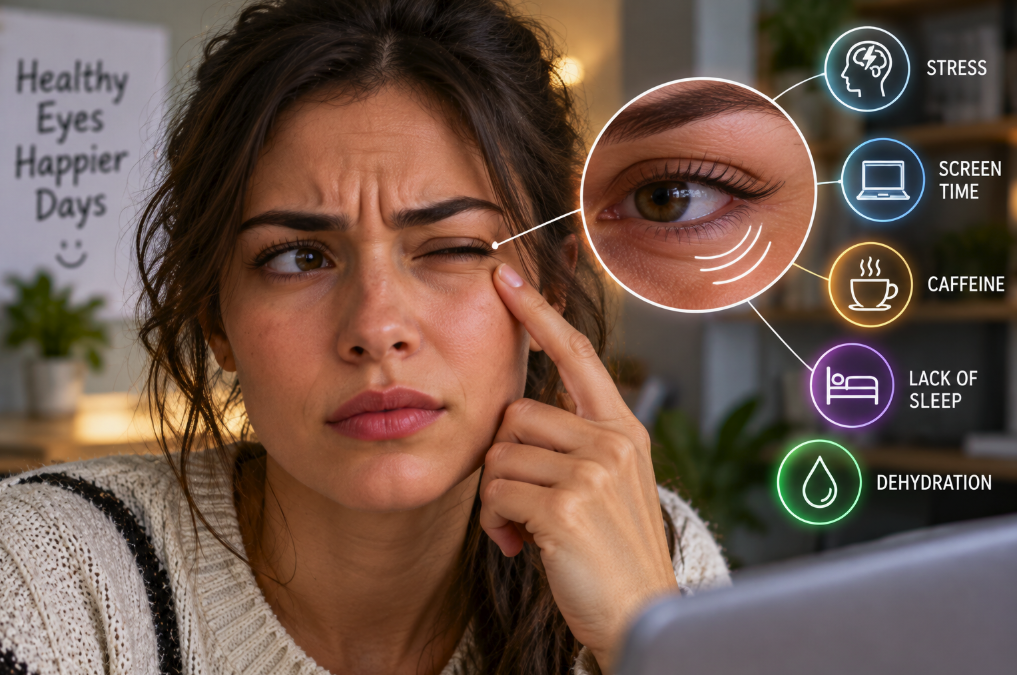
You are reading an email, driving home or trying to fall asleep when one eyelid begins to flutter. It stops. Ten minutes later it starts again. By the third day, a tiny muscle movement that nobody else can even see has become remarkably good at occupying your attention.
The reassuring news is that the most common form of eyelid twitching is usually harmless. Doctors call it eyelid myokymia: a fine, involuntary contraction of the muscle around the eye, often affecting just one upper or lower eyelid. It may last seconds at a time, recur over hours or days and then disappear as mysteriously as it arrived.
Stress, tiredness, caffeine and eye strain are among the familiar triggers. That combination also explains why eyelid twitching feels so characteristic of modern life: the person staring at a laptop after too little sleep with a large coffee beside them has assembled several possible triggers at once.
What is actually twitching?
Despite the phrase “my eye is twitching,” the eyeball itself usually is not the problem. In common eyelid myokymia, small involuntary contractions occur in the orbicularis oculi, the muscle involved in closing the eyelids. The movement can feel dramatic to the person experiencing it even when it is barely visible to anyone watching.
Mayo Clinic describes myokymia as the most common type of eye twitch and notes that it usually affects one eye at a time. Either eyelid can be involved. The spasms can be subtle or irritating and may recur for hours, days or longer before settling down.
The exact biological trigger is not always identifiable. In many cases there is no underlying disease to find. Instead, the twitch appears during a period when the nervous system and eye muscles are being pushed by some combination of fatigue, stimulation and irritation.
Stress and lack of sleep are classic triggers
Stress is one of the most commonly reported associations with eyelid myokymia. That does not mean an eye twitch proves that someone has an anxiety disorder, nor does it mean the symptom is “imaginary.” Stress produces real physiological changes in muscle tension, arousal and nervous-system activity, and involuntary muscle movements can become more noticeable during stressful periods.
Fatigue is another frequent trigger. A few late nights, a demanding work deadline or disrupted sleep can be enough to coincide with the appearance of a twitch. This is one reason the first advice for an otherwise ordinary eyelid flutter is often wonderfully unglamorous: sleep more and give it time.
There is also a feedback loop. The twitch begins, the person worries about it, then starts monitoring the eyelid constantly. Every small contraction becomes impossible to ignore, increasing anxiety about a symptom that stress itself may be helping to sustain.
Yes, your coffee may be involved
Caffeine is a stimulant, and excessive intake is a recognized trigger for eyelid twitching. The relevant amount is not identical for everyone. A person who rarely drinks coffee may react differently from someone accustomed to several cups a day, and caffeine can also arrive through tea, cola, energy drinks, chocolate and some medications.
This does not mean everyone with a twitching eyelid needs to abandon coffee. If the symptom appeared during a period of unusually high caffeine consumption, reducing intake for a while is a reasonable experiment. Mayo Clinic specifically lists decreased caffeine, along with rest and stress relief, among measures that often accompany improvement.
Alcohol, nicotine, bright light, wind and irritation of the eye surface are also reported triggers. Sometimes the explanation is not one dramatic cause but several small factors accumulating at the same time.
What do screens have to do with it?
Long periods in front of computers and phones are commonly associated with eye strain, and prolonged screen time is listed as a risk factor for eyelid myokymia in the American Academy of Ophthalmology’s EyeWiki. The sensible interpretation is not that a phone is secretly damaging the eyelid nerve every time you scroll. Rather, intensive screen use can contribute to visual fatigue and can accompany reduced blinking, dry or irritated eyes, long working hours and insufficient rest.
If a twitch tends to appear after marathon screen sessions, changing the conditions is more useful than panicking about the display itself. Regular visual breaks, comfortable lighting and dealing with persistent dry-eye symptoms can reduce the strain surrounding prolonged computer work. A poorly corrected vision problem can also make sustained near work more tiring, which is another reason persistent eye discomfort deserves a proper eye examination rather than endless self-diagnosis.
When an eye twitch is not ordinary myokymia
Not every involuntary movement around the eye is the same condition. Benign essential blepharospasm is an uncommon movement disorder in which both eyes may blink excessively or close involuntarily. It can become severe enough to interfere with vision and daily activities. Its underlying mechanism is different from the fleeting eyelid flutter most people experience.
Hemifacial spasm is different again. It typically affects muscles on one side of the face and often begins around one eye before spreading toward the cheek or mouth. Mayo Clinic notes that it is commonly caused by a blood vessel pressing on the facial nerve. A twitch that is spreading through one side of the face therefore deserves medical assessment rather than being casually blamed on an extra espresso.
Neurological disorders can occasionally include eyelid or facial twitching, but this is an important place to keep risk in perspective. Mayo Clinic notes that when eye twitching is associated with brain or nervous-system disorders, other signs and symptoms are almost always present. An isolated, fine eyelid flutter is far more commonly the benign variety than a sign of a serious neurological disease.
When should you see a doctor?
Most ordinary eyelid twitches settle without treatment. According to Mayo Clinic’s current guidance on eye twitching, it is sensible to arrange a medical evaluation if the twitch does not disappear within a few weeks, if the eyelid completely closes with each contraction, if opening the eye becomes difficult, or if the affected area feels weak or stiff.
Other reasons to seek assessment include twitching that spreads to other parts of the face or body, a drooping eyelid, or an eye that becomes red, swollen or produces discharge. Sudden changes in vision, severe eye pain or significant neurological symptoms are different from a routine twitch and should be evaluated promptly.
The point is not to turn every flutter into an emergency. It is to notice when the pattern stops behaving like common myokymia. A brief intermittent twitch in one eyelid during a stressful, sleep-deprived week is one pattern; persistent forced eye closure or spasms spreading across the face are another.
What can you do about an ordinary twitch?
There is no dramatic home cure because ordinary eyelid myokymia usually resolves on its own. The practical approach is to look for obvious triggers. Catch up on sleep. Reduce excessive caffeine for a while. Give your eyes breaks during prolonged screen work. If the eyes feel persistently dry or irritated, address that with appropriate professional advice rather than repeatedly rubbing them.
It can also help to stop checking the eyelid every few minutes. The sensation often feels much stronger from inside the face than it looks from outside, and constant monitoring makes a minor involuntary movement seem like the central event of the day.
That is perhaps why eye twitching generates so much anxiety. It is involuntary, repetitive and located next to one of our most valued senses, so the brain naturally treats it as worthy of attention. Most of the time, however, the message is less mysterious than it feels. Your eyelid may simply be reacting to a familiar collection of modern pressures: too little sleep, too much stimulation, irritated eyes and a nervous system asking for a quieter day.