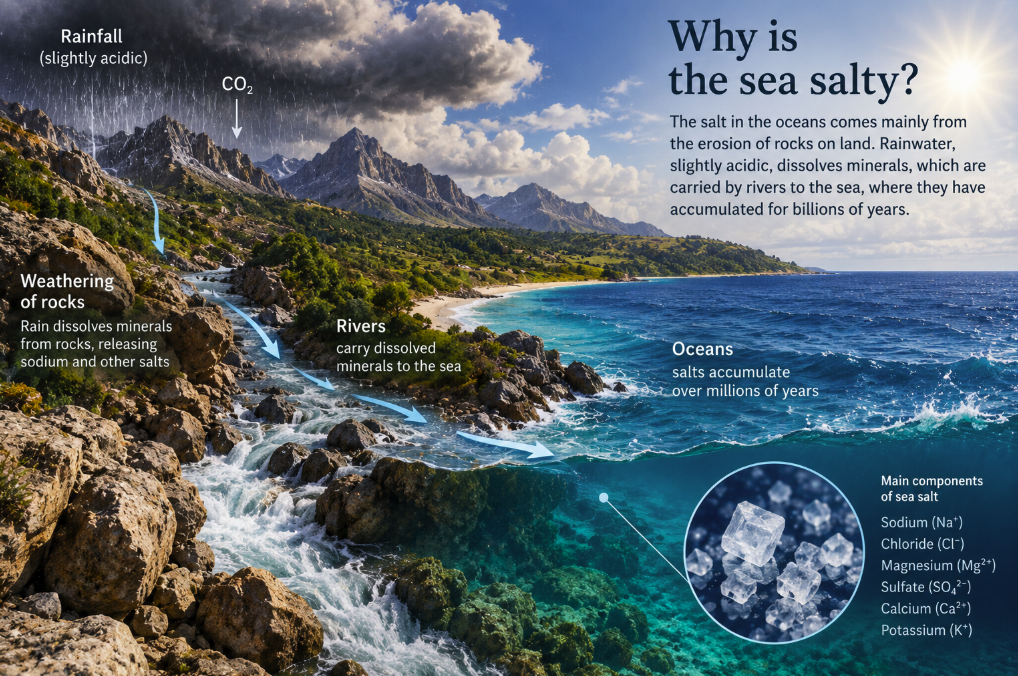
Taste a drop of seawater and the answer seems obvious: the ocean contains salt. The more interesting question is how it got there. There are no gigantic salt deposits steadily dissolving into every sea, and most rivers taste fresh even though they continually empty into the ocean. Yet average seawater contains about 35 grams of dissolved salts per kilogram of water.
The explanation is a planetary process that has operated for billions of years. Rain falls on continents, reacts with rocks and frees electrically charged atoms and molecules called ions. Streams and rivers carry some of those dissolved substances toward the sea. Once there, water can evaporate and return to the atmosphere, but most of the dissolved salts remain behind. Over geological time, the oceans have become one of Earth’s great chemical reservoirs.
The journey begins with rain and rock
Natural rainwater is slightly acidic even in an atmosphere free of industrial pollution. As water interacts with carbon dioxide in the air and soil, some of that gas dissolves and forms weak carbonic acid. The effect is mild, but over immense spans of time it helps water chemically attack minerals in exposed rocks.
This process, known as chemical weathering, releases dissolved ions. Water moving through soils, fractures and river systems then carries them downhill. Sodium, calcium, potassium, magnesium and many other substances ultimately reach lakes and oceans.
The U.S. National Oceanic and Atmospheric Administration identifies weathering of rocks on land as one of the principal sources of the salts found in seawater. The U.S. Geological Survey describes the same cycle: precipitation falls on land, weathering releases dissolved material and rivers transport it toward the ocean.
The process is extraordinarily slow from a human perspective. A river may contain only a tiny concentration of dissolved salts, far too little for us to perceive as strongly salty. But rivers have been delivering dissolved material to the oceans over geological timescales.
Why are rivers not salty too?
If rivers carry salt to the sea, it seems reasonable to ask why river water usually tastes fresh. The answer is partly concentration and partly the water cycle.
Rivers are continuously supplied by rain, snowmelt and groundwater. Their water moves through the landscape and eventually reaches the sea, carrying relatively small concentrations of dissolved ions with it. The ocean is different because much of the water that arrives eventually leaves again through evaporation.
When sunlight causes seawater to evaporate, water molecules enter the atmosphere while sodium, chloride and most other dissolved ions stay behind. The resulting water vapor later forms clouds and precipitation, beginning another journey across the continents.
The global water cycle therefore acts somewhat like a vast distillation system. Water evaporates from the sea, falls on land, interacts with rock, collects dissolved material and returns through rivers. The water can escape the ocean again as vapor; the salts generally cannot leave by evaporation.
Sea salt is more than sodium chloride
The word “salt” usually makes us think of sodium chloride, the familiar crystals used in cooking. Seawater contains a much richer mixture of dissolved ions.
Sodium and chloride dominate, together accounting for roughly 85 percent of the dissolved ions in seawater. Other important components include magnesium, sulfate, calcium and potassium. These substances have different geological sources and behave differently once they enter the ocean.
Some ions are readily taken up by organisms, incorporated into shells, trapped in sediments or used in chemical reactions. Sodium and chloride remain dissolved particularly efficiently and have long residence times in seawater. Over geological history, that persistence has helped make them the dominant ingredients of the ocean’s salty taste.
Average ocean salinity is about 35 parts per thousand, but it is not identical everywhere. Regions with intense evaporation tend to become saltier. Heavy rainfall, large rivers and melting ice can dilute surface waters. When sea ice forms, much of its salt is excluded from the ice and left behind in the surrounding water, increasing local salinity.
The seafloor changes ocean chemistry too
The continents are only part of the story. The deep ocean floor is chemically active, particularly around mid-ocean ridges where tectonic plates separate and new crust forms.
Seawater can penetrate cracks in hot oceanic rock, circulate underground and undergo chemical reactions before emerging again through hydrothermal vents. At great depth, intense pressure allows this water to reach temperatures of hundreds of degrees Celsius without boiling in the way it would at the surface.
During its journey through the crust, the water exchanges chemicals with the surrounding rock. Some substances are removed from seawater while others are added. When the hot, mineral-rich fluid emerges into the cold deep ocean, dissolved materials can precipitate and build the spectacular structures known as black smokers and white smokers.
NOAA’s description of hydrothermal vents explains how seawater-rock interactions at the seafloor contribute to this continuing exchange. Submarine volcanism and other geological processes also influence the chemistry of the oceans.
The ocean is therefore not simply a basin receiving minerals from rivers. It is part of an active geological system connected to both the continents and Earth’s crust beneath the sea.
Why doesn’t the ocean become saltier forever?
This leads to another puzzle. If rivers have been carrying dissolved minerals into the sea for billions of years, why has the ocean not become an impossibly concentrated brine?
The reason is that salts have exits as well as entrances.
Marine organisms extract dissolved substances from seawater to build shells and skeletons. Chemical reactions create new minerals. Particles settle onto the seafloor and become buried in sediments. Hydrothermal circulation can remove certain ions as water reacts with oceanic crust. Over longer geological cycles, plate tectonics carries marine sediments back into Earth’s interior.
Sea spray can even return small quantities of marine salts to the atmosphere and continents.
The modern ocean therefore reflects a dynamic balance between chemical inputs and outputs. It is not simply becoming steadily saltier at the rate suggested by the amount delivered by rivers each year. Over geological time, ocean chemistry has changed as climates, continents, biological activity and tectonic processes changed, but many major dissolved components are now regulated by long-term cycles.
Were the first oceans salty?
Earth’s oceans are ancient, but they did not necessarily begin with the same chemical composition they have today. As the young planet cooled, water accumulated at the surface while volcanic activity, newly formed crust and the early atmosphere interacted with it.
The chemistry of those early seas evolved over immense periods. Weathering supplied material from emerging continents, hydrothermal systems exchanged chemicals with the oceanic crust, and eventually living organisms became major participants in marine chemistry.
Modern seawater is therefore the result of billions of years of interaction among the atmosphere, rocks, oceans and life. Its familiar taste is a chemical record of Earth history.
Salt helps move the oceans
Salinity is not merely a curiosity. Dissolved salt changes the physical properties of seawater, including its density and freezing point. Together with temperature, salinity helps determine whether a mass of seawater rises, sinks or remains at a particular depth.
Cold, salty water is relatively dense and can sink into the deep ocean. Differences in temperature and salinity contribute to large-scale ocean circulation, which redistributes heat, oxygen, nutrients and carbon around the planet.
Scientists therefore monitor salinity from ships, autonomous instruments and satellites. Variations can reveal changes in evaporation, precipitation, river discharge and ice formation or melting. Something as simple as how salty a patch of ocean is can provide information about the global water cycle and climate system.
The salt left on your skin after swimming has travelled through a story far older than humanity. Some of its atoms were once locked inside continental rocks. Water and carbon dioxide helped release them, rivers transported them and ocean currents mixed them across enormous distances. Other components were altered through reactions deep beneath the waves.
The sea is salty not because it was seasoned once in the distant past, but because Earth is continuously weathering, dissolving, transporting and recycling its own materials. Every wave carries a small chemical trace of that planetary history.