It is one of those questions that sounds almost too simple to deserve a scientific explanation. Look up on a clear afternoon and the sky is blue. Yet that familiar color is the visible result of sunlight colliding with molecules thousands of times smaller than the wavelengths our eyes can see.
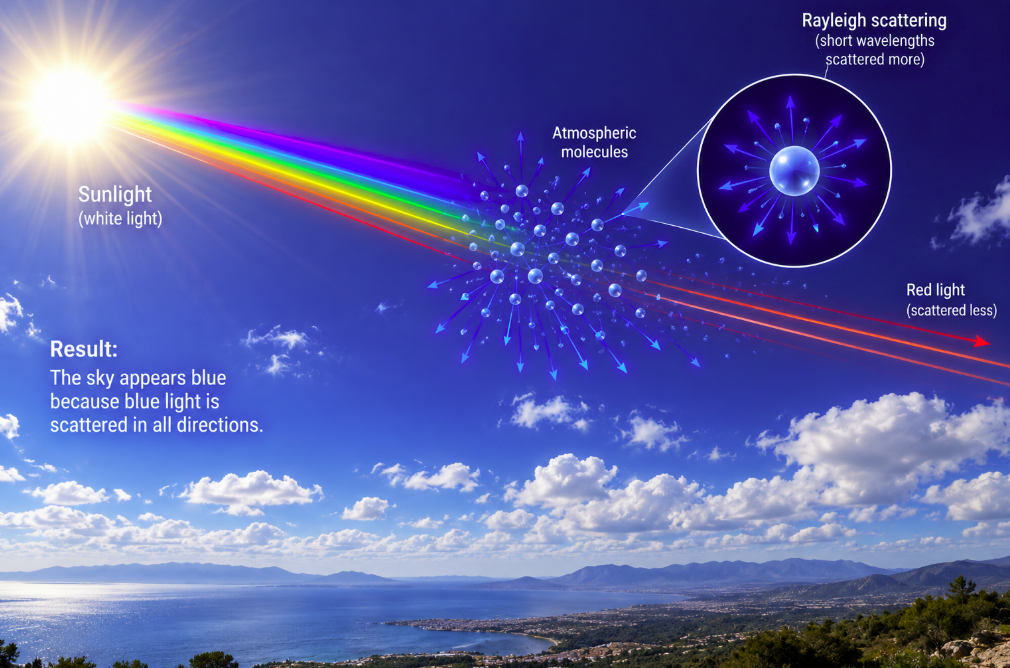
The key is a phenomenon called Rayleigh scattering. Sunlight may look white, but it contains a spectrum of visible wavelengths, from relatively long red waves to shorter blue and violet ones. When that light enters Earth's atmosphere, molecules of nitrogen and oxygen scatter the shorter wavelengths much more efficiently than the longer ones. Blue light is therefore redirected across the sky and reaches our eyes from every direction.
That is the short answer. The more interesting answer explains why the sky is blue rather than violet, why sunsets reverse the color scheme, why clouds are white and why a world with a different atmosphere can have an entirely different-looking sky.
White sunlight contains a rainbow
Visible sunlight is a mixture of wavelengths. A prism makes this obvious by separating white light into the familiar colors of a rainbow. Red occupies the longer-wavelength end of the visible spectrum, while blue and violet have shorter wavelengths.
When sunlight reaches the atmosphere, it encounters gas molecules that are far smaller than visible wavelengths. Under these conditions, scattering is strongly dependent on wavelength. In the idealized Rayleigh regime, the intensity of scattering varies approximately as 1/λ4, where λ is wavelength. That fourth-power relationship is why a modest difference in wavelength produces a dramatic difference in scattering.
NASA's current science glossary notes that air molecules are about a thousand times smaller than visible-light wavelengths and scatter blue light about four times more strongly than red light. NOAA likewise explains that the molecules of Earth's atmosphere preferentially redirect short-wavelength radiation.
Imagine a beam of sunlight entering the atmosphere above you. Much of its longer-wavelength red, orange and yellow light continues approximately along the original direction. A larger fraction of its blue and violet light is scattered sideways, backward and forward by air molecules. Those scattered photons can then arrive at your eyes even when you are looking nowhere near the Sun. The atmosphere itself appears illuminated in blue.
Then why isn't the sky violet?
This is the part often missing from the textbook answer. Violet has an even shorter wavelength than blue, so Rayleigh scattering should affect it more strongly. If shorter wavelength were the only consideration, we might expect a violet sky.
Several effects intervene. Human vision is much less sensitive to violet than to blue under daylight conditions. The Sun's visible output is also not equally intense at every wavelength by the time it reaches us, and some ultraviolet and short-wavelength radiation is absorbed in the upper atmosphere. The combined spectrum of scattered sunlight, filtered through both the atmosphere and the response of our eyes, is perceived predominantly as blue.
NASA's explanation of light scattering explicitly notes this distinction: blue and violet wavelengths are both preferentially scattered, but our eyes are more sensitive to blue. NOAA gives the same basic explanation.
So the color of the sky is not simply a property of air. It is the product of three things working together: the spectrum emitted by the Sun, the physics of Earth's atmosphere and the biology of human vision.
Why sunsets turn red
The same mechanism that makes noon skies blue creates red sunsets. When the Sun is high overhead, its light takes a comparatively short route through the atmosphere before reaching an observer. Near sunrise or sunset, sunlight arrives at a shallow angle and must travel through a much longer atmospheric path.
Along that extended journey, blue and violet wavelengths are repeatedly scattered away from the direct beam. What remains traveling toward your eyes is enriched in longer wavelengths — especially orange and red. The Sun itself can therefore appear yellow, orange or deep red, while the surrounding horizon glows with warm colors.
Particles larger than ordinary gas molecules complicate the picture. Dust, smoke, sea salt, pollution and tiny water droplets are aerosols, and their scattering behavior differs from pure Rayleigh scattering. Depending on their size and concentration, they can whiten the sky, deepen a sunset or produce unusual colors. This is one reason no two sunsets look exactly alike.
The geometry also explains why the sky near the horizon often looks paler than the deep blue directly overhead. Light arriving from near the horizon has traveled through more atmosphere and undergone more scattering events. Colors become mixed and the resulting light tends toward a washed-out blue or white.
Why clouds are white instead
If atmospheric scattering favors blue, why are clouds usually white? The droplets and ice crystals inside clouds are vastly larger than individual nitrogen and oxygen molecules. Their interaction with visible light is therefore governed by a different scattering regime, commonly associated with Mie scattering and more complex optical effects.
Cloud droplets scatter visible wavelengths much more evenly. Red, green and blue light remain mixed, and our eyes perceive the combination as white or gray. Thick clouds can appear dark because less sunlight makes it through the entire cloud to the observer below, not because the water itself has turned black.
Other planets do not have to have blue skies
A blue daytime sky is not a universal feature of planets. It depends on atmospheric composition, density and the particles suspended in the air, as well as the spectrum of the star illuminating the planet.
Mars provides a striking counterexample. Its thin carbon-dioxide atmosphere contains abundant fine dust. NASA spacecraft have photographed a generally reddish or butterscotch daytime sky, while sunsets around the Sun can appear blue. Martian dust interacts with light differently from Earth's comparatively clean molecular atmosphere, producing almost the visual inverse of the familiar terrestrial scene.
A world without a substantial atmosphere behaves differently again. From the Moon, the sky is black even during daytime because there is essentially no atmosphere to scatter sunlight across the sky. The Sun can blaze overhead while the surrounding sky remains dark.
This simple contrast reveals something profound about Earth's color. The blue above us is not a blue ceiling, nor is space itself blue. We are looking through an illuminated atmosphere.
Every patch of clear blue sky is sunlight arriving indirectly. Photons left the Sun, crossed roughly 150 million kilometers of space, entered Earth's atmosphere and were redirected by molecules of air before reaching your eyes. The sky's most ordinary color is therefore evidence of a microscopic interaction taking place across an entire planet — a daily demonstration of physics so familiar that it is easy to forget how remarkable it is.