The sky is so reliably blue on a clear day that the color can feel like a property of the atmosphere itself, as though Earth were covered by an enormous blue ceiling. It is not. Air is essentially transparent over short distances, sunlight looks white, and outer space behind the atmosphere is black. The blue appears only when sunlight and Earth's atmosphere interact.
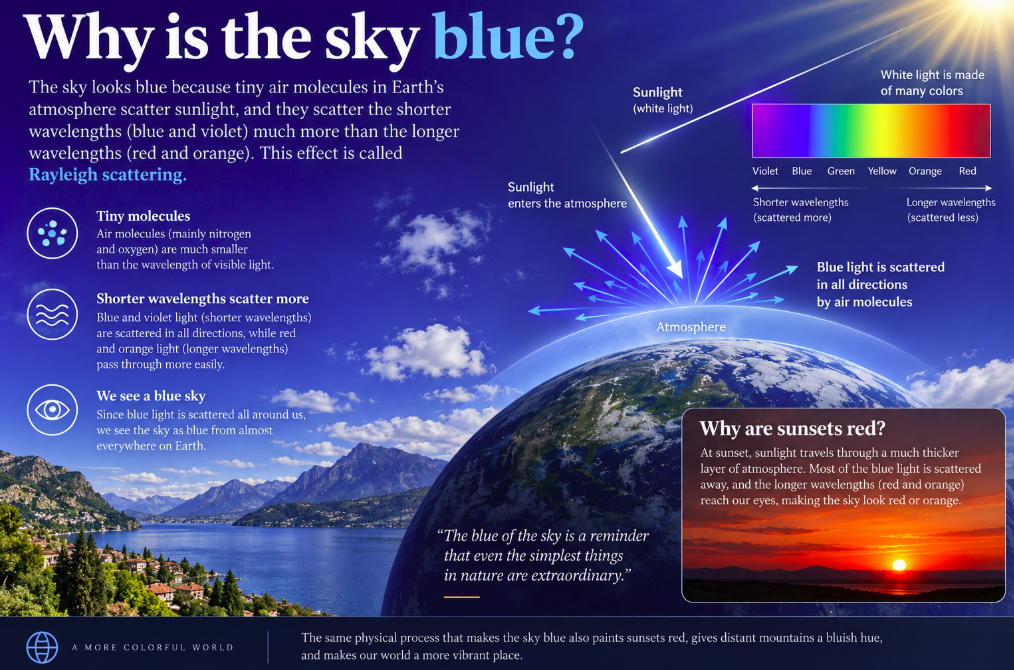
The main mechanism is called Rayleigh scattering. Tiny molecules in the air scatter shorter wavelengths of visible light much more strongly than longer wavelengths. Blue and violet light are therefore redirected across the sky far more efficiently than red and orange light. When you look away from the Sun on a clear day, much of the light reaching your eyes has taken this scattered route — and you perceive the sky as blue.
That familiar answer is correct, but it creates an immediate puzzle. Violet has an even shorter wavelength than blue, so Rayleigh scattering should affect violet more strongly. Why, then, isn't the sky violet?
White sunlight contains a rainbow
Sunlight looks white because visible sunlight contains a broad range of wavelengths that our visual system interprets together as white. A prism or a rainbow separates those wavelengths into the familiar sequence from violet and blue through green and yellow to orange and red.
Visible violet light has wavelengths near the short end of the spectrum, roughly around 400 nanometers, while red reaches toward 700 nanometers and beyond. Those tiny differences in wavelength have a surprisingly large effect when sunlight encounters the molecules of Earth's atmosphere.
Nitrogen and oxygen molecules are much smaller than the wavelengths of visible light. In this regime, scattering follows the physics associated with the 19th-century British scientist John William Strutt, better known as Lord Rayleigh. The strength of Rayleigh scattering varies approximately with the inverse fourth power of wavelength.
That fourth power is the crucial part. Halving a wavelength would not merely double the scattering; under the simplified relationship, it would make scattering 16 times stronger. Across the narrower range of visible light, the effect is still dramatic enough that blue wavelengths are scattered far more strongly than red ones.
As NASA's explanation of the blue sky describes it, sunlight entering Earth's atmosphere is scattered in all directions by gases and particles, with blue light scattered more strongly because of its shorter wavelength.
Imagine a beam of sunlight arriving from above. Much of the longer-wavelength light continues relatively directly through the atmosphere. Shorter wavelengths are more likely to be redirected by molecules. Some blue light that originally was not heading toward you gets scattered into your line of sight. Because air exists across the entire dome of sky, scattered blue light appears to arrive from almost every direction.
That is why the sky itself seems luminous. You are not looking at a blue object. You are looking through a vast volume of atmosphere that is continually redirecting sunlight toward your eyes.
Why isn't the sky violet?
This is where the one-sentence explanation becomes incomplete. Violet has a shorter wavelength than blue and is scattered even more efficiently. A simple statement that “the shortest wavelengths scatter most” might therefore lead you to predict a violet sky.
Human vision changes the answer. Our eyes contain cone cells with overlapping sensitivities to different portions of the visible spectrum, and we are considerably less sensitive to violet light than to blue-green wavelengths. The amount and spectrum of sunlight arriving at the atmosphere also matter, as does some absorption of short-wavelength light in the upper atmosphere.
NOAA notes that although both blue and violet are strongly scattered, our eyes are less sensitive to violet than to blue. The color we experience is the brain's interpretation of the entire scattered spectrum, not a meter reading that simply identifies whichever individual wavelength scattered most.
So Rayleigh scattering supplies the physical foundation, while the spectrum of sunlight, atmospheric transmission and human color vision help explain why the result looks blue rather than violet.
The same physics paints sunsets red
Once Rayleigh scattering explains a blue afternoon, it also explains one of nature's most dramatic color changes.
When the Sun is high in the sky, its light follows a comparatively short route through the atmosphere before reaching the ground. Near sunrise or sunset, sunlight arrives at a shallow angle and travels through a much longer atmospheric path.
Along that extended route, much more of the blue and violet light is scattered out of the direct beam. The light that continues toward an observer looking at the low Sun becomes richer in longer wavelengths — yellow, orange and red.
This is why the Sun can look orange or crimson near the horizon even though it appeared nearly white earlier in the day. The atmosphere has effectively removed much of the shorter-wavelength light from the direct line of sight.
Aerosols, dust, smoke and other larger particles can modify the colors further. The UCAR Center for Science Education explains that additional aerosols can increase scattering and help create especially colorful skies. This is one reason sunsets can change dramatically with atmospheric conditions.
The effect also explains why the sky near the horizon often looks pale blue or almost white during daytime. Light reaching your eyes from near the horizon has traveled through more atmosphere, undergoing repeated scattering that mixes colors and reduces the saturated blue appearance of the sky directly overhead.
Why are clouds white if the sky is blue?
Clouds provide another clue that the size of the scattering object matters.
Individual air molecules are far smaller than visible wavelengths, producing the strong wavelength dependence of Rayleigh scattering. Cloud droplets and ice crystals are much larger. They scatter visible wavelengths much more evenly, so red, green and blue light remain mixed. To human eyes, the result is usually white or gray rather than vivid blue.
The same distinction helps explain why haze can wash out a deep-blue sky. Larger aerosol particles scatter light differently from individual gas molecules, often spreading a broader mixture of wavelengths into your line of sight.
Climb to a high mountain or fly at high altitude and the sky overhead can appear a deeper, darker blue because there is less atmosphere above you to scatter sunlight. Continue upward beyond almost all of the atmosphere and the sky becomes black. Space contains no dense blanket of air molecules capable of scattering sunlight across your field of view.
That blackness provides perhaps the simplest proof that the blue does not belong to space or to sunlight itself. It is produced locally by the atmosphere.
Would the sky be blue on another planet?
Not necessarily. The color of a planet's sky depends on the composition and density of its atmosphere and on the size and nature of suspended particles.
Mars provides a striking counterexample. Fine dust suspended in its thin carbon-dioxide atmosphere makes the daytime Martian sky appear yellowish, tan or reddish in many images. Near sunset, however, the region around the Sun can become blue-gray — almost the reverse of the familiar terrestrial pattern.
NASA spacecraft have photographed this effect directly. Different atmospheric particles scatter and transmit wavelengths differently, so another world does not need to share Earth's palette.
Our blue sky is therefore not simply what an atmosphere looks like. It is the visible signature of a particular interaction between solar radiation, the molecules and particles surrounding Earth, and the biology of human vision.
So why is the sky blue? Because sunlight contains many wavelengths, and Earth's tiny atmospheric molecules scatter the shorter ones far more efficiently than the longer ones. Blue light is redirected toward us from across the sky, while our eyes and brains turn that scattered spectrum into the color we know as sky blue.
It is an ordinary sight produced by remarkably subtle physics. Every clear afternoon is, in effect, a planet-sized demonstration of how light interacts with matter — performed above our heads in full view.