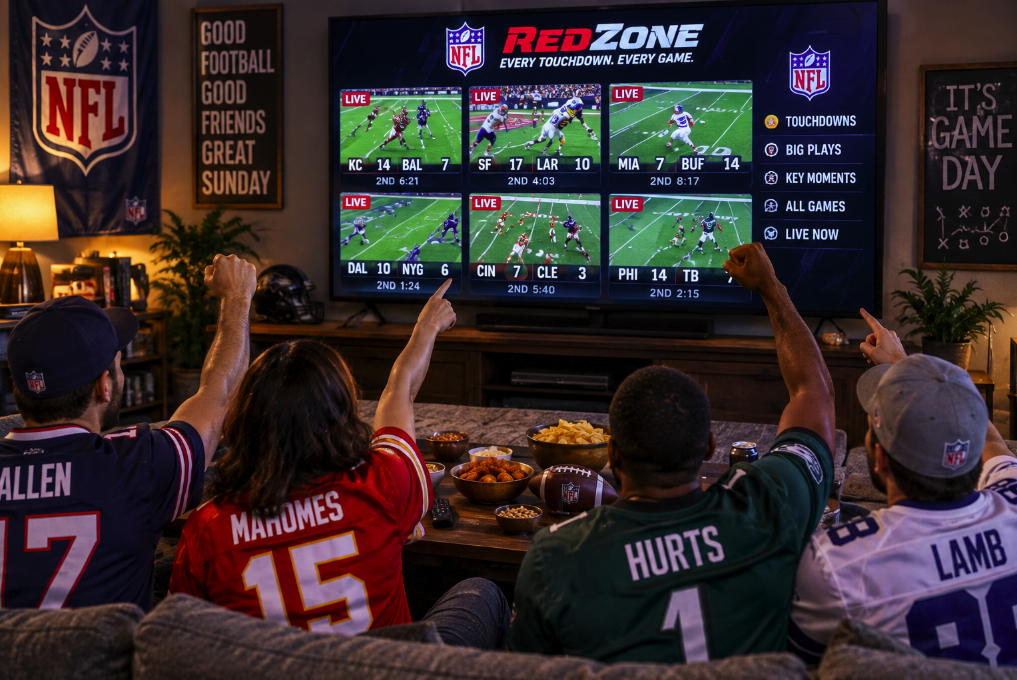
On an autumn Sunday in the United States, a peculiar national clock starts ticking shortly before 1 p.m. Eastern Time. Televisions switch on. Fantasy lineups receive one last nervous inspection. Phones fill with injury alerts. Sports bars become seas of jerseys. Then several NFL games begin almost simultaneously, and for the next seven hours millions of Americans follow a moving mosaic of touchdowns, interceptions, last-second field goals and score updates.
This is why searches for “NFL games today,” “NFL schedule” and “RedZone” surge when the season is underway. The National Football League is not simply presenting individual games. On Sundays it creates a synchronized weekly event, with most of the league playing inside a handful of concentrated television windows.
No product captures that experience more clearly than NFL RedZone, a channel designed for viewers who do not want to choose just one game.
What exactly is NFL RedZone?
NFL RedZone is a live Sunday-afternoon program that moves between NFL games as important plays develop. Rather than broadcasting one matchup from kickoff to the final whistle, it monitors the simultaneous early and late Sunday games and switches viewers to scoring opportunities, touchdowns, turnovers and other major moments.
The name comes from the football term red zone, generally the area between the opponent's 20-yard line and the goal line. Once an offense reaches that part of the field, the probability of a score becomes much more immediate—and RedZone traditionally treats it as a cue that something worth watching may be about to happen.
The NFL's current description calls the service seven hours of live football every Sunday afternoon during the regular season. It can show several games simultaneously and, at its busiest, use an “Octobox” layout containing as many as eight games on one screen.
Scott Hanson has hosted the NFL Network version since its inaugural season in 2009. His job is unusual even by live-television standards. Instead of guiding viewers through one contest, he narrates an afternoon in which several games may reach decisive moments at virtually the same time.
RedZone was built for the problem of too much football
Before RedZone, a fan watching Sunday football usually had a simple constraint: the local television market and national broadcast windows determined which games appeared on the main networks. Dedicated packages eventually made out-of-market games available, but watching several at once still required constant channel switching or multiple screens.
NFL Network announced RedZone in 2009 with an extremely clear promise: deliver the touchdowns and crucial moments from every Sunday-afternoon game. The channel debuted on September 13, 2009, the first Sunday of that regular season, with Hanson in the studio.
Its central innovation was editorial rather than technological. RedZone behaves almost like a live human algorithm. Producers monitor every game, decide which developing drive is most urgent and move the audience there. If two teams are about to score, the screen can split. If nothing important is happening in one game, viewers are transported to another. A touchdown missed during a switch can be replayed moments later.
The result eliminates much of football's natural downtime. A conventional NFL broadcast includes huddles, commercial breaks, reviews, timeouts and stretches in which field position changes without a score. RedZone compresses an entire league's Sunday afternoon into a continuous stream of consequence.
Why fantasy football made the format even more addictive
A traditional fan primarily cares whether one team wins. A fantasy-football player may care about a quarterback in Cincinnati, a receiver in Philadelphia, a running back in Houston and a tight end in Minnesota—all during the same afternoon.
That makes RedZone almost perfectly adapted to fantasy football. A touchdown in a game the viewer would otherwise never watch can suddenly determine a fantasy matchup. The NFL itself explicitly describes RedZone as a fantasy-football companion, and the program's rapid movement across games mirrors the way fantasy players experience the league: not as isolated contests, but as one enormous interconnected statistical event.
Sports betting has added another layer of simultaneous attention, although it is distinct from fantasy play. Point spreads, totals, player propositions and multi-game bets can make late scores in apparently decided games consequential to some viewers. The modern NFL Sunday therefore contains many overlapping narratives: team loyalty, fantasy performance, betting outcomes, playoff implications and simple entertainment.
A viewer no longer needs to support either team on the field to have a reason to care about the next play.
The Sunday schedule creates a national rhythm
The structure of the NFL schedule is a major reason game day feels so concentrated. Unlike baseball, basketball or hockey, which play many games across most days of their seasons, an NFL team plays only once per week in the regular season. Most games occur on Sunday, with additional showcase games typically appearing on Thursday and Monday nights and selected other windows.
Sunday afternoon is divided primarily into early and late kickoffs. The exact schedule changes every week, but the clustering means several games are often happening simultaneously. One national Sunday-night matchup then takes over in prime time.
This scarcity gives each game unusual weight. A baseball team can lose on Tuesday and play again Wednesday. An NFL defeat sits on the standings for an entire week. With a relatively short regular season, individual games can significantly affect playoff qualification and seeding.
For current matchups and kickoff times, the official NFL schedule remains the reliable source because games can be flexed or otherwise rescheduled as the season develops.
The television numbers explain the search traffic
The NFL's hold on American attention is not just cultural folklore. According to league-reported Nielsen figures, the 2025 NFL regular season averaged 18.7 million viewers per game across television and digital platforms. That was the second-highest regular-season average since comparable audience records began in 1988.
The biggest individual games operate at a different scale again. Holiday games and major national matchups can attract audiences more typical of enormous entertainment events than ordinary weekly television. The Super Bowl sits at the extreme end, but the league's strength comes from turning ordinary regular-season weekends into mass-viewing occasions for months.
That helps explain why search behavior becomes so intense on game days. Fans need information that expires quickly: Who plays today? What time is kickoff? Is a particular quarterback starting? What channel carries the game? How can RedZone be watched? What is the score? A search made two hours later may require a completely different answer.
Few forms of popular culture generate so many simultaneous questions with such short useful lifespans.
Why “the game of the day” keeps changing
There is rarely one objectively correct NFL “match of the day.” Before kickoff, the most anticipated game may be a rivalry, a meeting between elite quarterbacks or a rematch from the playoffs. Once play begins, an obscure matchup can become the afternoon's main attraction because it goes into overtime or produces an unexpected upset.
RedZone exploits precisely that uncertainty. It does not need to predict which game will be best. It can move toward whichever game becomes interesting in real time.
That is a subtle but important change in sports viewing. Traditional television asks the audience to select a program before knowing whether it will be exciting. RedZone selects moments after the action has begun. It treats the entire Sunday schedule as raw material for one giant live broadcast.
Why football fits this format better than almost any sport
American football is unusually compatible with rapid switching because plays are discrete. The ball is snapped, something happens, the play ends and the teams reset. A producer can leave one game between plays, show a touchdown elsewhere and return without necessarily destroying the viewer's ability to understand what is happening.
Scoring opportunities are also geographically legible. A team approaching the opponent's goal line is visibly close to a potential touchdown. The red zone therefore provides a natural editorial trigger.
Try the same approach with a continuously flowing sport and the cuts can feel much more disruptive. Football's stop-start structure, multiple simultaneous Sunday games and relatively infrequent scoring created ideal conditions for a channel whose purpose is to chase consequential moments.
From television program to Sunday ritual
RedZone's success says something larger about how sports consumption has changed. Fans increasingly follow highlights, statistics, notifications and multiple screens at once. Yet RedZone did not make live sports less important. It made the live moment more concentrated.
For some viewers, that intensity is the attraction; for others, it is exhausting. Watching one complete game provides tactics, tension and narrative rhythm that a highlights-driven format inevitably sacrifices. RedZone is excellent at answering “What is happening across the league?” but a single-team broadcast remains better at showing how and why a particular game is unfolding.
The two experiences coexist because they serve different kinds of attention. One asks you to inhabit a game. The other asks you to inhabit an entire Sunday.
And that is why, when the NFL season returns, America's search box begins filling with the same urgent phrases again: games today, kickoff time, scores, schedule, RedZone. They are not merely requests for information. They are signs that a weekly national ritual has started—and that somewhere, several teams are approaching the 20-yard line at exactly the same time.