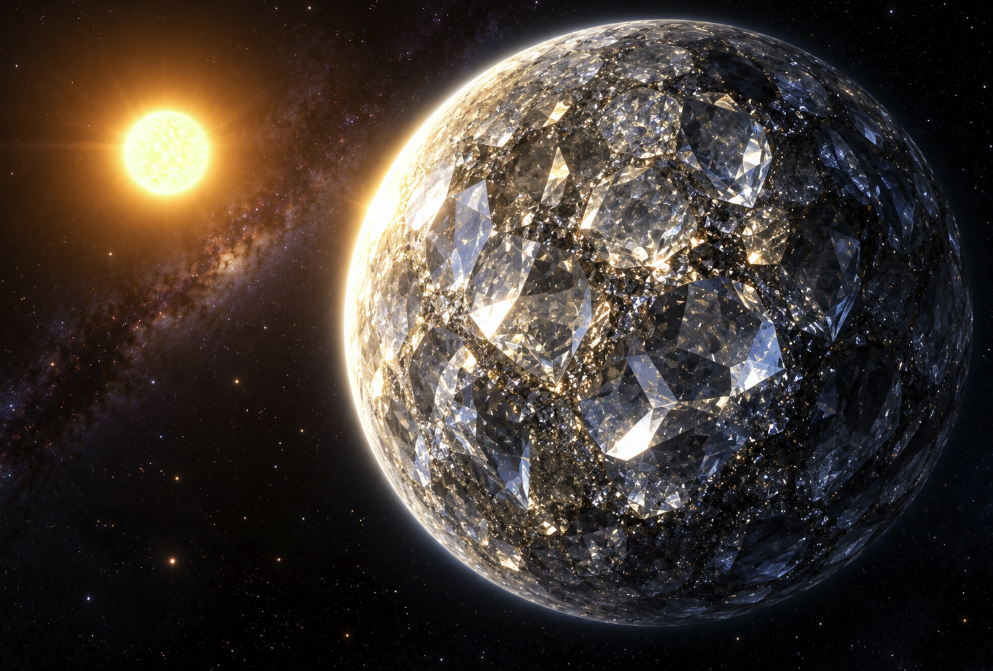
Few astronomical discoveries have produced a nickname as irresistible as the “diamond planet.” About 41 light-years away in the constellation Cancer, 55 Cancri e is a super-Earth nearly twice Earth's diameter and about eight times its mass. For more than a decade it has circulated through popular science as a world containing unimaginable quantities of diamond — perhaps several times the entire mass of Earth crystallized into the precious mineral.
The real story is both more cautious and, in some ways, more extraordinary. Astronomers have never visited 55 Cancri e, never photographed diamonds on its surface and never directly measured a diamond mantle. The famous claim came from a model of the planet's possible interior published in 2012. Since then, improved observations have transformed the picture. NASA now describes 55 Cancri e, also called Janssen, as an intensely hot rocky super-Earth whose surface is probably dominated by molten rock, while observations from the James Webb Space Telescope suggest it may even possess an atmosphere continually replenished by gases bubbling out of a magma ocean.
How a super-Earth became the “diamond planet”
55 Cancri e was discovered in 2004 orbiting the star 55 Cancri A, part of a nearby planetary system. It is an extreme world. NASA's current exoplanet catalog lists its mass at about 7.99 Earth masses and its radius at about 1.875 Earth radii. It completes an entire year in only around 0.7 Earth days — less than 18 hours.
The diamond idea took off in 2012, when a team led by Nikku Madhusudhan, then at Yale University, explored what the measured mass and radius might mean if the planet formed from carbon-rich material. Their model proposed a radically different interior from Earth's: carbon in forms including graphite and diamond, iron, silicon carbide and possibly silicates rather than a planet dominated by the oxygen-rich minerals familiar to terrestrial geology.
Under the immense pressures inside such a massive rocky planet, carbon can adopt the crystal structure of diamond. The researchers estimated that in one plausible interior model at least a third of the planet's mass could consist of diamond — roughly three Earth masses. Yale's announcement of the study described a possible surface rich in graphite over a thick diamond-bearing layer.
That is the origin of the extraordinary headlines. But there is an important distinction between “a model allows a large diamond-rich interior” and “astronomers have established that the planet is made mostly of diamond.” The latter goes far beyond what the observations demonstrated.
The diamond claim was never a photograph of the interior
For exoplanets such as 55 Cancri e, astronomers infer bulk properties from indirect measurements. The planet's gravitational effect on its star helps reveal its mass, while the amount of starlight blocked when it transits gives its radius. Combining mass and radius provides average density, but density alone does not uniquely reveal the ingredients inside a planet.
Different mixtures of iron, silicate rock, carbon compounds and volatile materials can sometimes reproduce similar bulk measurements. Interior models therefore depend on assumptions about chemistry and the composition of the host star. The 2012 diamond-rich interpretation was scientifically interesting precisely because it showed that rocky exoplanets might have chemistries radically unlike Earth's, not because astronomers had detected a planetary gemstone directly.
Even NASA's own public material reflects the evolving interpretation. An older NASA Ames feature discussed 55 Cancri e as a likely diamond planet and repeated the estimate that as much as one-third of its mass might be diamond. More recent NASA descriptions are notably different, focusing on a hot rocky planet, molten surface and possible atmosphere.
Webb found a world of magma and gas
The James Webb Space Telescope has now provided some of the most revealing observations yet. In 2024, NASA reported that Webb's NIRCam and MIRI instruments had found evidence consistent with atmospheric gases around 55 Cancri e. If confirmed, it would represent some of the strongest evidence for an atmosphere surrounding a rocky exoplanet beyond our Solar System.
The planet orbits only about 2.3 million kilometers from its star, roughly one twenty-fifth of Mercury's distance from the Sun. At that proximity, its dayside is hellishly hot. Webb measured a dayside temperature of about 1,540 degrees Celsius, according to NASA's report on the observations. The surface is thought to be at least partly, and perhaps globally, molten.
Intriguingly, that measured temperature was cooler than researchers expected for a bare dark rock with essentially no atmosphere. Webb's near-infrared observations also showed a spectral feature consistent with carbon monoxide or carbon dioxide. Together, the measurements suggest that an atmosphere rich in volatile gases may be moving heat from the dayside toward the nightside.
Such an atmosphere would itself face brutal conditions. The planet is bombarded by intense stellar radiation, so researchers expect any primordial atmosphere from the planet's youth to have disappeared long ago. One possibility is that the atmosphere observed today is secondary: gases dissolved in the molten interior escape from the magma, continually rebuilding a blanket above the surface even as material is lost to space.
Could diamonds still exist deep inside?
Nothing about the newer observations means that diamond is impossible inside 55 Cancri e. At sufficiently high pressures, carbon-rich material can form diamond, and the planet's interior reaches pressures far beyond those at Earth's surface. What has changed is the level of certainty scientists can reasonably attach to a carbon-dominated model.
The safest description today is therefore not “a planet made of diamonds.” It is an ultra-hot super-Earth whose exact internal composition remains uncertain. A diamond-rich interior is one historically important hypothesis, while modern observations are increasingly revealing its surface and atmospheric environment.
There is also an ironic problem with imagining 55 Cancri e as a glittering jewel floating in space. Even if enormous amounts of diamond exist at depth, the visible planet would not necessarily resemble a polished gemstone. Its outer environment may instead be dominated by incandescent molten rock, mineral vapor and a turbulent atmosphere containing carbon-bearing gases. NASA's Webb artwork depicts a glowing rocky world rather than a faceted crystal sphere.
That makes 55 Cancri e a useful lesson in how exoplanet science works. A memorable interpretation can become famous long before astronomers have enough data to decide among competing models. Then new telescopes arrive, measurements improve and the planet changes before our eyes — not because the world itself has changed, but because our picture of it has.
The “diamond planet” may yet hide extraordinary carbon chemistry beneath its magma. But what we can say with confidence is already remarkable: only 41 light-years away, a world eight times Earth's mass circles its star in less than 18 hours, probably beneath a molten surface and a strange atmosphere forged from its own interior. Reality does not need the diamond nickname to be exotic.