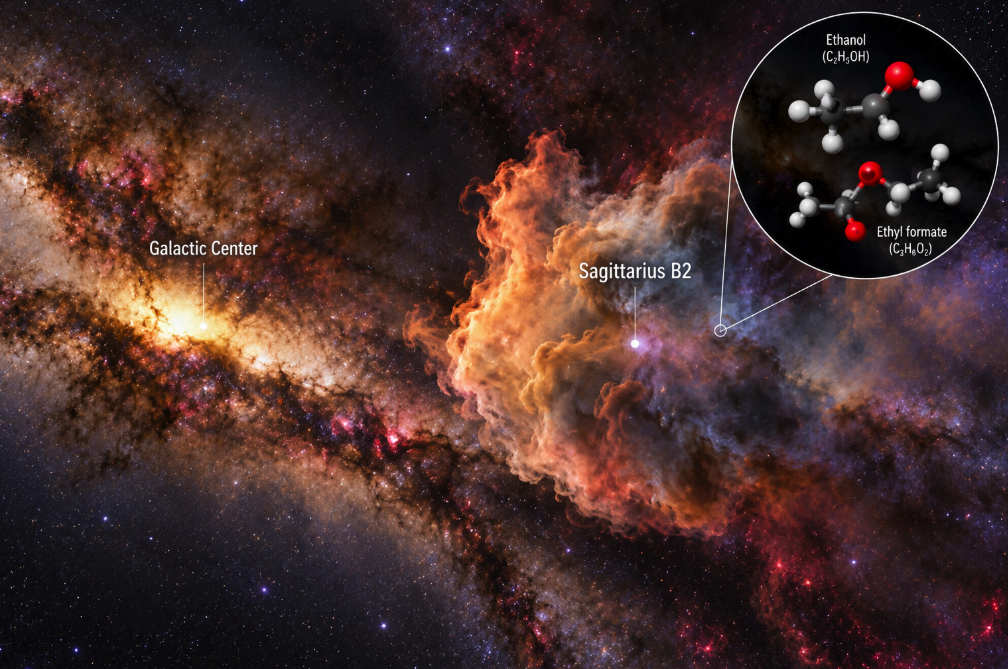
Near the heart of the Milky Way lies a cloud with a reputation that sounds invented for a science-fiction cocktail menu. Sagittarius B2 contains alcohol. It also contains ethyl formate, an organic molecule associated on Earth with fruity aromas and often described as contributing to the smell of rum and the flavor profile of raspberries. From those facts grew one of astronomy's most irresistible claims: somewhere in space there is a gigantic cloud containing billions — or even vastly more — liters of alcohol that would smell like rum and taste like raspberries.
The chemistry is real. The cosmic cocktail is not.
Sagittarius B2, usually shortened to Sgr B2, is a giant molecular cloud close to the center of our Galaxy. NASA describes it as the Milky Way's most massive and active star-forming region, located only a few hundred light-years from Sagittarius A*, the supermassive black hole at the galactic center. In 2025 the James Webb Space Telescope revealed its stars, warm dust and dense molecular structures in unprecedented infrared detail.
What makes Sgr B2 particularly remarkable, however, is invisible even to the most spectacular photograph. It is one of the richest natural chemistry laboratories astronomers know.
A cloud packed with molecules
Molecular clouds are enormous, cold concentrations of gas and dust where new stars can form. Hydrogen dominates their mass, but radio astronomy has shown that trace amounts of much more complicated chemistry can exist within them. Sagittarius B2 is exceptional in this respect. NASA's latest Webb observations of Sagittarius B2 describe Sagittarius B2 North as one of the most molecularly rich regions known.
Astronomers do not scoop these compounds into containers. They identify molecules remotely through spectroscopy. Molecules rotate and vibrate in characteristic ways and emit or absorb radiation at particular frequencies. The resulting spectral lines act somewhat like fingerprints, allowing researchers to determine which chemicals are present across thousands of light-years.
Alcohol chemistry has been known in Sgr B2 for decades. Methanol is abundant by interstellar standards, and ethanol — the same type of alcohol present in beer, wine and spirits — has also been detected. Other alcohol-related molecules have turned up as well. NASA's technical archive, for example, records the detection of ethylene glycol toward Sagittarius B2(N), alongside a discussion of formaldehyde, methanol, acetaldehyde and ethanol in interstellar chemistry.
But describing this as an enormous reservoir of drinkable alcohol is misleading. These molecules are dispersed through an extraordinarily tenuous astronomical environment and mixed with overwhelmingly larger quantities of hydrogen, helium, dust and many other compounds. A cloud can be gigantic enough to contain a huge absolute number of ethanol molecules while still having ethanol as only a trace constituent.
The molecule behind the raspberry-and-rum story
The most famous chapter arrived in 2009. Researchers from the Max Planck Institute for Radio Astronomy, Cornell University and the University of Cologne reported the detection of ethyl formate and n-propyl cyanide in Sagittarius B2(N). They used the IRAM 30-meter radio telescope in Spain to identify the molecules through numerous spectral lines.
Ethyl formate has the chemical formula C3H6O2. It belongs to a family of organic compounds called esters, many of which have recognizable fruity aromas. Ethyl formate is used in flavor and fragrance chemistry and is commonly associated with rum-like and fruity notes. That terrestrial connection quickly transformed a difficult piece of radio spectroscopy into the much more memorable story of a raspberry-flavored, rum-smelling cloud in space.
The actual 2009 Max Planck announcement was concerned with something more scientifically profound: how complex organic molecules can form in interstellar space. The researchers found that ethyl formate and n-propyl cyanide were among the most complex molecules of their kinds then detected in the interstellar medium.
The team proposed chemical pathways involving reactions on the surfaces of tiny dust grains. In the frigid environment of a molecular cloud, atoms and simpler molecules can accumulate on these grains, react and gradually assemble into more complicated structures. As young stars heat their surroundings, some products can evaporate from the grains into the gas, where radio telescopes can detect them.
Why the famous number of “liters of alcohol” is shaky
Popular accounts often convert the amount of alcohol in Sagittarius B2 into liters, sometimes producing numbers so enormous that they dwarf Earth's oceans. The visual comparison is entertaining, but scientifically it creates the wrong picture.
A liter is a measure of volume ordinarily used for liquids. The ethanol in Sgr B2 is not floating around as a gigantic lake, bottle or continuous liquid cloud. It exists as individual molecules in gas and on or around microscopic dust grains under conditions utterly unlike a terrestrial drink. Any conversion into liters requires assumptions about molecular abundance, the volume of the emitting region, density and what the molecules would occupy if somehow collected and condensed on Earth.
Those assumptions can change the resulting headline by enormous factors. It is therefore safer to say that astronomers have detected ethanol in the cloud than to present a viral “number of bottles” as though it were a directly measured astronomical quantity.
The same caution applies to the famous sensory description. Human noses and tongues do not respond to isolated molecular names; smells and flavors depend on concentration, mixtures, temperature and interactions among many compounds. Ethyl formate being associated with rum and fruit aromas on Earth does not mean an astronaut entering Sagittarius B2 would experience a cosmic raspberry cocktail. Quite apart from the vacuum problem, the cloud's physical environment is nothing like air above a glass of rum.
Webb is showing us the factory, not just the ingredients
The newest observations make Sagittarius B2 even more interesting. NASA reported in 2025 that although Sgr B2 contains only about 10% of the gas in the galactic center region, it is responsible for roughly half of its star formation. Webb's NIRCam can peer through some of the dust to reveal young stars, while its MIRI instrument traces warm dust heated by massive newborn stars. Some regions remain so dense that even Webb cannot see through them.
This matters for astrochemistry because stars and chemistry evolve together. Dense grains provide surfaces where molecules can assemble; radiation and heating from young stars alter those molecules; shocks and energetic particles can drive additional reactions. Sgr B2 is therefore not simply a static warehouse of exotic compounds. It is an active chemical ecosystem tied to one of the Galaxy's most vigorous stellar nurseries.
The larger significance reaches beyond amusing comparisons with drinks and berries. Complex carbon-bearing molecules can arise naturally in space before planets exist. The chemistry that later becomes part of comets, asteroids and young planetary systems begins in environments like these molecular clouds. Detecting increasingly elaborate molecules helps astronomers reconstruct the steps between simple interstellar ingredients and the organic inventory available to newly forming worlds.
Sagittarius B2 is not a bar floating near the center of the Galaxy. It is something better: a colossal natural laboratory where stars are being born and chemistry is quietly building surprisingly complicated molecules in the dark. The alcohol is real, the ethyl formate is real, and the raspberry-rum comparison has a genuine chemical origin. It is the picture of an enormous drinkable cloud that belongs to the legend.