Science-fiction space battles have trained us to expect a particular soundtrack: engines roar, lasers crack and exploding spacecraft detonate with a cinematic boom. Put the same battle in the real vacuum between planets, however, and an observer floating nearby would hear none of it.
The familiar statement that “there is no sound in space” is basically correct, but it hides a much more interesting story. Sound cannot cross a vacuum because it needs matter to carry its vibrations. Yet spacecraft routinely detect radio waves and other electromagnetic signals from planets, stars and black holes, and NASA has transformed many of those measurements into eerie, beautiful audio. In one famous case involving a supermassive black hole, astronomers even detected genuine pressure waves moving through hot gas — actual sound, although at a pitch impossibly low for human ears.
So can you hear sound in space? In empty space, no. But the universe is not uniformly empty, and “NASA space sounds” can represent several very different kinds of science.
Why a vacuum is silent
Sound is a mechanical wave. When someone speaks on Earth, the vocal cords create changes in air pressure. Molecules bump into neighboring molecules, passing the disturbance outward until it reaches an eardrum. The same basic principle works in water and solids: there must be material capable of transmitting the vibration.
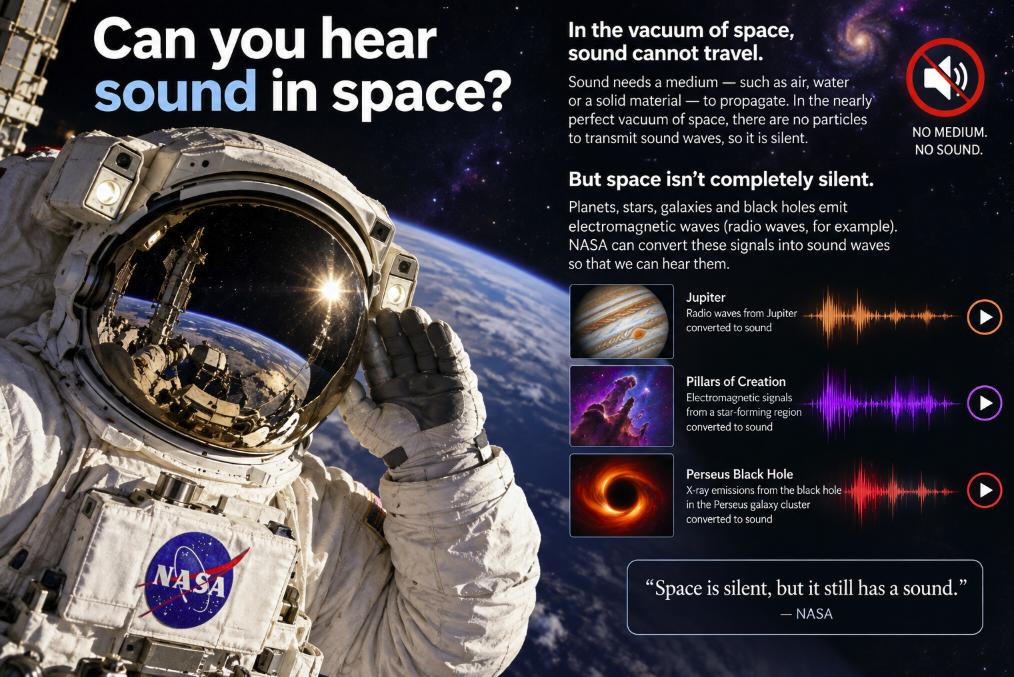
A vacuum removes that chain. As NASA explains in its guide to electromagnetic waves, sound waves cannot travel through the vacuum of space because there is no medium to transmit them.
Imagine striking a tuning fork outside a spacecraft. The metal itself would vibrate, but with essentially no surrounding air to compress and rarefy, those vibrations would not become an audible pressure wave traveling to another astronaut. The scene could contain plenty of mechanical activity and still be acoustically silent.
Inside a spacecraft, the situation changes completely. The International Space Station contains air, so astronauts hear voices, fans, pumps, alarms and equipment in much the same physical way we hear sounds on Earth. During a spacewalk, astronauts communicate by radio. Their voices become electrical signals and then electromagnetic radio waves that can cross the vacuum before being converted back into sound in another headset.
That distinction is crucial: radio waves are not sound waves. They are electromagnetic radiation, related to visible light, infrared, ultraviolet and X-rays. Unlike sound, electromagnetic waves do not require matter and can travel through a vacuum.
Then what are those famous “sounds of space”?
Search for the sound of a nebula or black hole and you can hear cosmic recordings that resemble electronic music, distant choirs, radar pulses or horror-film effects. Many are scientifically meaningful, but they should not be mistaken for what an astronaut's naked ears would hear while floating nearby.
The technique is called data sonification. NASA takes astronomical measurements and assigns aspects of those data to audible properties such as pitch, volume, rhythm or musical timbre. It is analogous to creating an image from telescope data, except the information is translated for the ear rather than the eye.
NASA's collection of astronomical sonifications includes observations from the Chandra X-ray Observatory, Hubble Space Telescope and James Webb Space Telescope. In Hubble sonifications, for example, brightness and position in an astronomical image can be mapped to loudness and pitch. Webb projects have transformed infrared images and even an exoplanet transmission spectrum into sound.
NASA explicitly cautions that these audio tracks are not ordinary sounds recorded in space. They are another representation of real observational data. The process is valuable partly because it allows patterns to be explored through hearing and makes astronomical data more accessible to blind and low-vision audiences.
This means the popular phrase “NASA recorded the sound of a planet” can be misleading. Instruments may have detected radio emissions, magnetic-field variations, plasma waves or light at various wavelengths, and researchers then converted those measurements into frequencies humans can hear. The underlying signal is real; the audible presentation is a translation.
The black hole that really did make sound
There is, however, a spectacular exception to the simple “space is silent” rule.
At the center of the Perseus galaxy cluster lies a supermassive black hole. The cluster is not an empty vacuum: it is immersed in an enormous reservoir of extremely hot gas. Because gas is matter, pressure waves can travel through it. Observations from NASA's Chandra X-ray Observatory revealed ripples in this gas associated with energy released around the central black hole.
Those ripples are pressure waves — in other words, sound waves propagating through the intracluster gas. Astronomers associated them with an extraordinarily low note, roughly 57 octaves below middle C, far beneath the range of human hearing.
In 2022, NASA released a remarkable sonification of the Perseus black hole based on these actual pressure waves. To make them audible, the signals were shifted upward by 57 and 58 octaves. NASA notes that this corresponds to frequencies 144 quadrillion and 288 quadrillion times higher than the originals.
This case is subtly different from taking the brightness of an astronomical image and assigning it musical notes. The Perseus project began with real pressure waves traveling through real gas. Humans still could not simply stand there and hear the original note — it is vastly too low, and there is no continuous medium connecting Perseus to our ears on Earth — but calling the underlying phenomenon “sound” is physically legitimate.
Space is not quite the perfect silence we imagine
The phrase “in space no one can hear you scream” remains excellent physics for an astronaut separated from everyone else by vacuum. But the universe contains regions of gas, plasma, planetary atmospheres and solid objects in which mechanical waves can exist. Space is mostly vacuum, not a magical zone where sound is forbidden under every circumstance.
Even the early universe carried pressure waves when matter and radiation formed a hot, dense plasma. Modern cosmology can study traces of those ancient oscillations. On smaller scales, planetary atmospheres obviously transmit sound as well: microphones carried to Mars have directly recorded the Martian wind and the noises of spacecraft hardware because Mars, unlike interplanetary space, has an atmosphere.
The real lesson is that “sound” and “space audio” are not interchangeable terms. A pressure wave in gas is sound. A radio emission is electromagnetic radiation. A telescope image converted into tones is a sonification. All three can eventually reach a human listener as audio, but they arrived there by very different physical routes.
That makes NASA's cosmic recordings more interesting, not less. They are not evidence that empty space secretly carries ordinary sound like Earth's atmosphere. They are ways of translating an invisible universe into a sense evolution never equipped us to use for astronomy.
If you floated between the stars without a radio, the surrounding vacuum would indeed be silent. But instruments can detect phenomena your ears never could, and scientists can turn those measurements into something audible. The cosmos may not come with a soundtrack — yet with the right data, we can give it one.