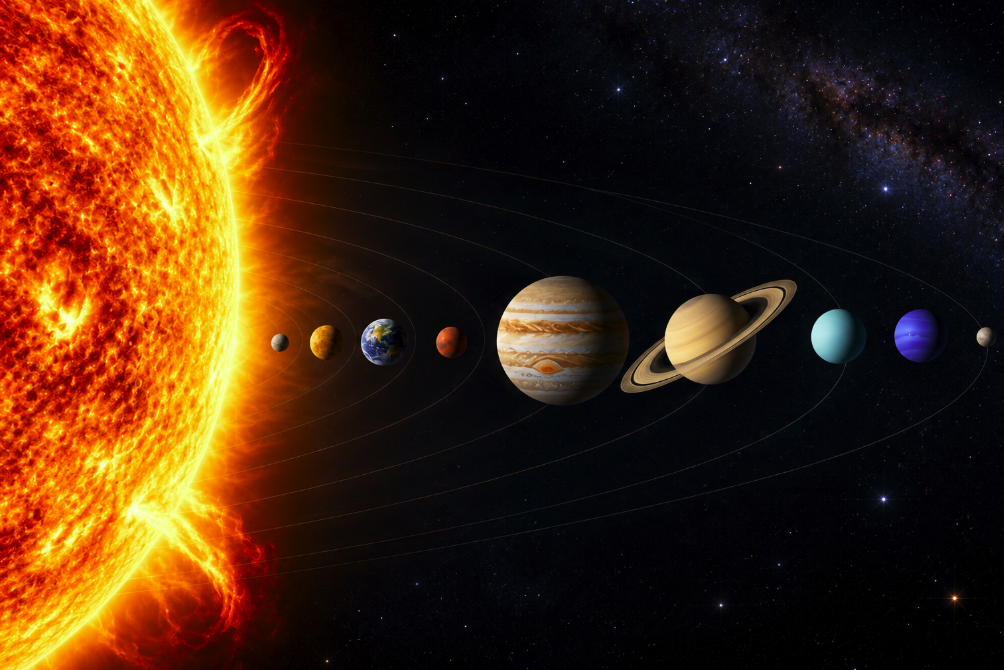
At this moment, Earth is moving in several different ways at once. It spins on its axis, circles the Sun at roughly 30 kilometers per second, and accompanies the entire Solar System on a vastly larger journey around the Milky Way. The familiar classroom picture of Earth tracing the same neat ellipse around a stationary Sun is therefore useful, but only because it deliberately ignores the Sun's own motion.
Put the Sun back into the moving Galaxy and the picture becomes much grander. NASA's current Solar System facts page gives our system's speed around the galactic center as about 515,000 mph, or 828,000 km/h. At that pace, the Sun carries the planets, dwarf planets, asteroids and comets with it, yet one circuit of the Milky Way still takes roughly 230 million years.
You will sometimes see a figure closer to 720,000 km/h, and it is not simply an internet invention. An older NASA description of the Sun used that average value. Astronomical estimates vary depending on the adopted distance to the galactic center, the reference frame and the model of the Milky Way's rotation. ESA's Gaia material, for example, describes the Solar System barycenter as moving around the galactic center at about 220 km/s, equivalent to roughly 792,000 km/h.
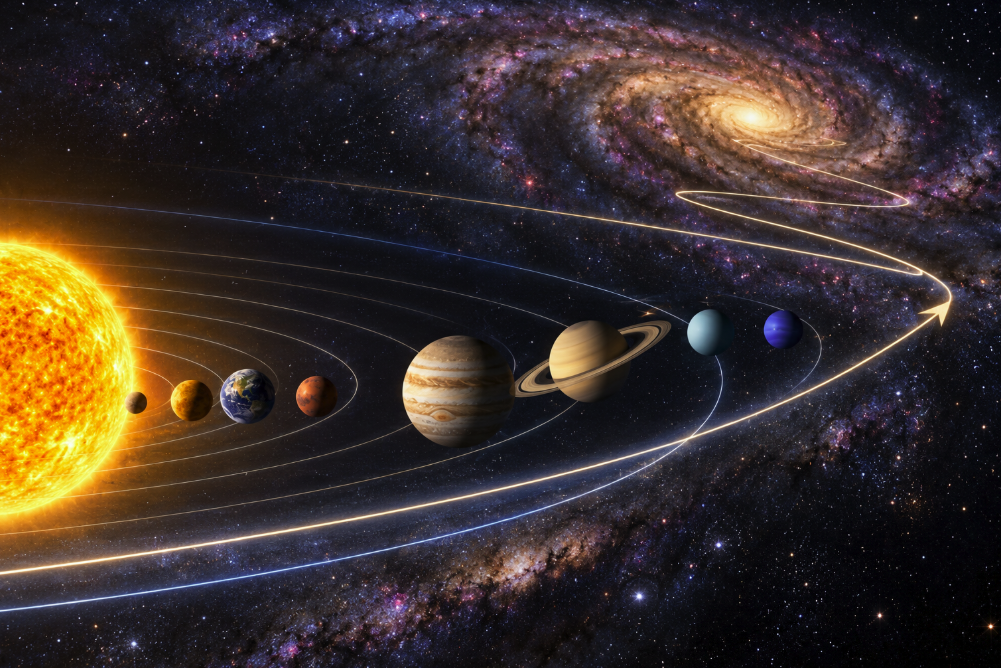
But there is another part of the popular story that needs more care: the claim that the planets therefore fly through space in simple corkscrew-shaped helices behind the Sun.
The Sun is not stationary
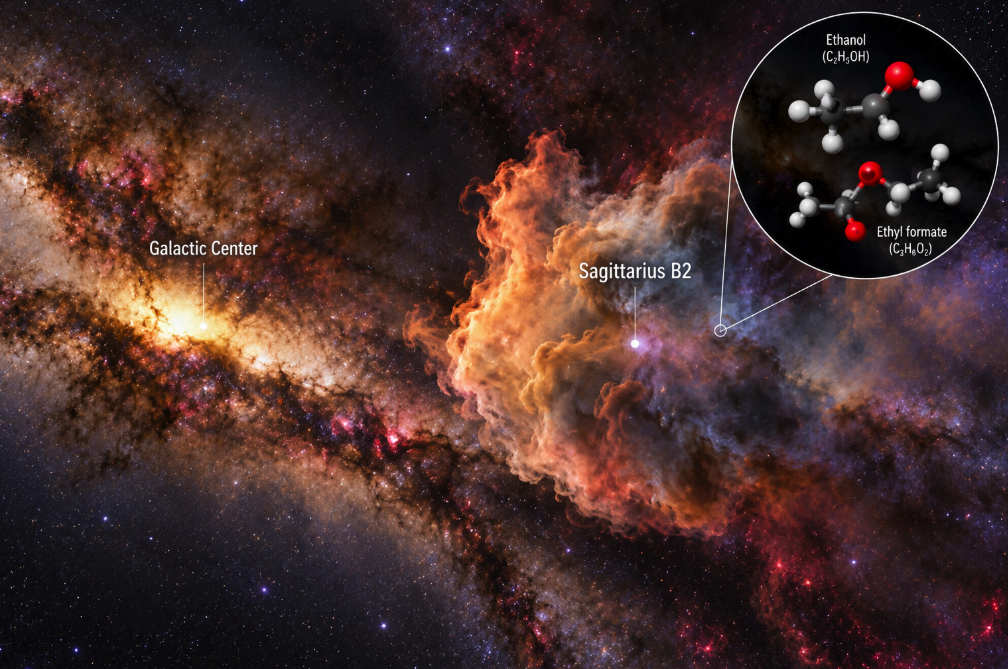
The Solar System lies in the Orion Spur, a relatively small feature of the Milky Way's disk between the Sagittarius and Perseus arms. The Sun is tens of thousands of light-years from the galactic center and is gravitationally bound to the Galaxy, just as Earth is gravitationally bound to the Sun.
That means our everyday orbital diagram is drawn from a convenient Solar System-centered point of view. Relative to the Sun, Earth's path is an almost elliptical orbit that repeats approximately once every 365.25 days. Relative to the center of the Milky Way, however, Earth's velocity is the combination of its motion around the Sun and the Sun's much larger-scale motion around the Galaxy.
There is no contradiction. Motion is always described relative to a chosen frame of reference. A passenger walking down the aisle of a moving train has one trajectory relative to the carriage and another relative to the landscape. Earth is doing the astronomical version of the same thing.
The scale difference is enormous. During one terrestrial year, the Sun travels billions of kilometers along its galactic orbit. Earth meanwhile completes its roughly 300-million-kilometer-wide circuit around the Sun. From a galactic frame, Earth's path therefore looks like a small periodic oscillation superimposed on the Sun's immense trajectory.
So is Earth's path really a helix?
In a suitably chosen moving coordinate system, a planet's trajectory can indeed be drawn as a helix-like or corkscrew curve around the Sun's direction of travel. This visualization is dramatic, and it captures one genuine idea: the Solar System does not return to precisely the same location in the Galaxy after Earth completes one year.
But the viral version of this image is often misleading because it makes the Sun look as though it is flying in a straight line with the planets trailing behind it like a vortex. The Sun is itself orbiting the galactic center along a curved path. The planets also orbit in a plane whose orientation matters, rather than forming a simple wake behind a projectile.
More importantly, there is no single absolute path through space. A helix is what appears after choosing a particular coordinate system. In a Sun-centered frame, Earth's orbit remains an ellipse. In a galactocentric frame, it becomes a wavy path wrapped around the Sun's much larger galactic orbit. Choose still another frame and the shape changes again.
Calling the real trajectory a spiral can introduce another confusion. In astronomy, a spiral usually suggests a path whose radius continually changes, either inward or outward. Earth is not normally spiraling away from the Sun as the Solar System crosses the Galaxy. Its orbit remains gravitationally bound.
A galactic year is almost unimaginably long
NASA estimates that the Solar System needs about 230 million years to complete one revolution around the center of the Milky Way. This interval is sometimes called a galactic year or cosmic year.
The number gives an extraordinary perspective on Earth's history. The Solar System is about 4.6 billion years old, so the Sun has completed only on the order of twenty galactic circuits since it formed. One galactic year ago, Earth was in the Mesozoic Era, when dinosaurs inhabited the planet. Human civilization occupies only an almost invisible fraction of one such orbit.
The galactic journey is also not perfectly flat and mechanically circular. The Milky Way is a gravitationally complicated system of stars, gas, dust and dark matter. The Solar System has motion relative to neighboring stars and a smaller vertical component relative to the Galaxy's disk. NASA educational material notes that the Solar System moves somewhat with respect to the galactic plane, while ESA's Gaia mission has actually measured the tiny acceleration of the Solar System toward the galactic center.
That acceleration is extraordinarily small — Gaia reports about 0.23 nanometers per second squared — but across astronomical timescales it is precisely the kind of gravitational pull that bends the Solar System's enormous velocity into an orbit.
Earth's motion has no single speed
There is a final twist. Asking how fast Earth is moving sounds like a question that should have one numerical answer, but velocity requires a reference frame. Earth moves around the Sun at roughly 107,000 km/h. The Solar System moves around the Milky Way at something on the order of 800,000 km/h, depending on the adopted parameters. The Milky Way itself moves relative to other galaxies, while the Local Group has its own motion on still larger cosmic scales.
None of those velocities replaces the others. They describe different layers of the same journey.
The most accurate mental picture, then, is not of a stationary Sun with planets eternally retracing circles on a fixed sheet, nor of a cosmic projectile dragging planets behind it in perfect corkscrews. It is a hierarchy of overlapping orbits and motions: the Moon around Earth, Earth around the Sun, the Solar System around the Milky Way, and the Galaxy moving within an evolving universe.
Our planet may feel motionless beneath our feet, but its apparent stillness is an illusion created by traveling along with everything around us.