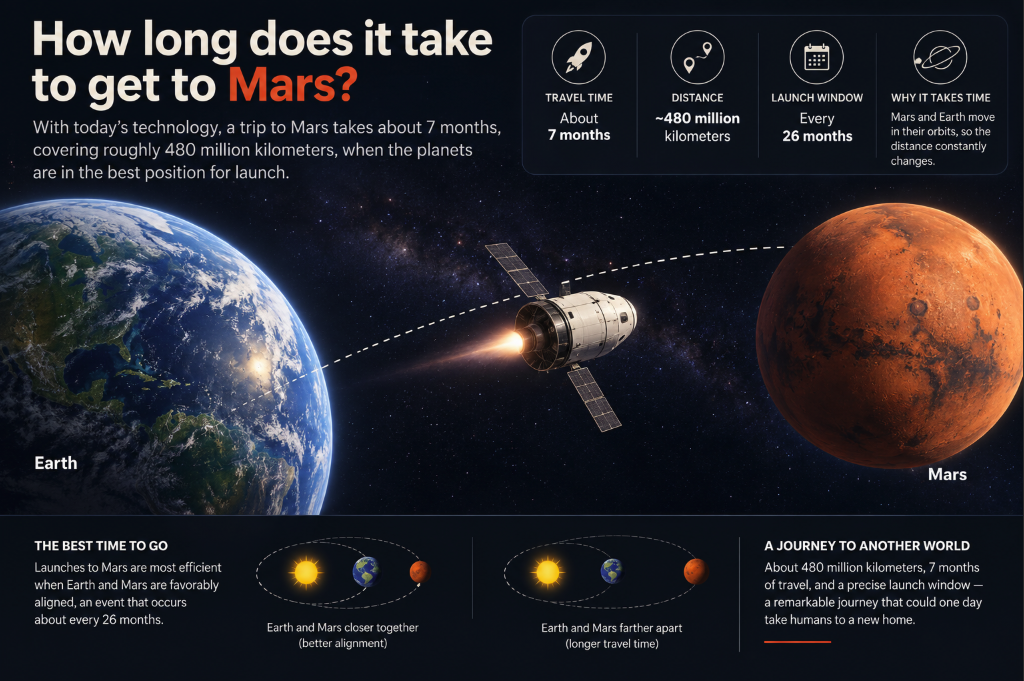
If Mars can come within roughly 55 million kilometers of Earth, why does a spacecraft sent there travel something closer to 480 million kilometers — and spend around seven months doing it? The answer is one of the most important ideas in spaceflight: you do not fly to another planet by pointing a rocket at where the planet is and traveling in a straight line.
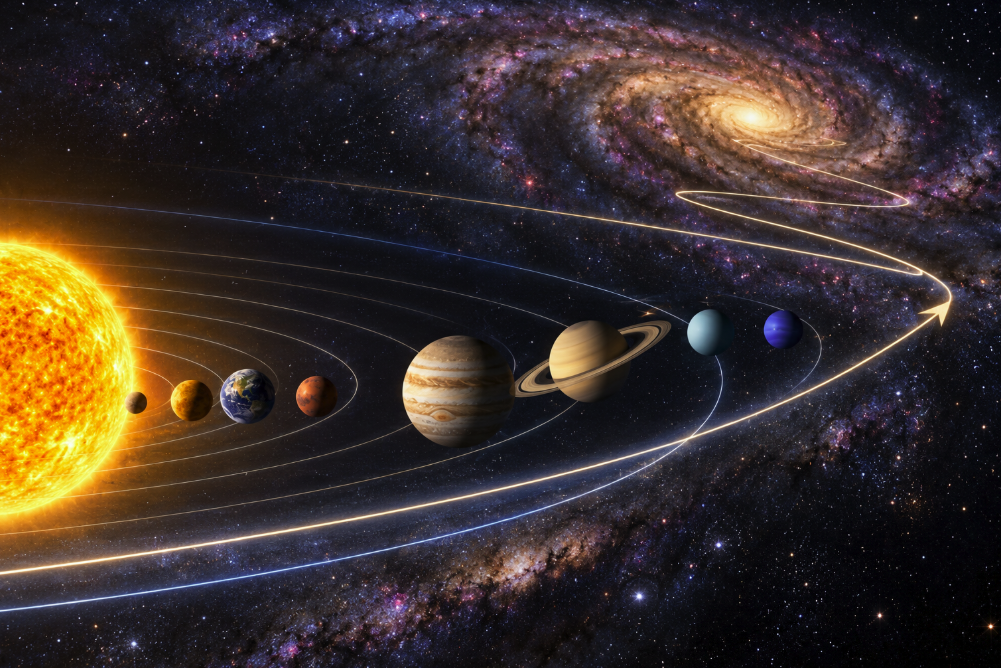
Earth and Mars are both racing around the Sun. A Mars-bound spacecraft must enter its own solar orbit, follow a long curved trajectory and intercept Mars at the place where the planet will be months later. With current chemical propulsion and the kinds of fuel-efficient trajectories used by robotic missions, the journey typically takes about seven to ten months. Many well-known missions have landed near the shorter end of that range.
NASA's Perseverance rover, for example, left Earth on July 30, 2020, and reached Mars on February 18, 2021. Its cruise lasted 203 days — a little under seven months — while the spacecraft traveled about 471 million kilometers.
Mars is moving while you travel
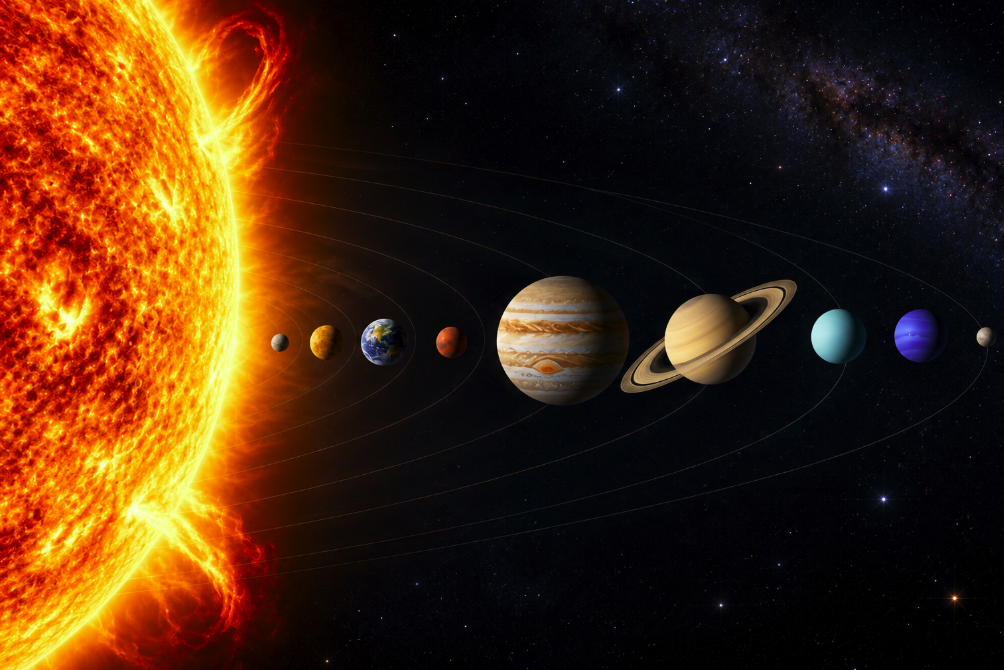
The first misconception is that the Earth–Mars distance is a single number. It is not. Earth orbits the Sun at an average distance of about 150 million kilometers, while Mars follows a larger orbit at roughly 228 million kilometers. Earth also completes an orbit faster.
As a result, the two planets are continually changing position relative to each other. NASA's current Moon-to-Mars architecture documentation notes that Mars can approach Earth to about 54.6 million kilometers, while at other times more than 400 million kilometers separates the planets.
But even the minimum separation does not tell you how far a spacecraft will travel. A mission follows a curved path around the Sun rather than crossing the instantaneous gap between two stationary worlds.
NASA's Jet Propulsion Laboratory uses a useful analogy: sending a spacecraft to Mars is like a quarterback throwing a football to a receiver who is running down the field. You do not aim at the receiver's current location. You aim at the point where the receiver and ball will meet.
The same principle operates on a vastly larger scale. Mission designers calculate where Mars will be months after launch and send the spacecraft onto an orbit that intersects the planet at that moment. Small trajectory-correction maneuvers during the cruise keep the vehicle on course.
Why the best chance comes every 26 months
Because Earth moves around the Sun faster than Mars, the geometry needed for an efficient journey repeats roughly every 26 months. These periods are called Mars launch opportunities or launch windows.
NASA's Mars mission timeline explains that missions are timed for periods when the planets occupy favorable positions because reaching Mars then requires less energy. For the Perseverance mission, the interplanetary cruise lasted about 200 days.
This is why Mars missions tend to depart Earth in clusters. When the window opens, agencies race to take advantage of the favorable alignment. Miss it, and simply launching a few months later may require far more energy or an impractical trajectory. Waiting for the next efficient opportunity can mean waiting more than two years.
The route often resembles what orbital mechanics calls a transfer orbit: the spacecraft leaves Earth's neighborhood and enters an elliptical path around the Sun that carries it outward toward Mars' orbit. The exact trajectory varies according to the launch vehicle, spacecraft mass, arrival speed, landing requirements and available fuel.
That trade-off explains why there is no universal seven-month rule. A faster trip generally demands more energy. A slower trajectory may save propellant or satisfy different mission requirements. NASA says that a relatively direct journey to Mars generally takes about seven to ten months.
How far does a Mars spacecraft actually travel?
The often-quoted figure of roughly 480 million kilometers makes sense when understood as distance traveled along the spacecraft's curved solar trajectory, not as the distance between Earth and Mars at departure.
Perseverance traveled about 471 million kilometers during its 203-day cruise. NASA's JPL describes a representative Mars journey as approximately 300 million miles — around 480 million kilometers — and says that, if everything goes well, a spacecraft can reach the Red Planet in about seven or eight months.
Other missions demonstrate how much the numbers can vary. Mars Reconnaissance Orbiter took roughly seven and a half months to arrive, while NASA's MAVEN spacecraft took around ten months. Mars Pathfinder reached its destination in about seven months along a trajectory that totaled roughly 497 million kilometers.
So asking “How far away is Mars?” and “How far must a spacecraft travel to Mars?” produces two very different answers. The first is a changing straight-line separation between planets. The second depends on orbital geometry and mission design.
Would astronauts also take seven months?
A human mission changes the engineering problem dramatically. Seven months of cruise is manageable for a robotic rover that does not need food, exercise, radiation protection or psychological support. A crewed spacecraft must keep people healthy while carrying life-support systems, supplies and shielding and still preserve enough capability for operations at Mars and the return journey.
NASA studies a range of human Mars architectures rather than assuming every crew will follow exactly the same trajectory as Perseverance. Its human-spaceflight planning has considered outbound journeys of roughly six to nine months as well as mission designs with different transit and surface-stay durations. A recent NASA architecture example for a possible 2039 opportunity shows an outbound leg lasting about 279.5 days, illustrating that future crewed missions need not match the familiar seven-month robotic cruise.
The entire expedition would be much longer than the one-way flight. Orbital alignment affects the return trip too, so astronauts could not normally land, take a photograph and immediately launch back toward Earth. Depending on the mission architecture, a complete expedition could keep a crew away from Earth for years.
Faster propulsion could eventually change the equation. Nuclear thermal propulsion, nuclear electric systems and other advanced concepts are studied partly because shorter transit times could reduce crew exposure to deep-space radiation and microgravity. But reducing a Mars journey is not simply a matter of building an engine that goes faster. Every gain in speed affects fuel, mass, heat management and the enormous challenge of slowing down when the spacecraft reaches Mars.
For today's proven interplanetary technology, the practical answer remains wonderfully simple: Mars is roughly a seven-month trip on a favorable, relatively direct mission, with NASA giving a broader typical range of seven to ten months. Yet the spacecraft may travel close to half a billion kilometers to get there — because in orbital mechanics, the shortest-looking line is rarely the path a spacecraft can actually take.