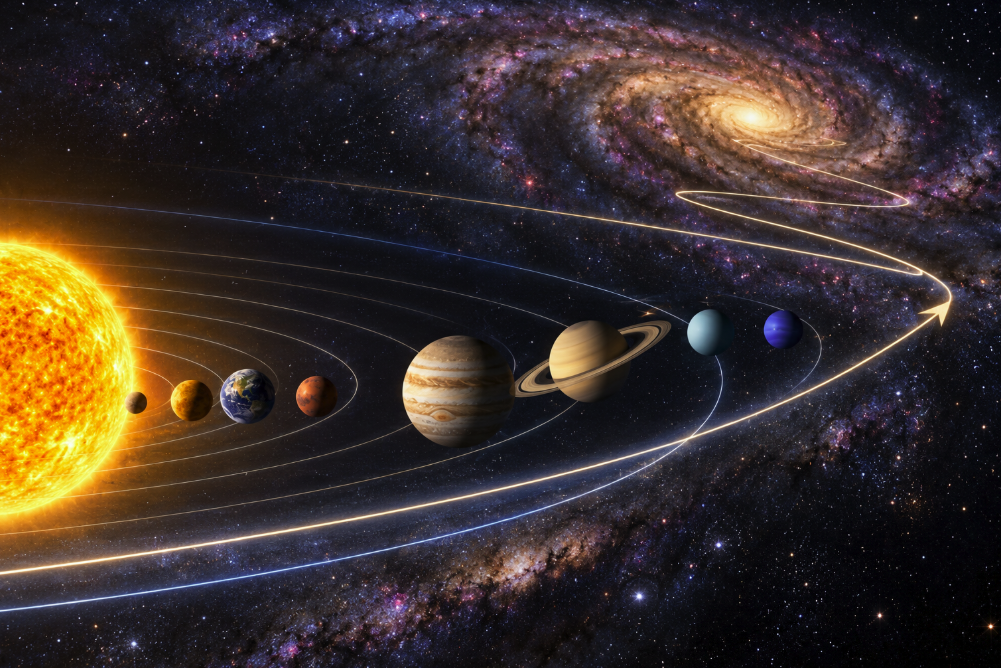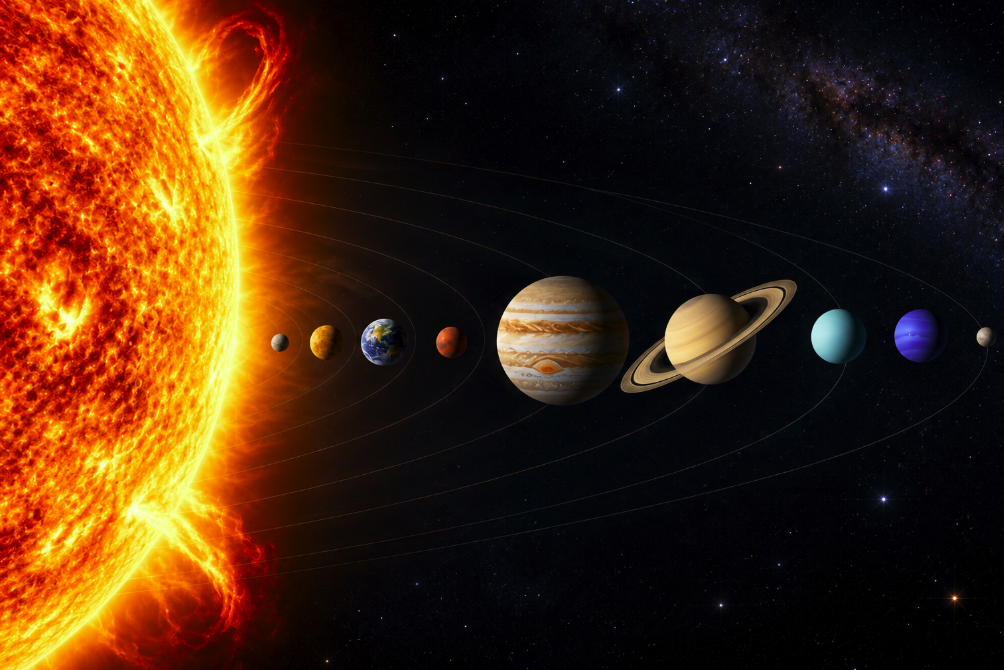
Imagine putting the entire Solar System on a cosmic scale: the eight planets, every known moon, the asteroids, comets, dwarf planets, dust and the enormous Sun. The result would be absurdly one-sided. Roughly 99.86% of the mass would sit on the Sun's side of the balance.
NASA's Planetary Data System gives the Sun a mass of about 1.9891 × 1030 kilograms and states that it contains 99.86% of the Solar System's mass. Other NASA pages round the figure to 99.8% or simply more than 99%, but the message is the same: what we casually call the Solar System is, by mass, overwhelmingly the Sun.
That leaves only about 0.14% for everything else. Even within that tiny remainder, however, the distribution is dramatically unequal. Jupiter and Saturn take the lion's share.
Jupiter is the heavyweight among the planets
Jupiter has a mass of about 318 Earths. Saturn comes next at roughly 95 Earth masses. By comparison, Neptune is about 17 Earth masses and Uranus about 14.5, while Earth itself contributes exactly one Earth mass by definition. Mars, Venus and Mercury are smaller still.
NASA's Jupiter facts page makes the imbalance especially vivid: Jupiter contains more than twice as much material as all the other planets combined. It is so massive that comparing Earth with Jupiter is less like comparing two peers than comparing a pebble with a boulder.
Saturn is much less massive than Jupiter despite its enormous diameter. The reason is density. Saturn is composed largely of hydrogen and helium and has an average density lower than that of liquid water. Still, its sheer size gives it a mass about 95 times Earth's, making it comfortably the second-heaviest planet.
Together, Jupiter and Saturn contain about 413 Earth masses. The eight planets combined total roughly 447 Earth masses, using NASA's approximate planetary figures. In other words, the two gas giants alone account for around 92% of the mass of all the planets. If we include moons, dwarf planets, asteroids, comets and interplanetary material in the non-solar remainder, their combined share is a little smaller, but Jupiter and Saturn still dominate it overwhelmingly.
So the popular statement that almost all of the remaining 0.14% is concentrated in Jupiter and Saturn captures the basic scale of the imbalance, although it should not be interpreted as literally all of that remainder. Uranus and Neptune are substantial worlds, and the Solar System also contains countless smaller bodies.
Why did the Sun get almost everything?
The answer lies in how the Solar System formed about 4.6 billion years ago. According to the standard model, our system began as a collapsing cloud of interstellar gas and dust. As gravity pulled the material inward, the cloud spun faster and flattened into a rotating disk known as the solar nebula.
Most of the material accumulated at the center. Pressure and temperature there eventually became high enough for hydrogen fusion to begin, creating the Sun. NASA's overview of the Sun notes that most of the original nebular material was drawn into the young star, while a much smaller quantity remained in the surrounding disk to build planets and other bodies.
This is why the Solar System's architecture has such an extreme mass hierarchy. The planets were not assembled from an equal share of the original cloud. They formed from leftovers orbiting the central object that had already captured nearly everything.
Jupiter's own history then repeated the process on a smaller scale. Growing beyond the frost line, where volatile compounds could condense more readily, its early core was able to accumulate enormous quantities of hydrogen and helium from the surrounding disk. NASA describes Jupiter as having taken most of the mass left over after the Sun formed. The result is a planet whose composition — mostly hydrogen and helium — resembles the Sun more than it resembles rocky Earth.
A star surrounded by crumbs — with one important twist
The numbers can make the planets sound almost irrelevant, but mass is not the whole story. NASA's Basics of Space Flight notes an intriguing reversal: although the Sun contains almost all the mass, the planets retain most of the Solar System's angular momentum associated with orbital motion.
This happens because angular momentum depends not only on mass but also on how that mass moves and how far it lies from the rotational axis. The planets are tiny compared with the Sun, but they orbit at enormous distances. Jupiter, in particular, is both massive and far from the center, making it exceptionally important dynamically.
The planets can even move the point around which the Sun itself travels. Strictly speaking, planets do not orbit the exact geometric center of an immovable Sun. All bodies in the Solar System orbit their common center of mass, called the barycenter. Because Jupiter is so massive, the Solar System barycenter can sometimes lie outside the visible surface of the Sun.
This does not mean Jupiter rivals the Sun gravitationally. It does not come remotely close. It means that even a comparatively tiny companion can shift a system's center of mass if it is massive enough and sufficiently distant.
How tiny is Earth's share?
The Sun is about 333,000 times as massive as Earth. Put another way, Earth's mass is only about three millionths of the Sun's. Even adding our Moon barely changes the comparison.
Yet this almost negligible slice of the Solar System's mass contains oceans, continents, an atmosphere and every human being who has ever lived. From our surface, the planets can seem like the principal actors and the Sun like one object among many in the sky. Physics reveals almost the reverse picture.
The Solar System is fundamentally a star with a thin entourage of leftover material. Of those leftovers, two planets — Jupiter and Saturn — claim most of the planetary mass, while Earth occupies a remarkably small fraction of a fraction. The familiar family portrait of eight planets circling the Sun may give each world equal visual billing, but gravity keeps a very different accounting.