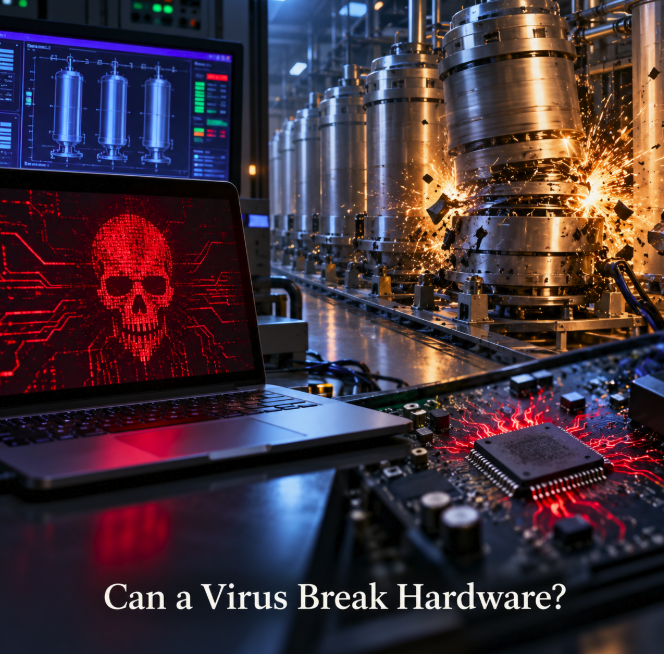
Computer viruses have a reputation for destruction. They can erase files, encrypt disks, steal passwords and make a computer unusable. But can malicious software cross the invisible boundary between code and matter and actually break the machine itself?
Usually, no. Most malware damages information or interferes with software, while the physical processor, memory chips and circuit boards remain perfectly intact. Reinstalling the operating system, restoring data or replacing corrupted firmware may bring the device back to life.
But “software cannot damage hardware” is not an absolute rule. Modern machines are controlled by software at almost every level. If malicious code gains authority over the systems that regulate motors, temperatures, voltages, fans or industrial equipment, it may be able to command physical components into unsafe conditions. The most famous demonstration is Stuxnet, malware designed not merely to infect computers but to manipulate machinery in the physical world.
Why ordinary malware usually does not destroy a computer
A typical malicious program runs within layers of software protection. The operating system controls access to hardware, while device firmware and embedded controllers impose additional limits. Modern processors also contain thermal monitoring and protection mechanisms designed to prevent routine software mistakes from turning into burned silicon.
This means a virus cannot normally issue a simple instruction such as “melt the CPU.” If malware forces the processor to work continuously, the computer may become hot and its fans may accelerate, but properly functioning thermal controls are designed to reduce performance or shut the system down before destructive temperatures are reached.
The same distinction explains why a machine that appears “dead” after malware is not necessarily physically broken. Corrupting boot files can stop a computer from starting. Damaging a storage device’s logical structures can make data inaccessible. Altering low-level firmware can prevent hardware from initializing correctly. From the user’s perspective, the device may look like a brick even though its electronic components have not been mechanically or electrically destroyed.
That distinction matters: making hardware unusable and physically damaging hardware are not always the same thing.
Firmware brings malware closer to the machine
Between an operating system and the electronics themselves lies firmware — low-level software stored in devices and responsible for fundamental hardware behavior. Computers use UEFI firmware during startup, while drives, network adapters, USB controllers and many other components contain their own embedded code.
Microsoft notes in its documentation on UEFI threats that malicious code can reside in firmware flash memory and may be difficult to remove automatically. Because firmware runs before or beneath much of the operating system, an attacker who compromises it can potentially evade security tools and regain control whenever the machine boots.
Firmware attacks are difficult and relatively uncommon compared with ordinary malware, but they illustrate why the software-hardware boundary is fuzzy. Microsoft also warns that improper firmware changes can permanently damage a device, which is one reason firmware updates should come from trusted manufacturers.
Even so, firmware malware should not automatically be imagined as a program electrically frying a motherboard. Its more realistic dangers include persistence, loss of control, disabling security protections and rendering a component unable to boot or operate correctly. Physical destruction requires an additional ingredient: hardware whose software-controlled behavior can be driven into a damaging state.
Stuxnet proved code could destroy machinery
Stuxnet changed the way the world thought about this problem. Discovered in 2010, the sophisticated worm targeted industrial systems associated with Iran’s uranium-enrichment program. Its purpose went far beyond stealing information.
The crucial targets were programmable logic controllers, or PLCs — industrial computers that issue commands to physical equipment. NIST’s Framework for Cyber-Physical Systems describes Stuxnet’s principal objective as causing physical damage to centrifuges. The malware manipulated digital control of mechanical systems so the centrifuges could damage or destroy themselves.
This is more precise than saying Stuxnet simply “infected the centrifuges’ firmware.” It first operated through Windows systems and industrial engineering software, then reprogrammed Siemens PLC control logic. Those controllers could alter the operating behavior of connected centrifuges while Stuxnet attempted to conceal what was happening from human operators.
CISA material likewise describes Stuxnet as a landmark cyberattack with serious physical consequences, and U.S. government industrial-control guidance notes that it reconfigured PLCs to send unwanted commands to actuators controlling centrifuge frequency.
The important lesson is that software did not somehow acquire magical destructive energy. The machinery already contained motors, rapidly rotating components and substantial physical forces. Malware gained control of the instructions governing those forces. Code became destructive because it could tell a powerful machine to operate incorrectly.
Cyber-physical systems make the risk much larger
A laptop is one thing. An industrial plant is another. Modern factories, power systems, water facilities and transportation infrastructure contain computers connected directly to pumps, valves, motors, turbines and safety equipment. These are cyber-physical systems: digital commands produce real-world effects.
In such an environment, changing a number can matter physically. A malicious command could alter rotational speed, pressure, temperature, flow or timing. If safety mechanisms are also defeated or operators are shown false information, equipment may continue operating under conditions it was never designed to tolerate.
This is why industrial cybersecurity treats integrity and safety as inseparable. CISA has documented later attacks against programmable logic controllers in which hostile actors changed control logic and device configurations, warning that deeper access could produce more serious cyber-physical effects on processes and equipment.
None of this means attackers can effortlessly destroy any internet-connected machine. Industrial systems differ enormously, safety layers can be independent of ordinary networks, and producing controlled physical damage often requires detailed knowledge of the target. Stuxnet was extraordinary precisely because of its sophistication and specialization.
Could malware damage your personal computer physically?
For an ordinary home user, physical destruction by malware is far less likely than ransomware, credential theft, spyware or data loss. Modern consumer hardware includes multiple protection mechanisms, and malware authors usually have more profitable goals than destroying the computer that gives them access to a victim.
There are nevertheless edge cases. Vulnerable firmware or hardware-management interfaces can give attackers unusually low-level control. A malicious or corrupted firmware update can leave a motherboard or peripheral unable to start. Devices with mechanically controlled parts or poorly protected thermal and power systems can theoretically present more opportunities for harmful commands.
But sensational claims should be treated carefully. A crashed operating system is not a fried motherboard. A corrupted SSD is not necessarily physically ruined. A computer that refuses to boot after a firmware failure may sometimes be recoverable by reflashing or replacing the affected component.
For modern Windows systems, technologies such as Secure Boot are designed to reduce the risk of low-level compromise. Microsoft explains that Secure Boot checks code executed before the operating system and verifies digital signatures so untrusted boot components are not silently loaded. Keeping firmware updated from official sources and avoiding unknown peripherals also reduces exposure to firmware-level attacks.
When software becomes a physical weapon
The best answer to the original question is therefore: yes, malware can cause physical hardware damage, but only under particular conditions, and it is rare compared with ordinary software damage.
There are two related but distinct ideas. Malware can compromise firmware and make a device extremely difficult to clean or even temporarily unusable. Separately, malware that controls a cyber-physical system can manipulate machinery until physical components fail. Stuxnet became famous because it demonstrated the second possibility on an unprecedented scale.
The deeper lesson is that software is not truly separate from the physical world. Every line of code eventually becomes electrical activity in a machine, and increasingly those machines control motors, vehicles, factories and infrastructure. When software controls physical forces, a malicious instruction can become more than corrupted data.
Sometimes, it can become a broken machine.