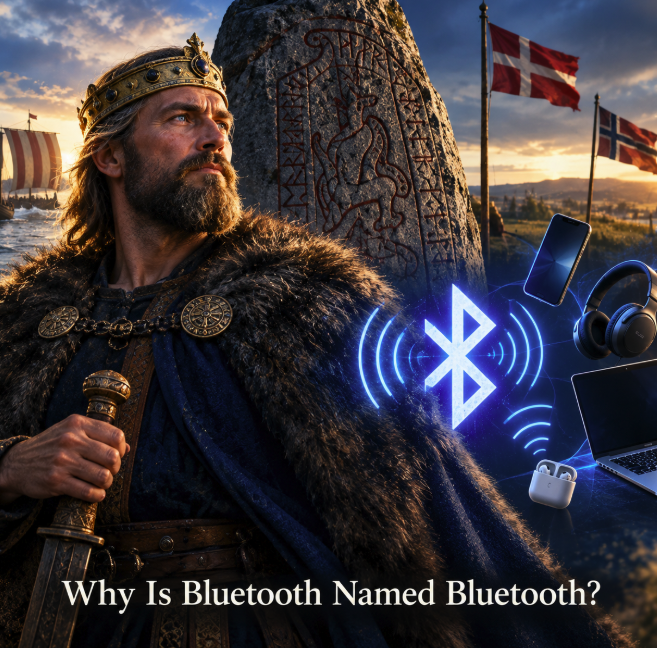
Bluetooth is such an ordinary part of modern life that its name barely sounds strange anymore. We tap an icon and headphones connect to a phone, a keyboard finds a computer, or a car starts playing music wirelessly. But judged as the name of a communications technology, “Bluetooth” is wonderfully peculiar. It is not an acronym, an engineering term or a reference to radio waves.
It is the nickname of a Viking king who lived more than a thousand years ago.
The connection was deliberate. In the 1990s, engineers were trying to create a common short-range wireless standard that could bring previously incompatible parts of the technology industry together. One of them saw a historical analogy in Harald “Bluetooth” Gormsson, the 10th-century ruler associated with consolidating Denmark and extending his rule into Norway. A temporary code name based on a medieval king unexpectedly survived — and ended up on billions of electronic devices.
The Viking king behind Bluetooth
Harald Bluetooth was the son of Gorm the Old and ruled Denmark during the second half of the 10th century, approximately from 958 until 987. His reign sits at a pivotal moment in Scandinavian history, when royal authority was becoming more centralized and Christianity was replacing the traditional Norse religion.
The most famous physical evidence of Harald’s reign still stands at Jelling in Denmark. Around 965, he erected a large rune stone commemorating his parents, Gorm and Thyra. According to Denmark’s National Museum, the inscription declares that Harald won all Denmark and Norway and made the Danes Christian. The stone is sometimes called Denmark’s “birth certificate” because it is an exceptionally important early written reference to the kingdom.
That historical detail requires a little care. Popular summaries often say Harald “united Scandinavia” or “unified the Scandinavian tribes.” That makes the achievement sound broader and tidier than the evidence supports. The Jelling inscription specifically associates him with Denmark and Norway, and Viking-age political control was more fluid than the borders of modern nation-states suggest.
Still, the image of Harald as a ruler who brought territories and people together was powerful enough to inspire an engineer a millennium later.
How a Viking became a wireless code name
In 1996, representatives from Intel, Ericsson and Nokia were working on standardizing short-range radio technology. The goal was interoperability: computers, mobile phones and other products from different companies needed a common way to communicate.
During those discussions, Intel engineer Jim Kardach proposed “Bluetooth” as a temporary code name. The official Bluetooth SIG history records his reasoning: Harald was remembered for bringing parts of Scandinavia together, while the new wireless standard was intended to bring the PC and cellular industries together through a short-range radio link.
The analogy was simple enough to stick. One king connected political territories; one communications standard would connect technological ecosystems.
Bluetooth was never supposed to be the final product name. The development team considered alternatives including “RadioWire” and “PAN,” short for Personal Area Networking. PAN initially looked promising, but searches showed that the term was already overwhelmingly common. RadioWire could not complete the necessary trademark process in time for launch.
The placeholder suddenly became the practical choice. By then, Bluetooth had already spread through the industry, and the odd name was becoming recognizable. What began as an internal historical joke turned into a global technology brand.
Did Harald Bluetooth really have a blue tooth?
The king’s nickname raises the obvious question: why was he called Bluetooth in the first place?
The traditional explanation is literal. The Bluetooth SIG says Harald had a dead tooth that appeared dark blue or grey, producing the nickname. A damaged or dead tooth can indeed darken significantly. The Danish form of his nickname is Blåtand, which translates directly as “Bluetooth.”
But the exact origin of a nickname from more than a millennium ago is difficult to prove. Later historical traditions preserve the name, while explanations for why Harald acquired it are less secure than the existence of the nickname itself. The discolored-tooth story is the familiar interpretation, not something that can be confirmed by a contemporary dental record.
Whatever happened inside Harald’s mouth, the English translation supplied one of technology’s most memorable names.
The Bluetooth logo is Harald’s initials in runes
The Viking connection goes deeper than the word. Look closely at the familiar Bluetooth symbol and it begins to make more sense as a historical artifact.
The logo combines two characters from the Younger Futhark, the runic alphabet used in Scandinavia during the Viking Age. According to the Bluetooth SIG, it merges the runes Hagall and Bjarkan — corresponding to the initials H and B for Harald Bluetooth — into a single bind rune.
That angular mark appearing in the settings menu of a smartphone is therefore effectively a monogram for a 10th-century Danish king.
It is an unusually successful piece of technological branding because almost none of this history is necessary to use the product. A person can connect earbuds every day without knowing anything about Jelling, Viking politics or runic writing. Yet once the origin is explained, both the name and symbol suddenly become coherent.
Why the metaphor turned out to be so appropriate
Early Bluetooth development was fundamentally about getting different products to cooperate. The Bluetooth Special Interest Group was formally established in 1998 to develop and promote an interoperable wireless standard. Instead of every manufacturer building an isolated connection system, compatible devices could speak a shared technical language.
That basic idea remains visible whenever a phone connects to headphones from another manufacturer or a laptop recognizes a wireless mouse. Bluetooth does not merely remove a cable; it creates a standardized bridge between devices that may come from entirely different companies.
The historical Harald obviously did not “connect” people in the friendly modern networking sense. Viking-age state building involved warfare, political maneuvering and religious transformation. But as a piece of 1990s engineering shorthand, the metaphor was irresistible: a ruler remembered for consolidation became the namesake of a standard designed for technological unification.
There is also a pleasing accident in how the name survived. “Personal Area Networking” sounds exactly like terminology created by a committee. “Bluetooth” sounds like a story. The temporary name had personality, an explanation and a visual identity built into it, while the supposedly serious alternatives faded away.
So the next time the blue runic icon appears on a screen, it is worth remembering what you are actually looking at. Hidden inside one of the most familiar symbols of wireless technology are the initials of Harald Bluetooth, a Viking king commemorated on a rune stone around a thousand years before anyone imagined smartphones, laptops or wireless headphones. The technology connects devices because, in the minds of its creators, its namesake once connected kingdoms.