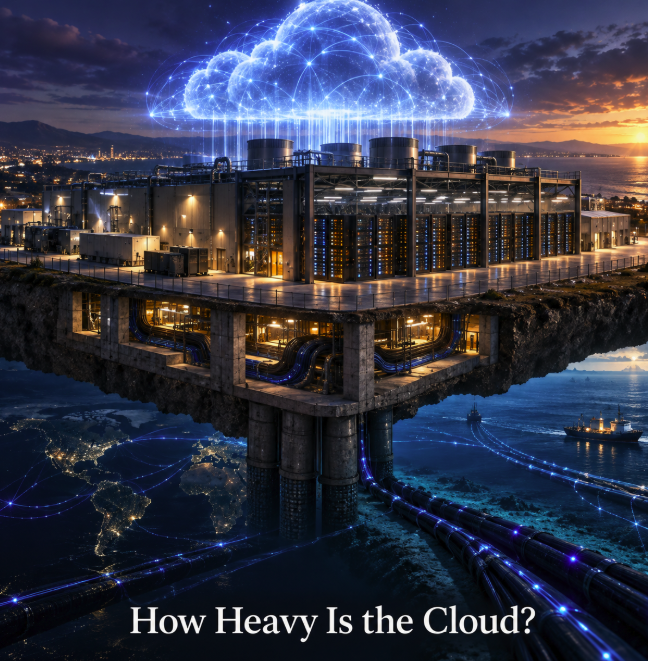
“The cloud” may be the most successful disappearing act in modern technology. Upload a photograph and it seems to float away. Stream a film and it arrives from nowhere. Ask an AI system a question and an answer materializes on a glass screen, with almost no visible machinery between your fingers and the response.
But nothing has floated anywhere. Your data has traveled through routers and fiber-optic cables toward buildings full of computers, storage systems, electrical equipment and industrial cooling machinery. Some of those connections cross entire oceans along cables resting on the seabed. The cloud is not weightless at all. It is an enormous physical system made from concrete, steel, silicon, copper, glass, water, batteries and generators.
So how heavy is it? There is no honest single number. Unlike a ship or a skyscraper, “the cloud” has no agreed physical boundary. Deciding what belongs on the scale is the first problem — and once you begin counting the infrastructure, the playful metaphor turns into a question about industrial civilization.
The cloud is really a collection of buildings
At its simplest, cloud computing means using remote computing resources rather than relying entirely on the machine sitting in front of you. Those resources live primarily in data centers: secure facilities containing racks of servers, storage equipment and networking hardware, supported by power distribution, backup systems and cooling infrastructure.
The International Energy Agency’s analysis of data-center energy demand breaks the system into exactly these physical components: servers, storage, networking equipment, uninterruptible power supplies, cooling, network connections, grid connections, backup generators and other infrastructure.
That hardware has to stand somewhere. A large data center requires foundations and floors capable of supporting extremely dense equipment, along with structural frames, walls, pipes, cables, transformers and cooling plant. The apparently ethereal cloud therefore begins with some of the heaviest materials humans routinely manufacture.
A 2026 Australian engineering study on embodied carbon in data-center construction illustrates the scale. One structural case study calculated more than 41,000 tonnes of concrete and roughly 2,700 tonnes of steel in the analyzed structure — and explicitly noted that its calculation did not include servers and racks, mechanical cooling equipment, generators, ducts, pipes, cables, façades or finishes. It is one project, not an average for every data center, but it shows how quickly the physical mass accumulates before the first server is counted.
Then add the machines
Walk inside a data hall and the abstraction disappears completely. Rows of metal racks hold servers packed with processors, memory, storage drives, circuit boards, power supplies and cooling hardware. Network switches connect the machines. Copper and fiber links snake above and below the racks. Batteries or other backup systems help bridge power interruptions, while generators can provide emergency electricity.
The global stock is expanding rapidly, particularly as artificial intelligence drives demand for high-performance accelerated servers. The IEA estimated that data centers consumed about 415 terawatt-hours of electricity in 2024, around 1.5 percent of global electricity consumption. Its 2026 update says consumption rose to about 485 TWh in 2025 and projects roughly 950 TWh by 2030 in its central outlook.
Electricity is not weight, of course, but those numbers reveal the industrial scale of the machinery. Supplying hundreds of terawatt-hours requires not merely computers but substations, transformers, grid connections and generation capacity. The physical footprint of cloud computing extends beyond the fence around a server farm.
This is why the question resembles IMOOND’s exploration of how much the internet weighs. Tiny estimates based on the mass associated with electrons or information can be entertaining physics thought experiments, but they are measuring something radically different from the actual hardware that makes digital communication possible.
The cloud stretches across the ocean floor
Even a gigantic data center is useful only if people can reach it. The global cloud therefore depends on telecommunications networks, and the most dramatic pieces of that network are hidden underwater.
According to TeleGeography, by early 2026 there were more than 1.5 million kilometers of submarine telecommunications cables in service worldwide. The International Telecommunication Union reported more than 500 operational submarine cable systems spanning over 1.4 million kilometers in 2025. These cables carry international data between continents and islands, linking cloud regions to users thousands of kilometers away.
Modern deep-sea telecom cables can look surprisingly slender compared with the volume of information they carry. At their core are optical fibers transmitting data as pulses of light, protected by layers designed to survive deployment and decades on the ocean floor. Near shore, where anchors and fishing activity create greater danger, cables receive heavier protection and may be buried beneath the seabed.
Should all 1.5 million kilometers count toward the cloud’s weight? That depends on the definition. The same cable may carry cloud traffic, ordinary web pages, financial transactions, video calls and private corporate data. It belongs to the internet’s shared nervous system rather than to a single cloud provider.
But exclude it and the cloud stops working. That is the central difficulty in putting the cloud on a scale.
So does the cloud weigh millions of tonnes?
Almost certainly, if “the cloud” is defined broadly enough to include its global buildings, computing hardware and essential network infrastructure. Yet presenting a precise global figure such as “the cloud weighs X million tonnes” would create an illusion of accuracy that the available data cannot support.
There is no global inventory listing the mass of every cloud server, rack, cooling tower, battery, generator, transformer, data-center building and relevant kilometer of cable. Facilities are constantly being constructed, expanded, upgraded and retired. Companies share infrastructure, and equipment can serve cloud computing alongside other internet services.
Even the boundary around a single data center is debatable. Do we count only servers? The building too? The concrete foundation? The substation outside? The transmission lines bringing electricity? The power station? The water infrastructure used for cooling? The factory that manufactured the chips?
Every wider definition makes the cloud heavier, until the exercise begins to overlap with the mass of the global energy and telecommunications systems themselves.
Its most important weight may not be measured in tonnes
The physicality of the cloud matters for more than trivia. Every server requires raw materials and manufacturing. Buildings require cement and steel, both carbon-intensive industries. Hardware must eventually be replaced. Data centers need electricity continuously and, depending on their cooling design, can also require significant water and cooling infrastructure.
The IEA’s figures show how rapidly this hidden industrial system is growing. Its 2026 analysis found that global data-center electricity demand increased 17 percent in 2025, while electricity consumption at AI-focused data centers grew even faster. The agency expects overall data-center power use to roughly double between 2025 and 2030 in its central projection.
That growth makes the language of “the cloud” increasingly misleading. The metaphor is useful because users do not need to know which exact machine stores a file or runs an application. But psychologically, it makes computing sound almost atmospheric — abundant, locationless and free of material consequences.
The reality is closer to a worldwide industrial machine. Your photograph may appear to live nowhere in particular, but somewhere a storage device holds it. Somewhere a processor handles the request to retrieve it. Somewhere cooling equipment carries away the heat. Light pulses travel through glass to bring it back to you.
So how heavy is the cloud? Nobody can place the whole thing on a scale, and any precise global tonnage depends on an arbitrary boundary. But the useful answer is much larger than the metaphor suggests: vast data-center structures can contain tens of thousands of tonnes of concrete and steel individually, while the network connecting them includes more than 1.5 million kilometers of submarine cable alone.
The cloud is not floating above us. Much of it is bolted to floors, buried underground and lying in the darkness at the bottom of the sea.