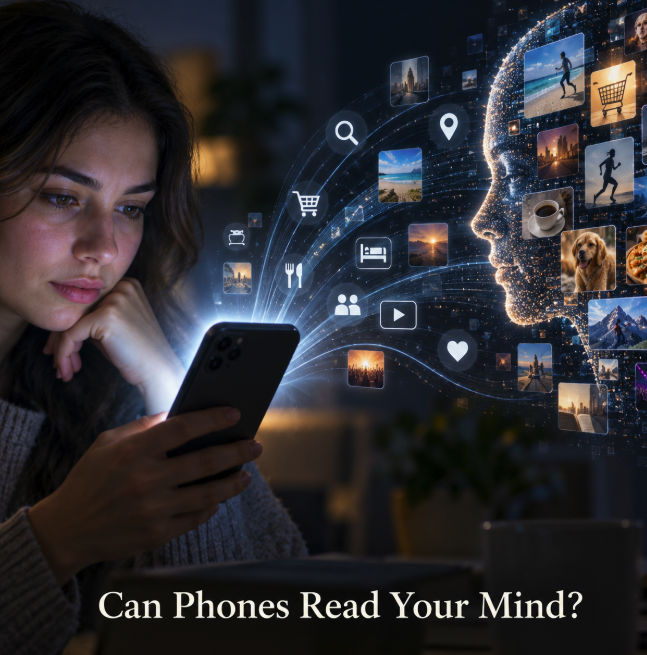
You mention hiking boots over dinner. The next morning, an advertisement for hiking boots appears on your phone. You never remember searching for them. The coincidence feels too precise, and an unsettling explanation immediately suggests itself: the phone must have heard you.
Experiences like this are so common that smartphones have acquired an almost supernatural reputation. Yet your phone does not need to read your mind — and an advertising platform does not necessarily need to secretly record your conversation — to make a disturbingly good guess about what you may want next.
The less cinematic explanation is also, in some ways, more remarkable. Modern advertising systems can build predictions from searches, websites, apps, purchases, approximate location, interactions with ads and other behavioral signals. Combine enough clues across millions or billions of interactions and an algorithm can sometimes anticipate an interest before you consciously notice how predictable that interest has become.
Your phone cannot literally read ordinary thoughts
A normal smartphone has no built-in sensor capable of decoding the private stream of thoughts inside your brain. Brain-computer interfaces are a genuine field of research, but systems that infer words, intended movements or other neural information require specialized equipment that measures brain activity. A phone sitting in your pocket is not silently extracting sentences from your neurons.
What phones and online services can collect, subject to operating-system controls, permissions, company practices and applicable law, is information about behavior. That difference is crucial. An algorithm does not need to know what you are thinking if it can estimate what people with a behavioral pattern like yours are likely to do.
Google’s own documentation on personalized advertising makes the principle explicit. Personalized ads can use previously collected information such as earlier searches, visits to websites or apps, location and demographic information to influence which advertisement is selected. Google also describes inferring interests from sites people visit and apps they use.
That is not telepathy. It is prediction.
Why the predictions can feel psychic
Imagine that you are thinking about taking a trip to Iceland. Perhaps you have not searched for “Iceland vacation” directly. But you watched two videos about the northern lights, checked the price of a waterproof jacket, looked at a map of Reykjavík after seeing a social post and spent longer than usual reading an airline promotion. Individually, those actions seem trivial. Together, they form a recognizable pattern.
Advertising and recommendation systems are built to detect patterns at a scale no person could monitor manually. They can group users into audiences, learn which behaviors tend to precede purchases and decide which ad has a higher probability of getting a response. The resulting prediction can arrive at exactly the moment when you feel you have only just started considering something.
Location adds another layer. Advertising systems may use location information where permitted, while apps can request access to a device’s location for many legitimate functions. Apple, for example, says apps may request access to location and other data and that users can later change those permissions. Its App Privacy Report can show how frequently apps access information including location, camera and microphone, as well as which domains they contact.
Even without knowing an exact location, context can be revealing. Being near an airport, attending an event, using a fitness app, browsing restaurant pages or repeatedly interacting with a particular category of content can all contribute to an inferred interest, depending on the platform and permissions involved.
But is the microphone secretly listening for ads?
This is the most persistent version of the theory. Smartphones obviously contain microphones, and apps with permission can use them for calls, voice messages, video recording, voice assistants and other features. That fact makes covert advertising surveillance seem technically straightforward.
But “a phone has a microphone” and “advertising platforms routinely record your private conversations to choose ads” are very different claims. There is no good basis for treating the second as the default explanation every time an eerily relevant advertisement appears.
Current mobile operating systems also include controls intended to make microphone access visible. Apple states that apps cannot access the microphone or camera without permission on iOS and iPadOS, and a visible indicator appears when either is being used. Its privacy tools can also report recent access. Cross-app tracking is separately controlled through App Tracking Transparency, which requires apps to ask permission before tracking activity across other companies’ apps and websites for advertising or sharing data with brokers.
A particularly revealing case arrived in 2026. The U.S. Federal Trade Commission announced settlements involving Cox Media Group and two marketing firms over claims surrounding an “Active Listening” advertising service. According to the FTC’s complaints, the companies told customers that the service could target ads using conversations captured from consumers’ smart devices. The FTC alleged that, contrary to those marketing claims, the service was not actually based on voice data and consumers had not opted into such targeting.
The episode is a useful warning in both directions. Companies can make alarming claims about what advertising technology supposedly does, so skepticism is justified. But sensational claims about devices listening to conversations are not automatically proof that the advertised technology actually works that way.
Coincidence does more work than we notice
There is also a psychological ingredient. People encounter enormous numbers of ads, recommendations and product references. Most are irrelevant and quickly forgotten. The one advertisement that matches a conversation from the previous evening is memorable precisely because it feels impossible.
This resembles the frequency illusion: once something becomes mentally salient, we suddenly notice it everywhere. If a friend mentions a particular car, shoe brand or holiday destination, related advertisements that would previously have passed unnoticed may suddenly jump out at you.
Memory can further distort the sequence. You may remember talking about an item before seeing the ad but forget an earlier interaction that helped trigger both events — perhaps a video you watched, a product a family member shared, a search performed days earlier or content that placed the idea in your mind in the first place.
None of this means targeted advertising is harmless or that privacy concerns are imaginary. The advertising ecosystem can involve substantial data collection, cross-service tracking and profiling. The point is that ordinary behavioral data can explain far more of the “my phone read my mind” feeling than people often assume.
How to make your phone less predictive
You cannot eliminate every inference while remaining online, but you can reduce the amount of information available for personalized advertising. Review app permissions and remove microphone, location, camera or contact access where an app does not genuinely need it. On iPhones and iPads, Apple’s App Tracking Transparency controls let users decide whether an app can track activity across other companies’ apps and websites. The App Privacy Report can provide additional visibility into permission and network activity.
Advertising accounts also commonly provide personalization controls. Google explains that users can manage information used for personalized advertising and that its ad systems use browsing and other activity to infer interests. Turning personalization down does not necessarily mean seeing fewer ads; it generally means the ads have less personal information available for choosing what to show you.
It is also worth periodically reviewing location permissions, deleting apps you no longer use and checking privacy settings after major operating-system updates. The goal is not to make yourself invisible — an unrealistic expectation for most connected devices — but to decide which forms of data collection are worth the convenience they provide.
So, can your phone read your mind? No. The uncomfortable truth is that it often does not have to. Human behavior leaves a long digital trail, and predictive systems are increasingly skilled at turning that trail into guesses about what we will click, buy, watch or want next. When one of those guesses lands perfectly, it can feel like telepathy. What you are usually seeing is something less magical and more measurable: statistics that know a surprising amount about people like us.