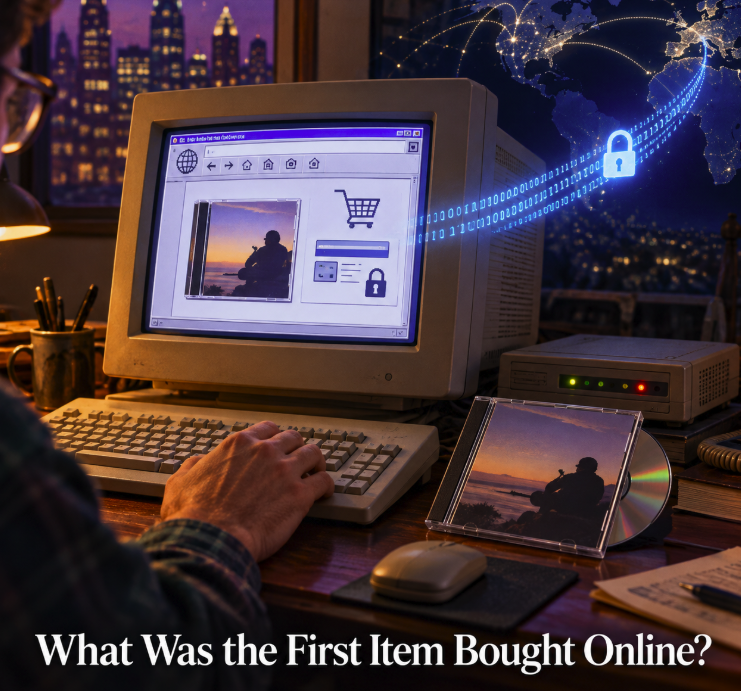
On August 11, 1994, a man in Philadelphia sat down at a computer and bought a CD. The album was Sting’s Ten Summoner’s Tales, the price was $12.48 plus shipping, and the seller was a young company called NetMarket. Nothing about the object itself was revolutionary. What mattered was how the money moved: the buyer entered his credit-card information and sent it across the Internet protected by encryption.
The following day, The New York Times reported the transaction under a headline that captured the moment: “Attention Shoppers: Internet Is Open.” The newspaper cautiously described it as apparently the first retail Internet transaction using readily available powerful encryption to protect privacy. That qualification matters, because the answer to “What was the first item bought online?” depends heavily on what we mean by online, bought and even Internet.
The Sting CD is the cleanest answer to a more precise question: what was the first widely documented secure retail purchase of a physical product made over the Web? But decades before online shopping carts became ordinary, people were already experimenting with networks as places to arrange transactions.
Before e-commerce, there were network deals
The story begins before the World Wide Web existed. In the early 1970s, students at Stanford and MIT used ARPANET, the research network that became an important ancestor of today’s Internet, to arrange a marijuana transaction. The episode is frequently called the first online sale, but that description stretches the modern meaning of e-commerce. The network helped people communicate about the deal; it did not provide anything resembling a Web store, encrypted checkout or online card payment.
That distinction makes more sense in the context of how ARPANET evolved into the Internet and how the World Wide Web emerged later. ARPANET began connecting research computers in 1969, long before browsers, shopping carts and commercial websites. Its famous first host-to-host message was the accidental two-letter “LO”, sent when a UCLA computer crashed while trying to transmit the word LOGIN.
There were other important precursors. In 1984, British pensioner Jane Snowball used a television connected to a computer system to order groceries from a local Tesco store as part of an interactive shopping experiment in Gateshead, England. Her groceries arrived at home, but payment was handled on delivery. It was remarkably close to modern online grocery shopping in spirit, yet it was not a secure Web payment—the Web itself had not been invented.
By the early 1990s, the ingredients for modern e-commerce were finally converging. The Internet was expanding beyond its academic roots, Tim Berners-Lee’s World Wide Web was spreading, graphical browsers were making websites easier to use, and entrepreneurs were trying to solve a problem that now seems almost mundane: how do you safely type a credit-card number into a computer and send it to a merchant?
The $12.48 Sting CD that made history
NetMarket was created by Dan Kohn and a small team of recent college graduates. Kohn had begun thinking seriously about Internet commerce while studying in London, where he could remotely connect to computers back at Swarthmore College. His idea was straightforward but ambitious: the network should not merely distribute information. It should also be able to support real commerce.
At noon on August 11, 1994, Phil Brandenberger of Philadelphia used NetMarket to purchase Sting’s 1993 album Ten Summoner’s Tales. Contemporary reporting put the price at $12.48 plus shipping. The credit-card information was protected using Pretty Good Privacy, or PGP, encryption integrated into NetMarket’s system. This is an important technical detail because later retellings sometimes say the purchase used SSL. Netscape’s SSL technology would become enormously important to secure Web commerce, but the NetMarket transaction is documented as using PGP-based encryption.
For the NetMarket team, encryption was the breakthrough. A website that merely displayed a catalog was not enough. Customers needed a way to transmit sensitive payment information without exposing the card number to anyone monitoring network traffic. Kohn famously told the Times that even if the NSA were listening, it could not obtain the buyer’s credit-card number.
The purchase looks almost comically small from the perspective of modern e-commerce: one CD, one buyer, less than thirteen dollars before shipping. Yet it demonstrated something fundamental. A stranger did not have to call a merchant, mail a check or hand cash to a delivery driver. A consumer could choose a physical product and securely transmit payment information through a computer network.
The timing was extraordinary. In 1994, the commercial Web was still tiny. Amazon had not yet opened its online bookstore, and eBay did not exist. Within a few years, buying things through a browser would move from an experiment requiring unusual software to an increasingly normal part of consumer life.
So was the Sting CD really the first online purchase?
The safest historical answer is: it was a landmark first, but not the only claimant.
Internet Shopping Network, another early online retailer, has been cited as selling computer equipment online before the NetMarket transaction. Pizza Hut also experimented with ordering pizza through the Web in 1994 and is frequently dragged into lists of e-commerce “firsts.” Meanwhile, the ARPANET marijuana deal and Jane Snowball’s grocery order push the timeline back much further if “online purchase” is defined broadly enough.
This is why the wording used by contemporary reporting remains useful. NetMarket’s Sting CD was celebrated not simply because somebody had used a computer to ask for an object. Its historical importance came from combining a Web-based retail transaction with encrypted transmission of credit-card information. Smithsonian later noted the competing claims and concluded that the answer changes depending on how the transaction is defined.
The ambiguity is not a flaw in the story. It reveals how technologies actually emerge. There is rarely a single morning when an invention suddenly appears in its finished modern form. Online shopping grew from networking experiments, electronic ordering systems, early websites, encryption software, credit-card infrastructure and entrepreneurs willing to test whether consumers would trust a computer with their money.
A purchase that now feels completely ordinary
What makes the 1994 transaction fascinating today is how little drama remains in the act it pioneered. A secure checkout page, an encrypted connection and a card number sent electronically are now so ordinary that shoppers barely notice the machinery underneath them. Browsers display a padlock, payment processors authorize a transaction in seconds, and a package may begin moving through a warehouse before the customer has closed the tab.
The Web itself had only recently become practical for ordinary users. Its early culture produced experiments that could seem wonderfully trivial at the time—such as the first famous webcam, built to watch a coffee pot—yet many of those experiments quietly revealed what a globally connected network could become.
So if someone asks what the first item bought online was, “a Sting CD” is a good answer, provided one extra phrase comes with it. On August 11, 1994, a copy of Ten Summoner’s Tales became the product in the first widely documented secure retail transaction on the Web. The broader history is messier, stretching from ARPANET deals and experimental grocery shopping to rival 1994 retailers. But that $12.48 purchase remains one of the clearest moments when the Internet stopped looking only like a place to exchange information and started looking like a place to shop.