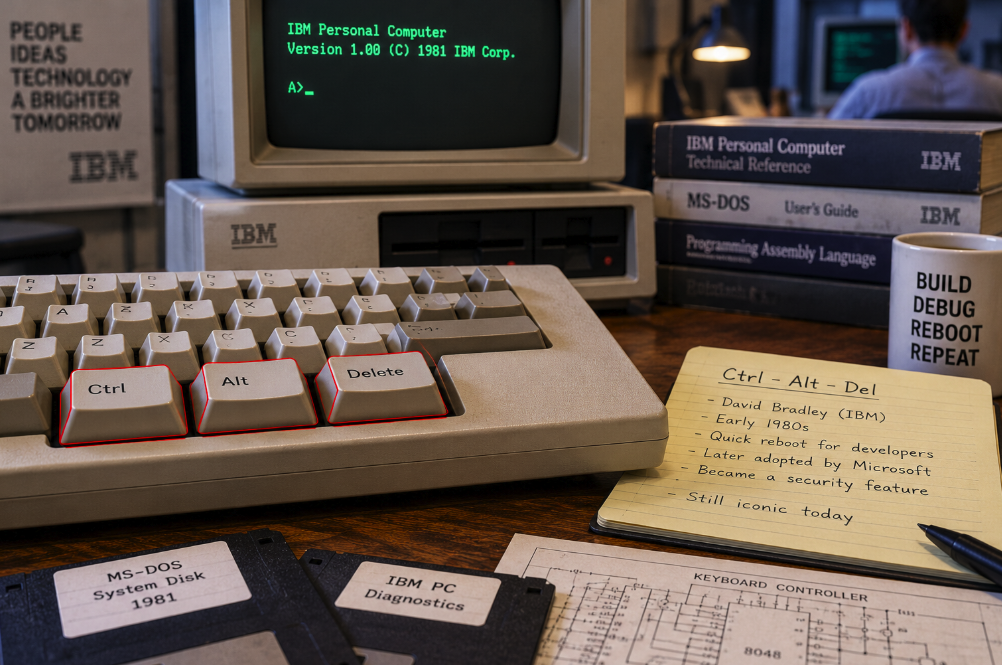
Few keyboard shortcuts have acquired a reputation beyond computing itself. Ctrl-C means copy, Alt-Tab switches windows, but Control-Alt-Delete became something larger: a universal gesture of technological frustration. When a computer froze, generations of users learned to reach instinctively for three keys.
Its origin was much less dramatic. Ctrl-Alt-Delete was not designed as a grand security feature, nor was it initially intended to become a ritual performed by millions of PC users. It began as a convenience for engineers developing the first IBM Personal Computer, who needed to restart prototype machines repeatedly without wasting time switching the power off and back on.
The man most closely associated with the combination, IBM engineer David Bradley, later summarized the irony with a famous joke: he may have invented it, but Bill Gates made it famous.
A shortcut born inside the original IBM PC project
In 1980, IBM assembled a small team in Boca Raton, Florida, to build a personal computer on an unusually aggressive schedule. The resulting IBM 5150 Personal Computer was unveiled on August 12, 1981. IBM's history of the PC describes how its open architecture helped turn the machine into a de facto industry standard and encouraged an enormous ecosystem of compatible hardware and software.
During development, engineers constantly crashed, tested and restarted their machines. A conventional power cycle was inconvenient because the hardware had to go through its startup checks again. Developers wanted a faster way to reset the system while debugging.
Bradley, who worked on the IBM PC's BIOS, created a keyboard-triggered reset. The first version reportedly used Control-Alt-Escape, but Escape sat too close to the other keys and could be activated too easily. The combination was changed to Control-Alt-Delete. On the original keyboard layout, Delete was positioned far enough away that deliberately pressing all three keys required an awkward two-handed action.
That awkwardness was a feature. A reset command should be easy for a developer to invoke intentionally and difficult to trigger accidentally while typing.
The resulting mechanism became known as a warm reboot or soft reset. Instead of physically turning the machine off and on, the user could tell the system to restart from the keyboard.
IBM documented it as a reset, not a security ritual
Early IBM documentation makes the original purpose unusually clear. Manuals preserved by the Computer History Museum describe Ctrl-Alt-Del as producing the equivalent of a system reset or reboot. One IBM manual explains that memory is cleared and the Personal Computer restarted, and explicitly says resetting this way is preferable to switching the power off and on because the system starts faster.
That is very different from what many Windows users later learned the combination to mean. There was no security screen, no Task Manager and no list of locked-user options. The key sequence was fundamentally an engineering reset mechanism.
Bradley also did not expect ordinary users to depend on it. The feature was created during development and was originally the sort of diagnostic convenience that might have remained an obscure implementation detail. But IBM's PC architecture spread far beyond IBM itself.
The 5150 became enormously influential, and compatible machines reproduced its behavior. Ctrl-Alt-Delete travelled with the PC platform.
Why those three keys were unusually powerful
Most keyboard shortcuts are interpreted by whichever application or operating system currently has focus. That makes them flexible, but it also means software can intercept them.
Ctrl-Alt-Delete developed a special status because its handling sat deeper in the PC architecture. In the DOS era, invoking it could restart the system even when ordinary software was misbehaving, although a sufficiently severe hardware failure could still leave the machine unresponsive.
This made the combination useful far beyond IBM's engineering lab. Software in the 1980s and early 1990s was often less isolated than modern applications. One malfunctioning program could leave a personal computer in a state from which the easiest recovery was a reboot.
The three-key salute became part of everyday PC culture.
Windows changed its meaning
As graphical operating systems became more sophisticated, Microsoft began using the famous sequence for purposes other than an immediate hardware-style reset.
Windows 3.x could intercept Ctrl-Alt-Delete and present the user with options when an application stopped responding. Microsoft's Raymond Chen has described how enhanced-mode Windows used the sequence to offer choices such as closing a non-responsive program, restarting the computer or cancelling the operation. The shortcut was already evolving from “restart this machine” into “something is wrong; give me control.”
The more consequential transformation came with the Windows NT security architecture. Microsoft adopted Ctrl-Alt-Delete as a Secure Attention Sequence, or SAS.
The idea solves a subtle security problem. Imagine malware displaying a fake Windows login screen. If the user cannot distinguish it from the genuine one, they may type a username and password directly into the attacker's program.
Windows can reserve Ctrl-Alt-Delete for a trusted system component. Microsoft's Winlogon documentation explains that Winlogon registers the Ctrl-Alt-Del Secure Attention Sequence so another application cannot hook the sequence first. When the SAS is received, Windows can switch to its protected logon environment. citeturn0search0
This gave an old reboot shortcut a completely new purpose: it became a way for the human at the keyboard to request the operating system's trusted attention.
Why Ctrl-Alt-Delete can protect a password
Microsoft's security guidance still explains the logic in remarkably direct terms. Requiring Ctrl-Alt-Delete before sign-in helps ensure that the user is communicating through a trusted path when entering credentials. Without that requirement, malicious software could imitate the standard sign-in dialog and attempt to capture the password. citeturn0search6
The security does not come from the keys themselves. There is nothing cryptographically magical about Control, Alt and Delete. The protection comes from the operating system reserving the sequence so ordinary applications cannot impersonate its response.
This distinction is important because it shows how software can transform the meaning of hardware conventions. Bradley selected the keys because they were physically inconvenient to press accidentally. Microsoft later benefited from the fact that the sequence already occupied a privileged place in PC architecture and user memory.
An ergonomic accident of 1981 became part of the authentication model of enterprise computing.
The Bill Gates joke that followed the shortcut for decades
Ctrl-Alt-Delete eventually became famous enough that its creators and inheritors were asked about it publicly. At a twentieth-anniversary event for the IBM PC in 2001, Bradley appeared on a panel with Bill Gates and delivered the line that has followed the story ever since: although Bradley invented the combination, Gates made it famous.
The joke worked because Microsoft Windows had transformed Ctrl-Alt-Delete from an engineer's convenience into something hundreds of millions of users encountered. Gates, for his part, later expressed regret about the three-key login requirement and suggested that Microsoft would have preferred a single dedicated key if the hardware environment had made that practical.
Yet the awkwardness is part of what made the combination memorable. It feels deliberate. Pressing three separated keys at once is not like tapping Enter or Escape. It resembles a small physical ceremony.
What Ctrl-Alt-Delete does today
Modern Windows no longer treats the sequence as a simple command to reboot. Microsoft's current Windows shortcut documentation says Ctrl-Alt-Delete opens the security screen, from which a user can lock the desktop, switch users, sign out, change a password or open Task Manager. citeturn0search10
That makes its present-day role almost the inverse of the original one. Bradley's shortcut existed to bypass the delay of restarting hardware during development. Modern Windows uses the same gesture to provide a controlled, trusted interface precisely when the user needs authority over the session.
Meanwhile, the original reboot meaning survives in cultural memory. “Ctrl-Alt-Delete it” became shorthand for forcing a fresh start, whether the thing being reset was a computer, a project or even an organization.
A tiny engineering decision that escaped into culture
The history of computing is full of decisions that were made under intense time pressure and then survived for decades because later systems inherited them. QWERTY outlived mechanical type bars. The floppy-disk icon survived as the symbol for Save long after many users had stopped seeing floppy disks. Ctrl-Alt-Delete followed the same path.
Its longevity was not planned. An IBM engineer needed to reboot prototype PCs more efficiently. IBM shipped the behavior. Compatible computers copied IBM. Software learned to recognize the combination. Microsoft turned it into a security boundary. Users turned it into folklore.
The original IBM PC itself was a product of 1981, a machine with as little as 16 kilobytes of RAM in its entry configuration. IBM could hardly have predicted that one of its developer conveniences would remain recognizable on computers with billions of times more memory. citeturn0search5
That is what makes Ctrl-Alt-Delete such a revealing artifact. Technology does not always evolve by replacing the old with the new. Sometimes a solution to yesterday's problem is repurposed until it solves an entirely different one.
David Bradley designed three keys to restart a machine quickly. Four decades later, pressing them still tells a Windows PC something remarkably fundamental: stop listening to ordinary software for a moment — the person at the keyboard wants control.