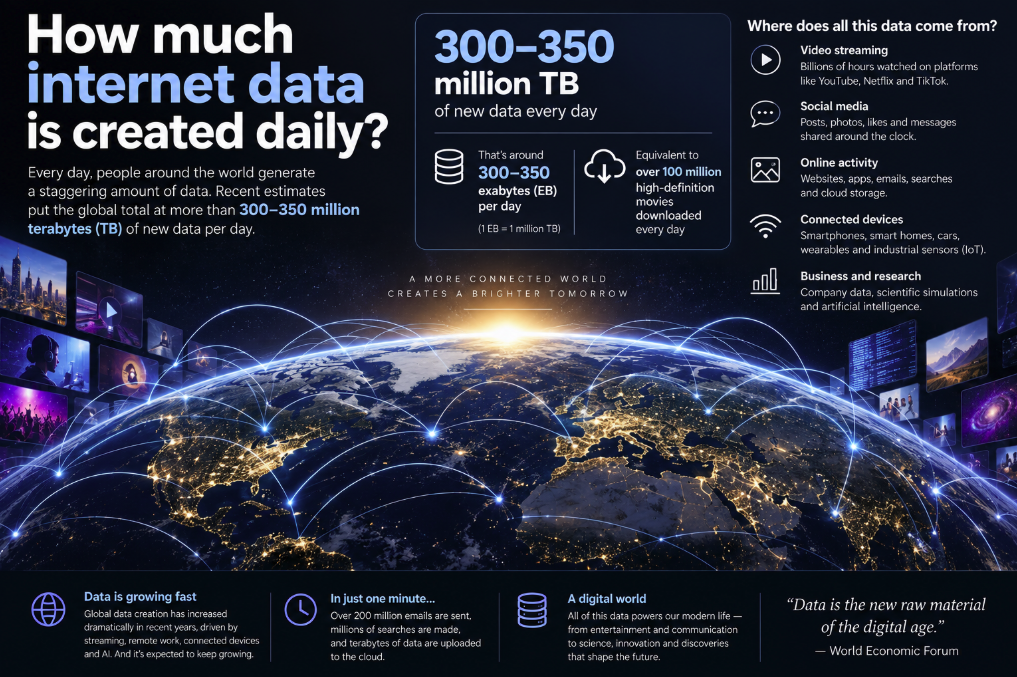
Every email, video stream, security-camera frame, cloud backup, online purchase, AI response and sensor reading leaves a digital trail. Multiply those events across billions of people, phones, computers, factories and connected devices, and the numbers quickly stop feeling human.
A widely repeated estimate says that roughly 400 million terabytes of data are created every day. You will also encounter figures closer to 300–350 million terabytes, while newer industry forecasts imply an even larger daily flow. None of these should be treated as a literal counter measuring only brand-new files uploaded to the public internet.
The reason is surprisingly important: “data created” usually means much more than original internet content. Industry measurements often include data that is created, captured, copied, replicated or consumed across the entire digital world. A photograph backed up to three cloud locations can contribute more than once. So can a database replicated across data centers. Temporary machine logs and sensor streams may count even if no human ever sees them.
The real answer, then, is not one perfectly precise number. Humanity now produces and processes hundreds of millions of terabytes of digital data every day, and the amount is rising rapidly.
What does 400 million terabytes actually mean?
Large data units become confusing almost immediately. One terabyte is 1,000 gigabytes under the decimal convention commonly used for storage. One million terabytes make an exabyte, and 1,000 exabytes make a zettabyte.
That means 400 million terabytes is about 400 exabytes, or 0.4 zettabytes. Repeated every day for a year, a daily average of that scale would correspond to roughly 146 zettabytes.
A frequently cited current estimate puts the figure at about 402.74 million terabytes per day. But its definition includes data that is newly generated, captured, copied or consumed. Describing all 402.74 million terabytes as “new internet data” therefore gives the statistic more precision — and a narrower meaning — than the methodology supports.
Current forecasts are also moving quickly. In July 2026, IDC said the world was generating more than seven petabytes of data every second. Sustained for 24 hours, seven petabytes per second would amount to more than 600 million terabytes per day.
That does not necessarily contradict the lower figure. Different estimates cover different years and may measure different parts of the global “datasphere.” IDC itself emphasizes that much of the world's data is not original information at all but copies and repeated versions. The safest conclusion is about scale rather than an illusory exact total: the daily flow is measured in hundreds of exabytes.
Where does all that data come from?
It is tempting to picture the internet as social-media posts, emails and websites. Those are visible sources of data, but they are only part of the story.
Video is enormous. Streaming services continuously move high-resolution movies, television, livestreams and short-form clips through global networks. Users upload their own videos while platforms generate thumbnails, recommendations, captions, analytics and multiple encoded versions optimized for different devices and connection speeds.
Messaging and social networks add photographs, voice notes, reactions, private messages, posts and metadata. Search engines process queries. Maps receive location information. Financial systems record transactions. Businesses continuously create databases, documents and backups.
Then there is the less visible machine world. Industrial equipment can contain sensors measuring temperature, pressure, vibration and performance. Cars generate telemetry. Security cameras record video. Satellites transmit observations. Websites create logs whenever servers receive requests. Cloud infrastructure monitors itself. Scientific instruments can produce enormous experimental datasets.
And increasingly, artificial intelligence both consumes and generates data. Training large models requires vast datasets, while deployed AI systems create outputs, embeddings, logs and intermediate information at machine speed. IDC forecasts that more than a billion AI agents could eventually be producing and processing information, adding another layer to global data growth.
Domo's long-running Data Never Sleeps project offers a more intuitive way to understand the torrent. Instead of trying to calculate all bytes in existence, it tracks what people and platforms do in a single internet minute. Its recent editions include millions of searches, hundreds of millions of emails and huge volumes of streaming and social activity occurring every 60 seconds.
Those statistics are not interchangeable with a global datasphere estimate, but they reveal why the total becomes so enormous. Digital systems rarely sleep.
Created, transferred and stored are not the same thing
This distinction explains many contradictory headlines about the size of the internet.
Suppose you record a 1-gigabyte video on your phone. You have created data. Your phone automatically uploads the file to cloud storage, producing another copy. You send it to a friend, who downloads it. A platform may create lower-resolution versions for streaming. Backup systems may replicate the file in another data center.
One original gigabyte can therefore result in several gigabytes being stored or transferred. Depending on the methodology, some or all of those copies and movements may contribute to a data-creation statistic.
Internet traffic is another concept again. Traffic measures information moving through networks, which means the same Netflix episode watched by a million households generates vastly more traffic than the size of one master copy. Storage capacity measures how much data devices can retain. Neither number directly tells us how much genuinely unique information humanity invented that day.
This is why claims such as “X terabytes of new information are created on the internet every day” deserve caution. There is no global meter attached to every server, phone, sensor and offline storage system. Researchers build estimates from models, market data, network activity and forecasts, and their definitions matter enormously.
The numbers are getting bigger faster than our intuition
The scale is easier to appreciate historically. IDC's Global DataSphere work has documented dramatic growth as smartphones, cloud computing, streaming video, connected devices and digital business expanded. The next wave adds generative AI, autonomous software agents, richer media and more sensors.
In a separate 2026 analysis, IDC reported that enterprises alone created about 6.9 petabytes of data every second in 2025 and projected 17.1 petabytes per second by 2029. The precise relationship between enterprise data and the wider global datasphere depends on IDC's methodology, but the direction is unmistakable.
More data does not automatically mean more knowledge. Huge portions are duplicated, temporary, low-value or never analyzed. A thousand nearly identical machine logs technically add data without adding a thousand new insights. An AI system can generate millions of words without creating an equivalent amount of genuinely new knowledge.
That distinction may become one of the defining technological questions of the next decade. The challenge is shifting from merely collecting information to deciding what deserves to be retained, trusted and understood.
So how much internet data is created every day? If “internet data” is being used loosely to mean the world's digital datasphere, a reasonable modern shorthand is hundreds of millions of terabytes every 24 hours. The familiar 300–350 million figure captures the right order of magnitude but is no longer a reliable current ceiling; widely cited estimates have passed 400 million, while newer IDC figures imply still greater volumes under broader definitions.
The more revealing fact is not the exact number. Before you finish reading this sentence, millions of devices around the planet will have generated, copied, transmitted and processed another mountain of information — most of it invisible, much of it temporary, and almost all of it produced faster than any human being could possibly comprehend.