It is one of those rules that millions of Americans seem to remember learning without remembering who taught it: you cannot drive a car barefoot. Maybe a parent said it. Maybe a driving instructor mentioned shoes. Maybe it simply sounded plausible enough to become common knowledge.
There is one problem. The supposed rule is a remarkably persistent American driving myth.
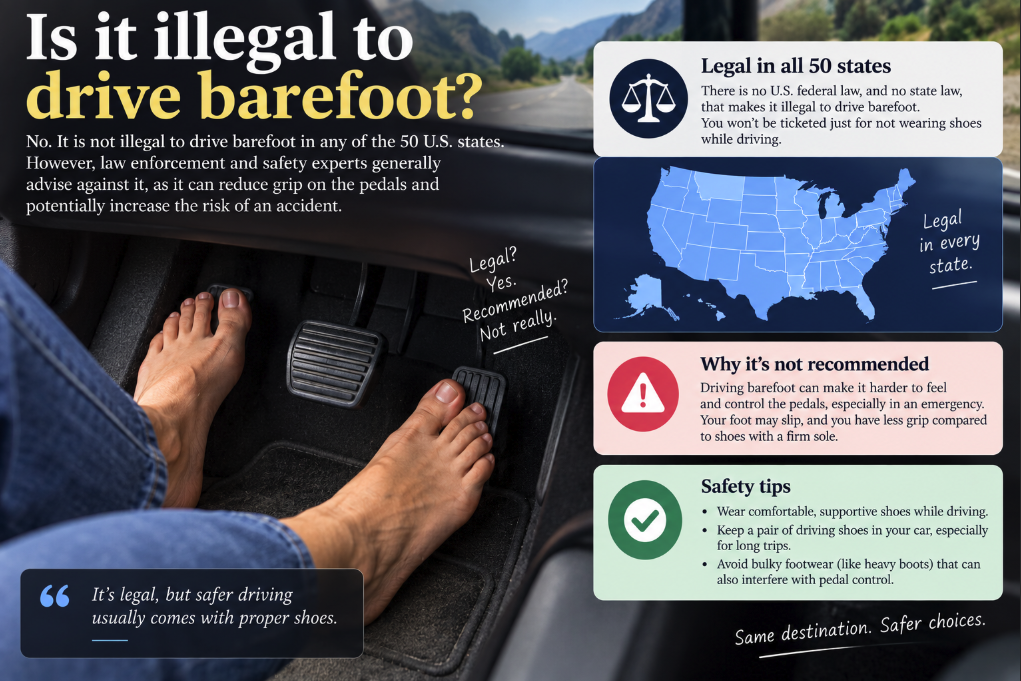
There is no general U.S. law requiring an ordinary passenger-car driver to wear shoes, and state authorities that address the question directly confirm that barefoot driving can be legal. Wisconsin's Department of Transportation, for example, answers the question “Is it legal to drive without shoes?” with an unambiguous “Yes.” Missouri's State Highway Patrol goes further, explicitly calling the belief that barefoot driving is illegal a popular misconception.
That does not mean footwear never matters. A driver is still responsible for controlling the vehicle safely, and both bare feet and badly chosen shoes can create practical problems. The surprising part is that the legal question and the safety question are not quite the same thing.
Where did the barefoot-driving myth come from?
Its exact origin is difficult to pin down, which is probably part of why it survived so well. Driving laws contain hundreds of detailed rules about licenses, seat belts, vehicle equipment, speed, signaling and safe operation. A rule requiring shoes sounds entirely believable among them.
The myth may also persist because footwear rules exist in other contexts. Motorcyclists are commonly advised to wear sturdy protective boots, commercial drivers may be subject to workplace requirements, and driving tests or employers can impose policies that are not identical to the state's traffic code.
Over time, “you should wear suitable shoes” easily becomes “you legally have to wear shoes.”
Official state guidance provides unusually clear evidence of the distinction. In a myth-busting article, the Missouri State Highway Patrol states that it is not illegal to drive barefoot in Missouri. The agency even notes that barefoot driving can sometimes be safer than driving in certain high heels, wedges or thin flip-flops.
That last point turns the familiar warning on its head. Shoes are not automatically safer merely because they are shoes.
Why flip-flops and heels can be worse than bare feet
Driving depends on surprisingly precise foot movements. The driver must move quickly between accelerator and brake, judge pressure through the sole and avoid anything that prevents a pedal from returning freely.
A loose flip-flop can fold or catch beneath a pedal. A wet foot can slide inside an open sandal. A very thick sole can reduce pedal feel. High heels alter the angle at which the foot contacts the floor and pedals, while bulky footwear can make it easier to touch two pedals unintentionally.
Missouri's highway patrol specifically mentions thin flip-flops that can bend under a pedal and footwear that may allow the foot to slip or twist. Its conclusion is not that everyone should drive barefoot, but that the safest option depends on whether the driver can operate the pedals reliably.
This is the useful principle behind the folklore: footwear should never interfere with vehicle control.
A well-fitting flat shoe with a secure sole will generally provide predictable contact and protection. But if the choice is between bare feet and an unstable pair of footwear that can become trapped around the pedals, taking the problematic shoes off may be the safer option.
Could you still get in trouble while driving barefoot?
Potentially — but not simply because your feet are bare.
Traffic codes contain broad duties requiring motorists to operate vehicles safely. If a driver's behavior becomes careless, reckless or otherwise violates a traffic rule, the fact that the person was barefoot does not provide a defense. Conversely, the absence of shoes does not automatically establish that the driving was unsafe.
This distinction matters after a crash. Investigators and insurers may consider anything that contributed to loss of control. If a driver could not brake effectively because a foot slipped, or if a loose shoe became lodged under a pedal, those circumstances may be relevant to what happened even if no statute specifically regulates footwear.
The same logic applies to countless legal activities behind the wheel. Drinking coffee is not universally prohibited, adjusting climate controls is not inherently illegal, and wearing an unusual pair of shoes is not normally a traffic offense by itself. But any of them can become part of unsafe conduct if they prevent the driver from paying attention or controlling the vehicle.
Is barefoot driving legal in all 50 states?
The familiar national version of the myth says that every U.S. state bans barefoot driving. The opposite claim — that ordinary barefoot driving is legal throughout the 50 states — has been repeatedly documented by driving organizations and state authorities, and there is no general federal footwear requirement for private motorists.
Still, traffic law is primarily state law, not one nationwide code. Regulations can change, local rules can differ in specialized circumstances, and vehicle categories such as motorcycles or commercial fleets can involve additional requirements. Anyone needing legal certainty for a particular jurisdiction should check that state's current motor-vehicle code or licensing agency rather than relying on a social-media graphic.
What can be said confidently is that the broad American belief that taking your shoes off behind the wheel is itself a traffic offense is false. Official sources in states including Wisconsin and Missouri explicitly reject it.
Why might barefoot driving feel different?
Without a shoe sole between the foot and pedal, a driver receives more direct tactile feedback. Some people therefore feel that they can judge pedal pressure more precisely barefoot. Others find the opposite: a hard brake pedal can be uncomfortable against an unprotected foot, especially during emergency braking.
Temperature can matter too. A vehicle floor can become extremely hot or cold, and an injured foot has no protective layer. Shoes also matter once you leave the vehicle; a collision or roadside emergency can leave broken glass, sharp metal or hot pavement underfoot.
That is one practical reason keeping secure footwear in the car makes sense even for someone who prefers driving barefoot.
There is also a simple safety consideration when removing shoes: do not leave them loose around the driver's footwell. A sandal sliding forward and becoming trapped beneath a brake pedal is a much more concrete hazard than the mythical barefoot-driving ticket.
The rule worth remembering
The enduring story about barefoot driving is a good example of how road-safety advice turns into imaginary law. Somewhere along the way, the sensible idea that drivers should wear appropriate footwear became the much stronger claim that driving without shoes is illegal.
It generally isn't. Wisconsin DOT says so directly. Missouri State Highway Patrol not only confirms it but points out that certain footwear can make pedal control worse.
So if you climb into a car after a day at the beach, being barefoot is not automatically the legal problem generations of drivers were warned about. The more important question is whether you can operate the accelerator, brake and clutch — if there is one — securely and without obstruction.
In driving, the safest foot is not necessarily the one wearing a shoe. It is the one that can control the pedals properly.