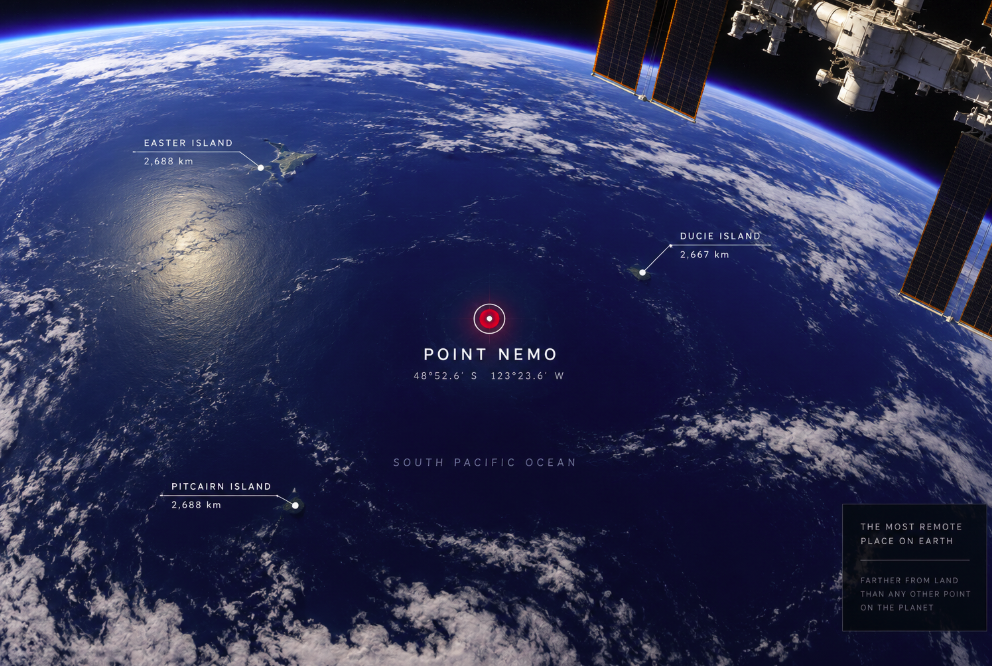
There is a place in the South Pacific where the horizon contains nothing but water and the nearest scraps of land are roughly 2,688 kilometers away. No island marks the spot. There is no lighthouse, settlement or permanent buoy announcing that you have arrived. Point Nemo is simply a set of coordinates in an enormous ocean — yet mathematically, it is one of the strangest places on Earth.
Its formal description is the oceanic pole of inaccessibility: the point in the world's oceans farthest from any land. The isolation is so extreme that a popular claim about Point Nemo is genuinely possible. When the International Space Station passes sufficiently close overhead, astronauts orbiting a few hundred kilometers above Earth can be much nearer to the point than any human standing on land.
That does not mean astronauts are always the nearest people; a ship can of course sail through the region. But the comparison captures the scale beautifully. At the right moment, the closest people to a location on Earth's surface can be in space.
A point defined by distance
According to the U.S. National Oceanic and Atmospheric Administration, Point Nemo lies at approximately 48°52.6′ south, 123°23.6′ west. NOAA gives its distance from the nearest land as about 2,688 kilometers, or 1,670 miles.
Three remote pieces of land define the geometry around it: Ducie Island in the Pitcairn group lies to the north, Motu Nui near Rapa Nui — Easter Island — lies to the northeast, and Maher Island off Antarctica lies to the south. None is anything like a convenient refuge for a stranded traveler. citeturn0search0
The point was calculated in 1992 by Croatian-Canadian survey engineer Hrvoje Lukatela using geospatial computation. This is an important detail because Point Nemo was not “discovered” in the conventional geographical sense. Nobody needed to sail across the ocean until they happened upon it. It is the solution to a mathematical problem: find the location on the ocean surface whose nearest land is farther away than the nearest land from any other ocean point. Guinness World Records likewise identifies Lukatela's 1992 calculation and gives the commonly accepted distance as 2,688 kilometers. citeturn0search7
The exact numerical answer can shift slightly depending on the coastline dataset and how tiny coastal features are represented. Geography becomes surprisingly complicated when the winning point depends on measuring distances to small islands and Antarctic coastline. The familiar coordinates are therefore best understood as the conventional location of Point Nemo rather than a physical marker planted in the sea.
Why it is called Nemo
The name is a literary joke with two layers. Nemo is Latin for “no one,” an appropriate label for a point defined by its remoteness. It also refers to Captain Nemo, the enigmatic submarine commander created by Jules Verne and best known from Twenty Thousand Leagues Under the Seas.
A location surrounded by thousands of kilometers of open ocean could hardly have been given a more fitting name. NOAA explicitly connects the nickname with Verne's famous submariner. citeturn0search0
Unlike the North or South Pole, however, Point Nemo has no special physical appearance. Ocean water at the coordinates does not change color. There is no geological pinnacle underneath defining the point. Move a few kilometers away and the sea looks essentially the same.
Its significance exists because of its relationship to everything else.
Are astronauts really the closest humans?
The most repeated Point Nemo fact sounds like an Internet exaggeration: sometimes the nearest humans are aboard the International Space Station.
The geometry makes it possible. Point Nemo is about 2,688 kilometers from the nearest land. The ISS normally orbits only a few hundred kilometers above Earth's surface. Guinness notes that if the station is directly overhead at roughly 400 kilometers altitude, someone at Point Nemo would be considerably closer to its crew than to anyone on the nearest land. citeturn0search7
The crucial qualification is often omitted. “Nearest land” does not mean “nearest human.” The South Pacific is remote, but it is not sealed off. Research vessels, cargo ships, yachts or expeditions can enter the region. If a ship were 50 kilometers away, its crew would obviously be closer than orbiting astronauts.
Nor is the ISS permanently above Point Nemo. The station circles Earth continuously, so the astronaut comparison applies during suitable passes and when no surface vessel happens to be closer.
Even with those caveats, it remains an extraordinary geographical fact. Most places on Earth are surrounded by people. Point Nemo is distant enough from permanent habitation that space can temporarily be the nearer human environment.
The ocean around Nemo is empty for another reason
Remoteness from land is only part of the story. Point Nemo lies within the South Pacific Gyre, one of the great rotating systems of ocean currents.
The central waters of subtropical gyres tend to receive relatively limited supplies of nutrients compared with highly productive coastal regions and major upwelling zones. Point Nemo is also extremely far from continental sources that can deliver nutrients to marine ecosystems.
This does not make the region biologically sterile. Microorganisms and other marine life exist in the open ocean. But the environment is famously oligotrophic — nutrient-poor — and the combination of geographical isolation and ocean circulation makes it a very different ecosystem from a rich continental shelf.
The eerie image of Point Nemo as an empty blue desert therefore has some scientific basis, provided it is not exaggerated into the claim that nothing lives there.
Why spacecraft are sent toward the same part of the Pacific
Point Nemo is also associated with one of the strangest cemeteries on the planet: a graveyard for spacecraft.
Large spacecraft in low Earth orbit cannot always be left to fall wherever atmospheric drag eventually takes them. Operators can perform controlled reentries, steering a vehicle so that surviving debris falls into a remote region where the probability of hitting people, buildings or ships is extremely low.
The broad South Pacific Ocean Uninhabited Area used for such disposals is associated with the region around Point Nemo. The famous Russian space station Mir was deliberately brought down over the South Pacific in 2001, and numerous unmanned cargo vehicles and other spacecraft have also been directed into remote oceanic reentry zones.
It is important not to imagine a tidy pile of intact spacecraft sitting exactly beneath the Point Nemo coordinates. Reentering vehicles break apart, much of their material burns in the atmosphere, and surviving debris can be scattered across long footprints. The “spacecraft cemetery” is a broad disposal region, not an underwater parking lot centered on a single pin.
Its association with Point Nemo nevertheless makes perfect sense. The same property that makes the point fascinating to geographers — extreme distance from people and land — makes the surrounding South Pacific useful when engineers need the safest practical place for controlled debris to fall.
Isolation is a mathematical concept, not an atmosphere
Point Nemo often appears in lists of mysterious or forbidden locations, which can give it an almost supernatural reputation. In reality, nothing prevents a properly equipped vessel from sailing through it. There is no exclusion zone created simply because it is Point Nemo.
The difficulty is logistical. A ship reaching the area must travel enormous distances through open South Pacific waters. There is no nearby harbor to enter if equipment fails, no convenient airport and no inhabited island just beyond the horizon.
That is what a pole of inaccessibility measures: not mystical isolation, but distance from a boundary — in this case land.
Continents have their own poles of inaccessibility, defined as places especially far from coastlines or other specified edges. The oceanic version is conceptually inverted. Instead of finding the point on land most deeply embedded within a continent, it finds the point in the ocean most deeply embedded within water.
A place that exists mostly as coordinates
Point Nemo is compelling partly because it challenges the way we imagine geography. Famous places usually have something to photograph: a mountain, waterfall, monument, city or island. Point Nemo has almost nothing visually unique to offer. A photograph taken there would probably show ordinary open ocean.
Yet invisible geometry makes that water exceptional. Draw circles outward from the point and you can travel roughly 2,688 kilometers before reaching the nearest land. Put the International Space Station overhead and the human beings above you may be more than six times closer than those nearest coastlines.
The name “Nemo” — no one — seems almost designed for it. But the irony is that this supposedly empty place connects several very human stories: our urge to map the planet precisely, our fascination with Jules Verne, our expansion into space and our need to find somewhere safe for spacecraft to return when their journeys are over.
Point Nemo is not the end of the world. It is something stranger: a perfectly ordinary patch of ocean that mathematics has identified as the place on Earth's seas most distant from everywhere else.