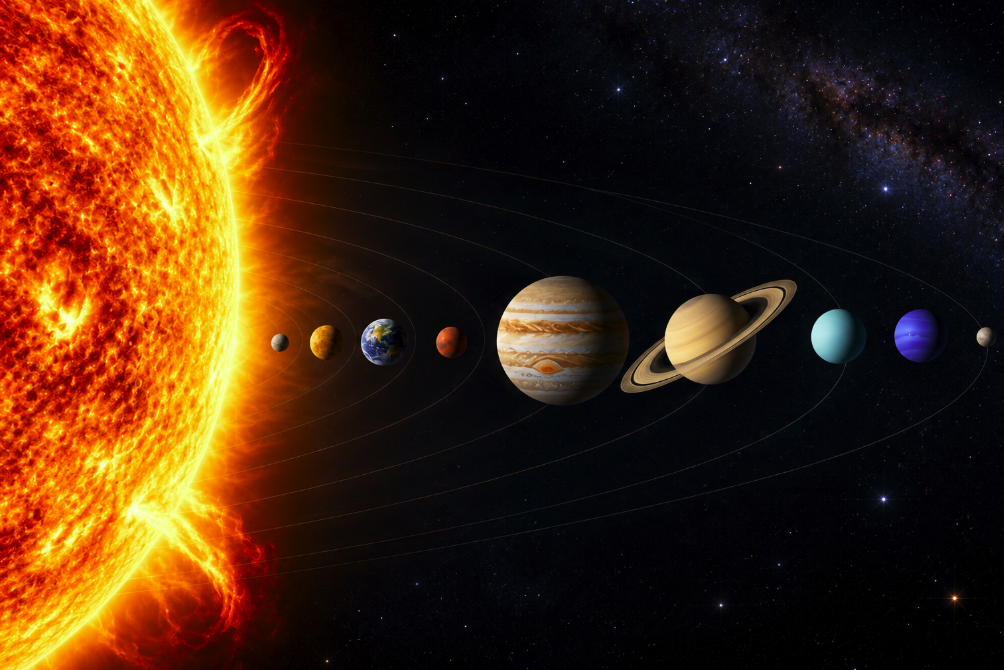
Listen to some of NASA's most famous recordings from the outer Solar System and space does not sound silent at all. Jupiter whistles, crackles and roars. Saturn produces eerie rising tones. Earth's magnetosphere can generate noises that resemble birdsong. Voyager 1 has sent back a thin, ghostly whistle from interstellar space.
There is an obvious problem: space is supposed to be silent.
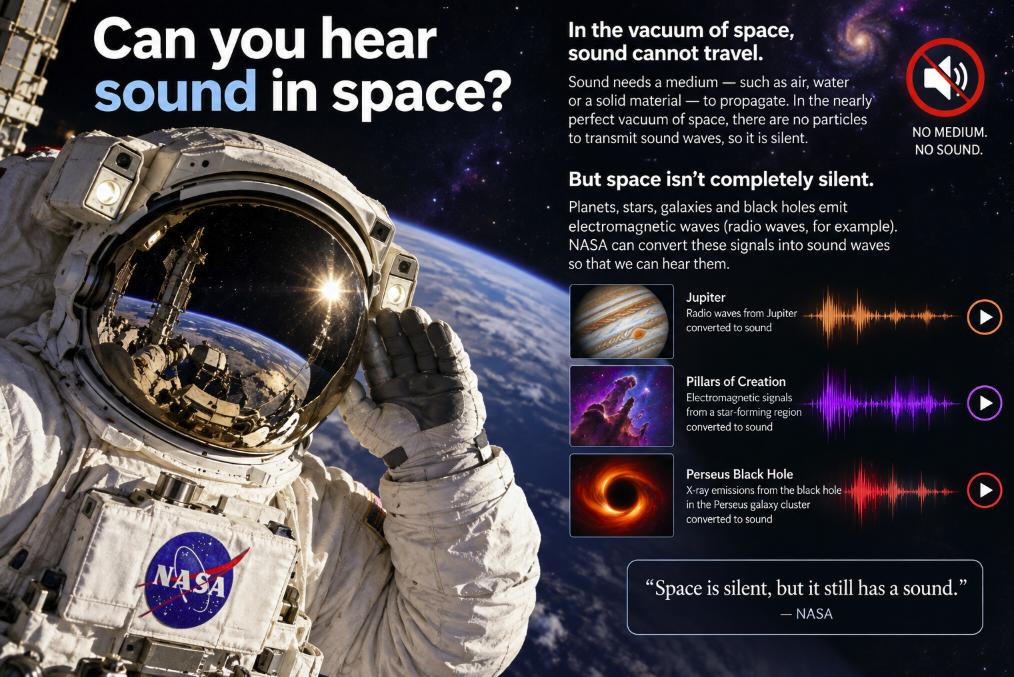
That statement is still correct. The near-vacuum between planets cannot carry ordinary sound the way Earth's atmosphere does. If two astronauts floated outside a spacecraft with no radio connection, shouting would not help. Human hearing depends on pressure waves traveling through a material medium such as air, water or a solid.
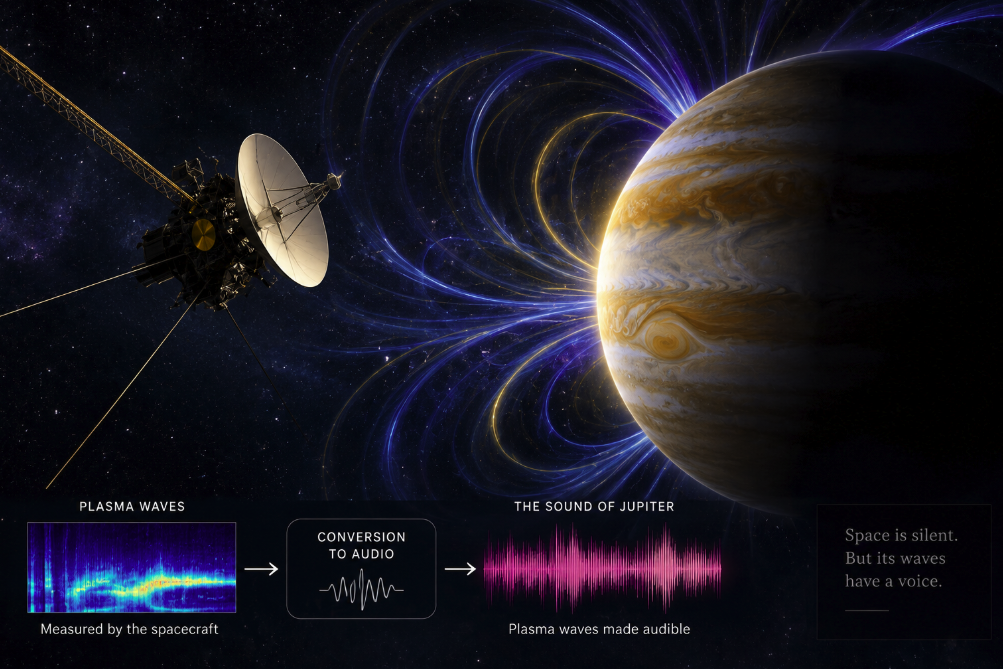
The “sounds of space” released by scientific missions are something different. Spacecraft measure changing electric fields, magnetic fields, radio emissions and oscillations in plasma — the electrically charged gas that fills much of the space environment. Scientists can then represent those measurements as audio. Sometimes the frequencies are already within the range of human hearing and need little more than amplification. In other cases, researchers shift, compress or map the data into frequencies our ears can perceive.
What we hear is therefore neither science-fiction sound added for drama nor a microphone recording made in a vacuum. It is physical data given an audible form.
Why ordinary sound cannot cross empty space
Sound is a mechanical disturbance. When a speaker cone vibrates in a room, it pushes and pulls nearby air molecules. Those molecules interact with their neighbors, creating a pressure wave that eventually reaches the eardrum.
Remove the medium and that chain breaks down. There are not enough particles in an ideal vacuum to transmit an ordinary acoustic wave from one listener to another.
Interplanetary space is not a perfect vacuum, however. It contains particles, magnetic fields, radiation and, crucially, plasma. The solar wind itself is a stream of charged particles flowing outward from the Sun.
Plasma supports many types of waves. But these are not simply faint versions of the sound traveling through a concert hall. They can involve collective oscillations of charged particles and fluctuations in electric and magnetic fields. NASA's explanation of how spacecraft “listen” around Earth makes the distinction explicit: plasma waves are electromagnetic phenomena measured by specialized instruments, not pressure waves that an unprotected human ear could hear. citeturn0search7
A spacecraft does not need a microphone
Plasma-wave instruments behave more like extremely specialized radio receivers than conventional microphones.
Electric antennas detect changing electric fields. Search-coil magnetometers can detect fluctuations in magnetic fields. The resulting voltage measurements vary with time, preserving information about the frequency and intensity of the waves passing the spacecraft.
NASA notes that plasma-wave detectors typically measure electrostatic and electromagnetic components of waves across broad frequency ranges. Voyager's Plasma Wave Subsystem, for example, covers roughly 10 hertz to 56 kilohertz using two long antennas arranged in a V. citeturn0search6turn0search10
Those numbers immediately reveal why the recordings can sound so natural. Human hearing is conventionally described as extending from about 20 hertz to 20 kilohertz in young listeners. Some plasma phenomena therefore oscillate at frequencies that overlap the audible range.
In such cases, researchers can convert the electrical signal into a loudspeaker signal without inventing a melody. The speaker moves air in the laboratory according to the measured waveform. Our ears then hear an acoustic representation of an electromagnetic or plasma phenomenon that occurred millions or billions of kilometers away.
Voyager literally brought interstellar plasma into the audio range
One of the clearest examples came from Voyager 1.
After the spacecraft crossed the heliopause and entered interstellar space, its Plasma Wave Science instrument detected oscillations in the surrounding ionized gas. The waves were valuable because their frequency revealed the density of electrons around the spacecraft.
NASA emphasizes that the instrument did not detect sound. It detected electron plasma waves. Yet the oscillations occurred between a few hundred and a few thousand hertz, allowing scientists to play the measurements through a loudspeaker. citeturn0search0
Inside the heliosphere, Voyager detected tones around 300 hertz. In denser interstellar plasma, measurements rose into the roughly 2–3 kilohertz range. The change in pitch became scientific evidence about the environment through which Voyager was traveling. citeturn0search0turn0search1
The “whistle” is therefore not merely a novelty. Its pitch encodes plasma density. Higher-frequency oscillations indicate that electrons are packed more densely.
Listening becomes another way of inspecting a graph.
Jupiter's magnetosphere is an enormous radio laboratory
Jupiter provides a much more violent environment. Its gigantic magnetic field traps electrically charged particles and creates an immense magnetosphere filled with plasma. Interactions among the planet's rotation, magnetic field, solar wind and moons generate an extraordinary variety of radio and plasma emissions.
NASA's Juno spacecraft carries an instrument appropriately named Waves. One sensor detects the electric component of radio and plasma waves, while a magnetic search coil measures magnetic fluctuations, including signals in the audio-frequency range. The instrument helps researchers investigate Jupiter's auroras and the behavior of its magnetosphere. citeturn0search16
During Juno's close flyby of Ganymede on June 7, 2021, Waves recorded radio emissions as the spacecraft crossed the moon's magnetic environment. Scientists shifted signals ranging from about 10 to 50 kilohertz into a lower audio range. In the resulting recording, the pitch abruptly changes as Juno enters a different region of Ganymede's magnetosphere. citeturn0search5turn0search15
That detail is essential. The public audio is not necessarily the raw frequency exactly as it existed in space. Frequency shifting can make otherwise ultrasonic data accessible to human hearing while preserving patterns in the signal.
Saturn and Enceladus produced a 16-minute conversation
Cassini supplied another spectacular example near the end of its mission.
On September 2, 2017, its Radio and Plasma Wave Science instrument recorded intense plasma waves associated with an interaction between Saturn and its icy moon Enceladus. Researchers converted those electromagnetic measurements into an audible “whooshing” signal.
The published version is highly processed in time. NASA's Jet Propulsion Laboratory explains that roughly 16 minutes of data were compressed into 28.5 seconds, making the evolution of the phenomenon much easier to hear. citeturn0search13
This is a useful reminder that “space audio” is often a scientific visualization for the ear. Changing playback speed, shifting frequencies or mapping data to sound can expose structures that would otherwise be difficult to perceive.
The important question is not whether the recording sounds exactly as a hypothetical astronaut would hear it. In many cases there is nothing for an astronaut's ears to hear directly. The important question is whether the transformation faithfully preserves meaningful relationships in the measurements.
Earth has its own strange chorus
You do not need to travel to Jupiter to find exotic plasma waves. Earth's magnetic environment is full of them.
NASA's Van Allen Probes measured phenomena known as whistlers, hiss and chorus. When converted to audio, chorus emissions can sound uncannily like a flock of birds at dawn. Hiss resembles its name, while whistler-mode waves can produce descending tones. citeturn0search7turn0search14
These emissions are created by physical processes involving charged particles and electromagnetic fields in the magnetosphere. Their audible character is a consequence of their frequencies and the way the measurements are reproduced.
Scientists study them because plasma waves can transfer energy to particles trapped around Earth. Understanding those interactions matters for space weather and for predicting radiation conditions that can affect spacecraft and satellites.
The eerie soundtrack is scientifically useful precisely because changes in pitch, rhythm and intensity correspond to changes in the plasma environment.
Does every planet really have its own sound?
There is a poetic truth in saying that each planet has a voice, but scientifically the phrase needs qualification.
A planet does not possess one permanent audio signature comparable to a person's voice. Its electromagnetic environment produces many different emissions, and those emissions change with location, solar activity, magnetic conditions and interactions with moons or rings.
Jupiter can generate several types of radio and plasma signals. Saturn has others. Earth produces chorus, hiss and whistlers. Even within the same magnetosphere, a spacecraft can cross from one region into another and hear the translated signal change abruptly.
What makes planetary environments distinctive is the combination of magnetic-field strength and geometry, rotation, plasma populations, solar-wind interaction, atmosphere and satellites. Those conditions shape characteristic families of emissions.
So the planets do have recognizable electromagnetic personalities — just not one immutable “sound” each.
Sonification can reveal patterns the eye misses
Turning scientific measurements into audio belongs to a broader practice called sonification. Almost any time-varying dataset can, in principle, be mapped onto sound: brightness can control volume, frequency can control pitch, and changes in intensity can alter timbre.
Sonification is often used for public outreach because it makes invisible phenomena emotionally immediate. But it can also help researchers notice patterns. Human hearing is remarkably sensitive to rhythm, pitch changes and transient events. A subtle feature buried in a visual plot may become obvious as a sudden whistle, pulse or change in tone.
NASA and JPL have accumulated recordings from Voyager, Galileo, Cassini, Juno and other missions, including plasma waves, lightning-associated radio emissions and particle impacts. citeturn0search8turn0search11
Not all “NASA sounds” are produced by the same method, however. Some datasets require substantial sonification. Some electromagnetic signals can be shifted into the audible range. Others, like Voyager's interstellar plasma oscillations, already occupy audio frequencies and can essentially be amplified and played.
Lumping all of them together as “recordings of sound in space” hides the most interesting part of the story: the translation method tells us what the spacecraft actually measured.
Space is silent, but it is not still
The famous statement that no one can hear you scream in space remains physically sound. A vacuum does not provide the dense material medium needed for ordinary airborne sound.
But silence is not the same thing as inactivity.
Charged particles oscillate. Magnetic fields fluctuate. Radio waves sweep through planetary magnetospheres. Solar eruptions disturb plasma far beyond the planets. Lightning and auroras generate electromagnetic emissions. Instruments aboard spacecraft can measure those changes with extraordinary precision.
When scientists translate the measurements into audio, our ears gain access to a part of the universe that was never designed for hearing.
The result can resemble whistles, birds, wind, machinery or electronic music. None of those comparisons means that a microphone floating beside Jupiter would hear a cosmic orchestra. The “music” exists first as variations in fields and charged particles. A spacecraft measures them; electronics and software turn the data into signals; a loudspeaker finally creates the pressure waves that reach our ears.
Space itself may be acoustically silent. Yet once we learn how to translate its waves, silence turns out to contain an astonishing amount of information.