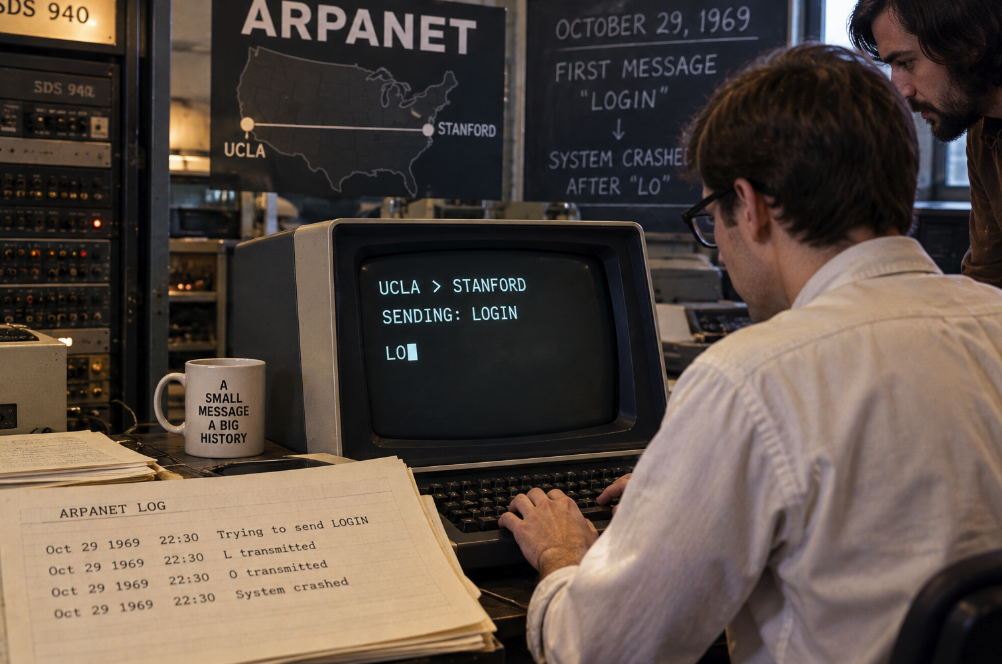
The first message sent across the network that would become a crucial ancestor of the modern Internet was not profound, poetic or even complete. It consisted of two lowercase letters: lo.
That was not the plan. At 10:30 p.m. on October 29, 1969, a programmer at the University of California, Los Angeles, began trying to log in remotely to a computer at the Stanford Research Institute in Northern California. The intended command was LOGIN. The receiving system failed before the attempt could get very far.
The “L” arrived. Then the “O.” When the next letter was attempted, the system crashed.
And so one of the most consequential communications systems in human history began with what looked almost like an accidental greeting: “LO.”
Two computers, hundreds of miles apart
The experiment belonged to ARPANET, the Advanced Research Projects Agency Network, a U.S.-funded research project designed to connect computers at different institutions. In 1969, computers were expensive, scarce machines that often used incompatible systems. The idea that researchers could sit at one computer and interact with resources on another through a general-purpose network was still experimental.
UCLA became ARPANET's first node. The second was installed at the Stanford Research Institute, or SRI, in Menlo Park. Once those two sites were connected, the network could finally do what a network requires: carry information between separate hosts.
The UCLA side was led by computer scientist Leonard Kleinrock, whose earlier research had helped establish mathematical foundations for packet-switched data networks. His student programmer Charley Kline operated the UCLA host, an SDS Sigma 7. At SRI, programmer Bill Duvall was working with an SDS 940.
Kline and Duvall were also speaking over the telephone while they tested the new network. That detail makes the birth of networked communication wonderfully paradoxical: the programmers used an established communications technology to confirm, letter by letter, whether the new one was working.
The plan was not actually to send a poetic message
Stories about technological milestones often acquire ceremonial dialogue. Alexander Graham Bell supposedly summoned Watson. Samuel Morse sent “What hath God wrought.” The ARPANET team had prepared nothing comparable.
They were simply attempting a remote login.
Kleinrock's account of the first transmission records the event at 22:30 on October 29, 1969. Kline typed the letter L and checked by telephone whether SRI had received it. Duvall confirmed that it had. Kline typed O. Again, confirmation came back.
Then came G.
The remote system crashed. UCLA's surviving IMP log preserves the event, and the successful payload of that first attempt was therefore just “lo.” citeturn0search0
Later retellings often say that the team was sending the entire word “LOGIN,” which is a perfectly reasonable shorthand. The underlying procedure was slightly more interesting. Kleinrock has explained that UCLA needed to type log, after which the SRI system was supposed to complete the command by adding in. The failure occurred while that login process was being attempted. citeturn0search25
What actually crashed?
It is tempting to imagine that the newborn ARPANET itself collapsed under the enormous burden of three characters. The reality was more mundane.
Kleinrock's detailed recollection says the SRI host suffered a memory overflow. In other words, the failure was associated with the remote computer rather than evidence that packet switching itself could not carry the message. The problem was fixed quickly. citeturn0search7
UCLA says the intended message was transmitted successfully soon afterward. Kleinrock's own account says the full login worked about an hour later. The first attempt became famous not because it represented the day's ultimate technical success, but because history had already captured those first two transmitted characters. citeturn0search0turn0search1
Failures are normally edited out of origin stories. Here, the failure became the origin story.
Why “LO” feels almost too perfect
Kleinrock has repeatedly joked about the accidental symbolism. “Lo” is an old English interjection used to attract attention, surviving most recognizably in the expression “lo and behold.”
The researchers did not plan that connection. Yet a network destined to transform communication had, by accident, appeared to announce itself.
UCLA has embraced the coincidence in its institutional memory. Its account of ARPANET's fiftieth anniversary described the two letters as inadvertent but prophetic. The university still identifies the event as one of its defining technological milestones. citeturn0search1turn0search5
There is a useful lesson in the accidental poetry: the people building foundational technologies often do not experience the decisive moment as history. For Kline and Duvall, a system crash during a login test was a technical problem to fix before going home.
ARPANET was not yet “the Internet”
The phrase “first Internet message” is convenient but historically imprecise. ARPANET was a major precursor to the Internet, not simply the modern Internet at an earlier date.
In October 1969, the network consisted of the earliest ARPANET nodes and did not yet use the TCP/IP protocol suite that would later become fundamental to internetworking. The World Wide Web was decades away. Email had not yet become ARPANET's defining application.
What made ARPANET historically transformative was the architecture it helped develop and demonstrate: computers connected through a packet-switched network could share resources and communicate across distance without requiring a dedicated end-to-end circuit for every interaction.
Packet switching divides data into manageable units that can travel through a network and be handled by switching nodes. It represented a very different model from traditional telephone networks, where a dedicated circuit was established for a conversation.
Kleinrock's research on queueing and data networks was part of the theoretical background for this new environment. ARPANET then became a practical laboratory in which networking ideas, protocols and applications could evolve.
The strange machines that carried “LO”
The first message did not travel directly from the UCLA host to the SRI host over something resembling a modern Ethernet connection. Each host communicated through a specialized packet-switching machine called an Interface Message Processor, or IMP.
The IMPs were built by Bolt Beranek and Newman for ARPA. They functioned somewhat like ancestors of today's packet-network routers, accepting traffic from connected host computers and moving it across ARPANET.
UCLA's first IMP arrived in 1969, giving the university the network's first node. SRI's connection made the first host-to-host test possible. By the end of that year, ARPANET had expanded to four nodes, also including UC Santa Barbara and the University of Utah.
Four machines hardly sound like the beginning of a planetary communications infrastructure. But scale can be deceptive. The important achievement was not how many computers were connected on October 29. It was that independently operated computers could communicate through a general network architecture that could grow.
The first network message was not the first email
Another historical confusion sometimes surrounds the event. “LO” was the first host-to-host message over ARPANET, but it was not an email.
Network email developed later, famously associated with Ray Tomlinson's work in 1971. Email would quickly become one of ARPANET's most popular uses, demonstrating something that has repeated throughout Internet history: infrastructure designed for one purpose can become socially important because users discover another.
The October 1969 experiment was about remote computer access. The researchers wanted one machine to use another machine's resources. Human-to-human messaging was not the defining objective of that particular test.
Yet communication between people would eventually become one of networking's most powerful consequences.
A crash is a fitting beginning for the networked age
There is something unusually modern about the fact that the first ARPANET message ended in a crash. The Internet's history is often presented as a smooth sequence of inventions: packet switching, ARPANET, TCP/IP, the Web, browsers, search engines and smartphones. Actual engineering is rarely smooth.
Networks fail. Servers run out of memory. Protocol implementations contain bugs. Connections time out. Systems are repaired, redesigned and tried again.
The first ARPANET exchange already contained that pattern. Attempt a connection. Confirm the first pieces of data. Crash. Diagnose. Repair. Retry. Continue.
Within hours, the failure was a solved engineering problem. Within decades, the architecture it belonged to had contributed to a global network connecting billions of people and devices.
The contrast is almost absurd. Today, enormous videos cross oceans in seconds, financial markets coordinate across continents, spacecraft send scientific data through networks, and a person can speak face-to-face with someone on the opposite side of Earth from a device carried in a pocket. The lineage of that world includes a night in 1969 when two programmers needed a telephone call just to confirm that a single letter had arrived.
“LOGIN” was the intention. “LO” was what history received. The system crashed after two characters, but the larger experiment did not. In that sense, the most important part of the story is not that ARPANET failed on its first famous attempt. It is that the engineers fixed it and tried again.