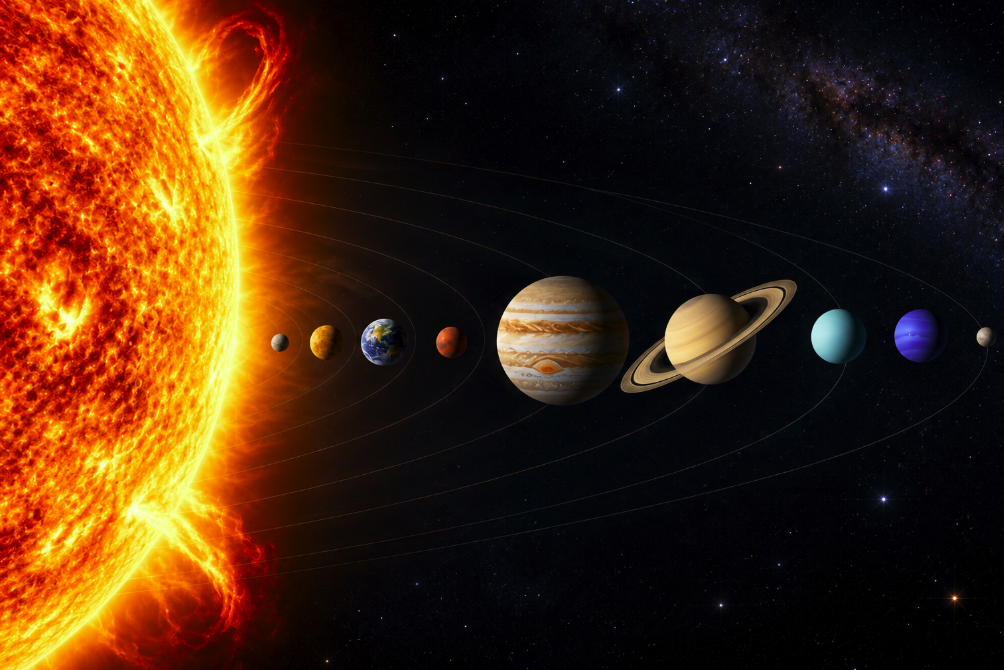
From the ground, Earth is almost too large to understand. Nations fill maps. Mountain ranges divide regions. Oceans separate continents. Political borders seem concrete because they organize passports, wars, elections, economies and identities.
Then an astronaut looks out of a spacecraft window.
The borders vanish.
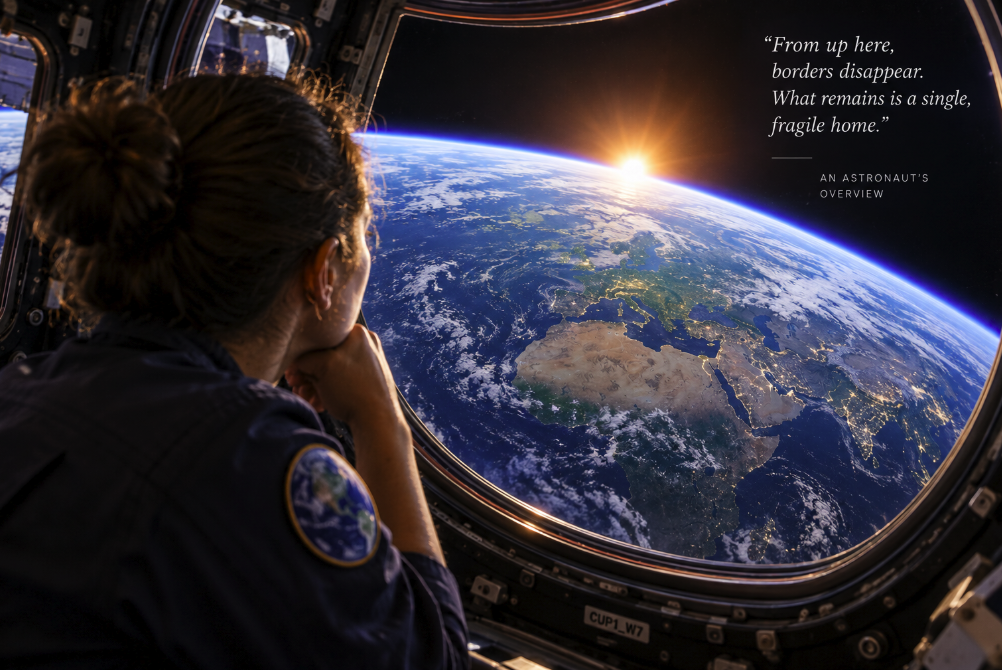
What remains is a luminous planet suspended against black space, wrapped in an atmosphere that can appear astonishingly thin. Cities may be visible at night and storms can stretch across countries, but the lines that dominate political maps are mostly absent. Every human being, every forest, every conflict and every civilization occupies the same small sphere.
Many astronauts have described a powerful change in perspective after confronting that view. The experience has a name: the Overview Effect.
It is often described as an instantaneous revelation, but the science is more careful. The Overview Effect is not a diagnosed neurological condition, nor does every astronaut experience it identically. It is a recurring pattern in astronaut accounts involving awe, self-transcendence, identification with humanity and heightened awareness of Earth's vulnerability. For some, the shift appears immediate. For others, its meaning develops over months or years.
A name invented before the International Space Station existed
The term was coined by writer and space philosopher Frank White, who published The Overview Effect: Space Exploration and Human Evolution in 1987.
White had not traveled to orbit. His insight began during an airplane flight, when he imagined what it might mean for people living permanently in space to see Earth as a whole system rather than as the landscape beneath their feet. He subsequently interviewed astronauts to investigate whether people who had actually seen the planet from space recognized the experience he was describing.
They did.
In a NASA interview with White, he explained that astronauts repeatedly spoke about the absence of visible borders and boundaries, along with a broader change in how they understood humanity's relationship with the planet. He also emphasized that the effect is not necessarily identical for everyone: some astronauts describe a dramatic moment, while for others the realization develops gradually.
That distinction matters. The Overview Effect is better understood as a family of related experiences than as a switch that automatically flips when someone reaches orbit.
What astronauts actually see
The International Space Station travels roughly 400 kilometers above Earth and circles the planet about every 90 minutes. From its windows, astronauts can watch continents, oceans, auroras, thunderstorms, deserts and city lights sweep beneath them at orbital speed.
The station's Cupola, with its seven windows, has become particularly associated with the Overview Effect. NASA astronauts use it operationally to observe spacecraft and Earth, but it also offers an extraordinary panoramic view of the planet.
In a 2025 NASA retrospective on 25 years of continuous human presence aboard the ISS, astronauts repeatedly described the same visual ingredients: the blackness of space, the brilliant Earth, the thin atmospheric boundary and the absence of the political divisions familiar from maps.
NASA astronaut Christina Koch described seeing the atmosphere as a remarkably thin line surrounding everything and everyone humans know. Former astronaut Nicole Stott recalled initially wanting to locate Florida from orbit, only to find that her concept of home expanded: Florida remained special, but it had become part of a larger home — Earth.
The visual stimulus is simple. The psychological implications can be enormous.
Psychologists recognize the ingredients: awe and self-transcendence
For decades, much of the evidence for the Overview Effect came from astronaut memoirs and interviews. Researchers have since tried to place those accounts within established psychological frameworks.
A 2016 peer-reviewed paper in Psychology of Consciousness: Theory, Research, and Practice examined astronaut descriptions of viewing Earth from space. The authors connected the Overview Effect with two concepts already studied in psychology: awe and self-transcendent experience.
Awe occurs when a person encounters something perceived as extraordinarily vast — physically or conceptually — that challenges existing mental frameworks. A towering mountain can provoke it. So can an immense night sky, a monumental building or a powerful scientific realization.
Seeing the entire human world floating in space may be an unusually concentrated version of that experience.
The researchers noted that astronaut accounts often contain overwhelming emotion, appreciation of beauty and a heightened sense of connection with humanity and Earth as a whole. The experience can temporarily reduce the psychological importance of the individual self and replace it with identification with something larger. That is the self-transcendent element.
The 2016 study by David Yaden and colleagues did not claim that spaceflight creates one universal altered state. Instead, it proposed that existing research on awe and self-transcendence provides a useful scientific framework for understanding the recurring themes in astronaut testimony.
Why borders suddenly feel artificial
One of the most famous elements of the Overview Effect is the observation that national borders cannot normally be seen from space.
This statement is partly literal and partly psychological.
Some human boundaries do leave visible traces. Roads, cities, agricultural patterns, deforestation and lighting can reveal where political or economic systems change. Under certain conditions, even heavily fortified boundaries can produce visible differences in land use or nighttime illumination.
But the crisp colored lines printed on maps are absent.
From orbit, rivers cross nations without acknowledging customs posts. Weather systems spread over multiple countries. Smoke, dust and atmospheric pollution travel across borders. Oceans connect rather than separate. The atmosphere itself belongs to no state.
The resulting perspective can expose a mismatch between two realities: political boundaries are enormously consequential to people living on the surface, yet physically the biosphere operates as one interconnected planetary system.
Astronauts do not necessarily return rejecting nationality or politics. The more consistent theme is a change of scale. National identity can remain meaningful while appearing nested inside a larger identity as a human being living on Earth.
The atmosphere looks disturbingly fragile
Another repeated observation concerns Earth's atmosphere.
At ground level, the sky appears immense. It seems to extend indefinitely upward. From orbit, however, the atmosphere can look like a thin glowing rim between the planet and black space.
That visual contrast is psychologically powerful because the atmosphere performs an enormous amount of work. It contains the air humans breathe, moderates temperature, participates in the water cycle and helps shield life from hazardous radiation and small incoming objects.
The European Space Agency has explicitly connected astronauts' perception of this thin protective layer with the Overview Effect and the realization that Earth's apparently vast environment can suddenly seem finite and vulnerable.
NASA's recent astronaut accounts make the same connection. Retired astronaut Mike Foreman said that seeing the thin atmosphere encouraged a stronger conservationist perspective. Others describe Earth as beautiful precisely because it is surrounded by an environment that is otherwise immediately hostile to human life.
From the surface, environmental damage can feel local. From orbit, the planet itself becomes the local environment.
Does the Overview Effect make astronauts more environmentalist?
The claim is plausible, but it requires careful wording.
A qualitative study published in the Journal of Environmental Psychology investigated the ecological dimensions of the Overview Effect through astronaut interviews. Most participants reported experiences consistent with increased awareness of Earth's fragility, interconnectedness and responsibility for planetary stewardship. The researchers found that for many participants these experiences contributed to enhanced environmental attitudes and, in some cases, longer-term behavioral changes.
That does not mean a flight to space automatically produces a particular political position or guarantees lifelong environmental activism. Astronauts arrive with different personalities, cultures, beliefs and previous experiences. Their reactions differ.
But the environmental psychology research supports something stronger than anecdote alone: ecological concern is a recurring and distinguishable dimension of the reported experience.
It may not happen in one dramatic instant
Popular descriptions often portray the Overview Effect as a sudden epiphany: an astronaut reaches the window, sees Earth and immediately acquires a new worldview.
Sometimes astronaut accounts sound exactly like that. Emotional reactions can be intense. NASA's T.J. Creamer has recalled bringing crewmates into the Cupola and seeing them moved to tears by the view.
But Frank White's interviews suggest substantial variation. Some people describe an immediate transformation; others process the experience gradually. Long-duration astronauts also see Earth thousands of times, under changing light, weather and orbital conditions.
The Overview Effect may therefore be both an event and a process. The first view can create awe, while months of watching the planet as a single moving system may deepen the intellectual consequences.
This distinction is scientifically useful because memory can also reshape experience. What an astronaut says years later may combine the original emotional moment with subsequent reflection, public speaking and changes in personal philosophy.
Can people experience it without going to space?
This question has become increasingly interesting as virtual reality and immersive visualization improve.
Photographs such as Apollo 8's Earthrise and Apollo 17's famous full-Earth imagery transformed public culture without requiring viewers to leave the ground. Modern astronauts stream high-resolution views from orbit, and immersive simulations can place users inside virtual spacecraft looking back at a realistic Earth.
Researchers have experimented with virtual-reality experiences designed to evoke some of the same awe and self-transcendent feelings associated with the Overview Effect. But a simulation and an actual orbital experience are not psychologically identical.
An astronaut looking through a window knows, at a bodily level, that there is no ordinary ground beneath them. The planet outside is not an image. Everyone they know really is down there. Beyond the thin wall of the spacecraft is an environment in which an unprotected human cannot survive.
That knowledge may be inseparable from the emotional force of the view.
The strange lesson of leaving Earth
Human spaceflight was originally driven by engineering ambition, geopolitical competition and exploration. Yet one of its unexpected products has been a new way of looking at the place astronauts left behind.
From orbit, Earth becomes small enough to see as a whole but large enough to contain everything familiar. The atmosphere becomes visible as a boundary. Political divisions lose their cartographic certainty. The blackness surrounding the planet makes its habitability seem improbable.
Psychology has useful words for parts of the response: awe, self-transcendence, connectedness, cognitive reframing. None completely captures the experience described by people who have actually been there.
Perhaps that is why the Overview Effect remains so compelling. Space exploration promises encounters with other worlds, but one of its most profound discoveries may be a different perception of our own.
To see Earth from space is not to learn that borders are imaginary or that the planet is fragile; both facts can be understood from the ground. The change is that abstract knowledge becomes visual reality. For a few minutes, or sometimes for the rest of a person's life, the map gives way to the planet.