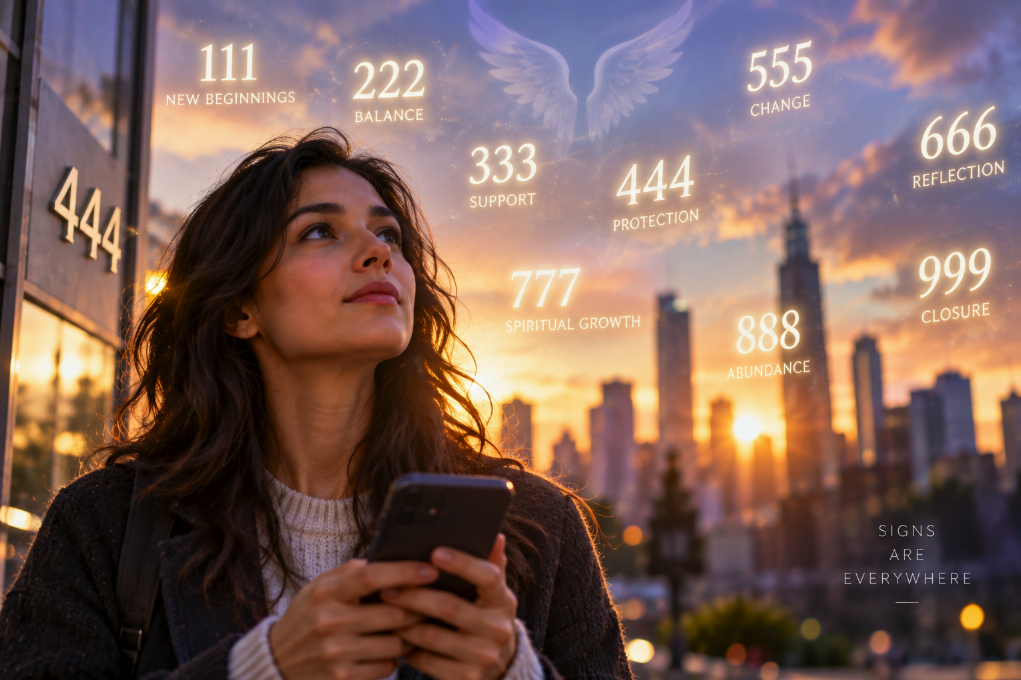
You check your phone and it is 4:44. Later, a receipt ends in $4.44. That evening, three fours appear in an address or a license plate. After the third encounter, coincidence can start to feel like correspondence: is 444 trying to tell you something?
That question sits at the heart of the modern fascination with “angel numbers,” repeating or conspicuous numerical sequences such as 111, 222, 333, 444, 777 and 11:11. Across social media and contemporary spirituality, they are commonly interpreted as signs of reassurance, change, alignment, protection or some other message from angels, guides or the universe.
There is no scientific evidence that a sequence such as 444 is an external supernatural message, and there is no universally accepted dictionary assigning objective meanings to these numbers. Yet the phenomenon is culturally fascinating because it combines something very old—the human tendency to give numbers symbolic significance—with something surprisingly recent: the specific idea of looking up repeated everyday digits as “angel numbers.”
What do 111, 333, 444 and the other angel numbers supposedly mean?
Meanings vary between authors, websites and spiritual communities, so any tidy list should be understood as a set of popular interpretations rather than fixed rules. In contemporary angel-number culture, 111 is often associated with beginnings, intention or directing attention toward your thoughts. 222 commonly represents balance, patience, relationships or trust that events are developing as they should.
333 is frequently interpreted as encouragement, creativity, growth or support. Someone who keeps seeing 333 may therefore encounter advice online to express themselves, continue with a project or regard the sequence as reassurance that they are not facing a situation alone.
444 has become one of the most searched sequences and is commonly given a particularly comforting meaning: stability, protection, foundations and support. The symbolism fits neatly with the number four itself. Four suggests structure in many everyday contexts—four corners of a square, four cardinal directions, four legs supporting a table—making it easy to turn repeated fours into a metaphor for solidity.
555 is usually associated with change or transition. 666, despite its ominous reputation in Christian culture, is often reinterpreted by modern numerology communities as a prompt to reassess priorities or restore balance rather than as a prediction of evil. 777 tends to signify spiritual development, intuition or good fortune, while 888 is frequently linked with abundance and material or personal reward. 999 commonly represents completion, closure and the end of a cycle.
Then there is 11:11, perhaps the most culturally recognizable repeating-number moment of all. Long before somebody learns an elaborate numerological system, a digital clock displaying 11:11 already looks unusually symmetrical. That visual neatness makes it memorable, easy to photograph and perfect for the social-media age.
Angel numbers are newer than they look
People have attached symbolic, mystical and philosophical significance to numbers for millennia. The Pythagorean tradition in ancient Greece famously treated number as fundamental to understanding reality, while many religions and cultures developed their own symbolic associations with particular numbers. But it would be misleading to say that ancient Greeks were looking at 4:44 on clocks and interpreting it the way a TikTok creator might today.
The recognizable modern angel-number system emerged much later. American New Age author Doreen Virtue became a central figure in popularizing the concept around the turn of the twenty-first century. Her earlier book Healing with the Angels discussed number sequences, and the 2005 book Angel Numbers, written with Lynnette Brown and published by Hay House, presented interpretations for numbers from 0 to 999. The book's own description explicitly addresses the question of why someone repeatedly sees sequences such as 111, 333 or 444.
Virtue later underwent a major religious conversion and publicly rejected her former New Age teachings, including angel numbers. That reversal is a remarkable part of the story: one of the people most closely associated with codifying the modern phenomenon ultimately disavowed it. The practice nevertheless continued without her and spread through books, blogs, Instagram, YouTube and TikTok, where a symbolic system designed for quick lookup was almost perfectly adapted to short-form content.
This history does not tell anyone what they must personally believe about a meaningful coincidence. It does clarify an often-blurred distinction. Number mysticism is ancient; the modern mass-market language of “angel numbers” is not.
Why do you suddenly see 444 everywhere?
Psychology offers several mechanisms that can make repeated numbers seem to multiply once they become meaningful to you. One is selective attention. Every day you encounter an enormous number of numbers: times, prices, percentages, addresses, passwords, battery levels, page numbers, dates and notifications. Most disappear from awareness because they have no reason to stand out.
Give 444 special importance, however, and your attentional system now has a reason to notice it. The number was not necessarily absent before; it simply failed to earn a place in memory. A related phenomenon is often called the frequency illusion: after learning about or focusing on something, you begin noticing it with surprising regularity.
Confirmation bias can strengthen the effect. Seeing 4:44 feels like a “hit” and becomes memorable. Checking your phone at 4:37, 5:12 or 8:26 usually feels meaningless and is forgotten. Over time, memory accumulates the striking matches while discarding the far larger background of ordinary numbers.
Humans are also exceptional pattern-finders. Psychologists use the term apophenia for perceiving meaningful connections or patterns in information that may actually be unrelated or random. Pattern detection itself is not a defect; it is one of the brain's most useful abilities. The same cognitive machinery that lets us recognize regularities can sometimes assign significance where chance is sufficient to explain what happened.
That tension between sincere experience and ordinary cognitive mechanisms appears in other popular mysteries too. IMOOND's exploration of why people can share remarkably convincing false memories shows how something can feel subjectively undeniable while still having a plausible psychological explanation.
Does psychology make the experience meaningless?
Not necessarily. Science can investigate whether repeated-number sightings occur beyond chance and how attention and memory influence what people notice. It cannot dictate the personal meaning someone chooses to give a coincidence. Those are different questions.
A person might see 333 during a difficult week and use it as a reminder to call a friend. Someone might notice 555 while considering a career change and treat it as a prompt to think seriously about what they want. Those decisions can feel meaningful without requiring the number itself to have been transmitted by an external intelligence.
This is where angel numbers overlap with the broader idea of synchronicity, famously associated with psychiatrist Carl Jung: coincidences can feel meaningful because an external event resonates strongly with a person's internal circumstances. Jung's concept has had enormous cultural influence, but it should not be mistaken for scientific proof that the universe is deliberately arranging numerical messages.
The distinction is useful because it leaves room for both curiosity and skepticism. “This coincidence made me think differently” is a claim about personal experience. “Angels objectively caused my receipt to total $4.44” is a claim about the external world and requires evidence of a different kind.
So what does 444 actually mean?
If you are asking for the popular angel-number interpretation, 444 usually means protection, stability, support and strong foundations. If you are asking what science has established that 444 means when it repeatedly appears on clocks, receipts or license plates, the answer is much simpler: no supernatural meaning has been demonstrated.
Both answers explain why the phenomenon persists. The first gives an emotionally resonant story to a visually striking coincidence. The second explains why the human brain may encounter that coincidence as though it were suddenly everywhere.
Perhaps that is the real cultural power of angel numbers. Numbers are normally the language of precision: 444 is exactly 444, never approximately something else. Angel-number culture transforms that precision into ambiguity. Three identical digits become a tiny blank screen onto which people can project hope, anxiety, decisions, relationships and expectations about the future.
The next time 11:11 flashes on a clock or 444 appears unexpectedly, you can interpret it spiritually, psychologically or simply enjoy the coincidence. What is certain is that the experience reveals something enduring about human beings: when the world produces a pattern, we rarely stop at noticing it. We want to know what it means.