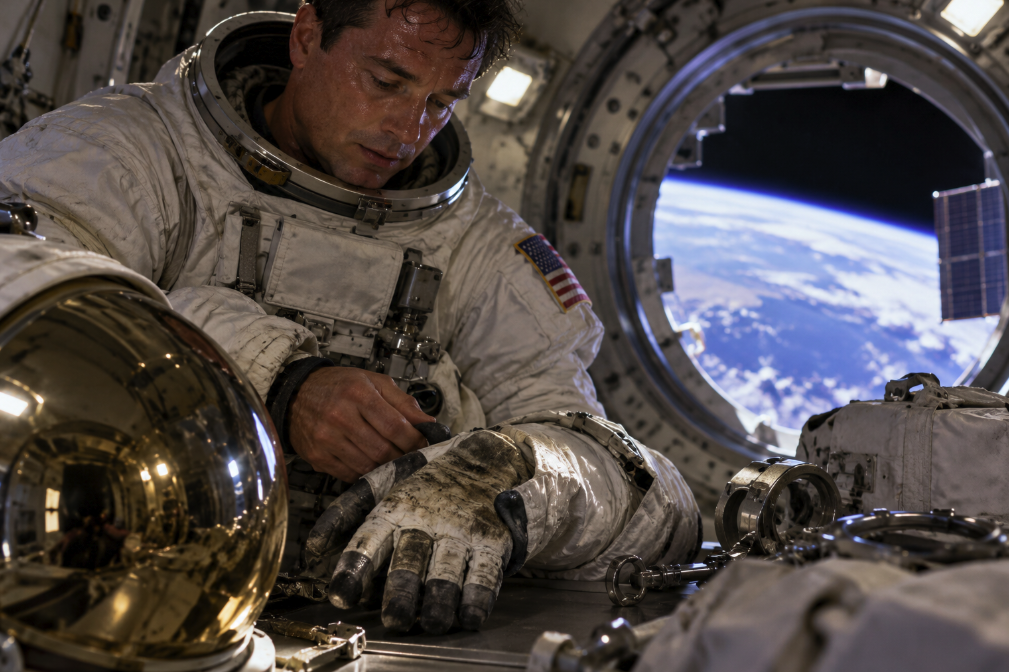
Space is a vacuum, so an astronaut cannot simply lift a visor and take a sniff. Yet crews returning from spacewalks have repeatedly described something remarkably close to a smell of space: an acrid, metallic aroma that follows them through the airlock and clings to suits, helmets, gloves and tools.
The comparisons are wonderfully terrestrial. Astronauts have likened it to seared steak, spent gunpowder, ozone and hot metal. NASA astronaut Don Pettit, who had once worked with an arc welder, found perhaps the most evocative comparison: the sweet metallic fumes produced by welding. European Space Agency astronaut Alexander Gerst has described a mixture reminiscent of walnuts and motorcycle brake pads.
These accounts are real, but the popular explanation for them is often presented with more certainty than the science allows. Polycyclic aromatic hydrocarbons, or PAHs, may contribute to some of the aromas associated with space chemistry, but scientists have not established that oxidation of PAHs is the single cause of the smell astronauts encounter after an EVA. Around the International Space Station, another suspect is especially important: atomic oxygen.
You cannot actually smell the vacuum
Smell requires molecules to reach receptors inside the nose. During a spacewalk, an astronaut is sealed inside a pressurized suit and cannot smell the external environment. The familiar descriptions therefore begin only after the astronaut enters an airlock, the compartment is repressurized and the helmet comes off.
Whatever produces the odor has apparently interacted with, or remained on, surfaces exposed outside. NASA notes that the scent can cling to EVA equipment. Pettit's account is particularly useful because he sometimes encountered it while operating the International Space Station's airlock and greeting crewmates after their spacewalks, rather than only after performing an EVA himself.
NASA itself describes the phenomenon as distinctive but chemically unresolved. In an Ames Research Center explanation of the smell of space, scientists discuss several possible processes rather than identifying one definitive molecule.
Why atomic oxygen is a strong suspect
The International Space Station orbits in what is called low Earth orbit. Although this environment is extraordinarily tenuous compared with the atmosphere at sea level, it is not completely empty. Ultraviolet radiation from the Sun breaks ordinary molecular oxygen, O2, into individual oxygen atoms. This atomic oxygen is extremely reactive.
A spacecraft racing around Earth encounters those atoms at orbital velocity, and exposed materials can be chemically attacked. NASA researcher Scott Sandford has pointed out that the ISS effectively plows through this residual atmosphere, creating conditions in which oxidation can affect surfaces facing the direction of travel. The same chemistry can act on spacesuit materials during an EVA.
Former NASA astronaut Tom Jones proposed another related mechanism. Atomic oxygen could adhere to external fabric, tools or airlock surfaces. Once the airlock is repressurized, reactions involving oxygen may produce ozone or other oxidized compounds. Jones compared the resulting odor to ozone, hot electrical insulation and gunpowder. It remains a hypothesis rather than a complete chemical identification, but it fits both the environment and many astronaut descriptions.
The phenomenon also illustrates why calling the aroma simply the smell of empty space is misleading. Astronauts are probably smelling products of an encounter between spacecraft materials and the near-Earth space environment.
Where PAHs fit into the story
Polycyclic aromatic hydrocarbons are large carbon-rich molecules made from fused rings of carbon atoms. On Earth they are associated with incomplete combustion and can be found in soot, vehicle exhaust, burnt food and smoke. In astronomy, PAHs are widespread: their spectral signatures reveal carbon chemistry in many regions of interstellar space.
Louis Allamandola, who led astrophysics and astrochemistry research at NASA Ames, has explained that PAHs are exceptionally robust molecules capable of surviving harsh radiation environments. Their relationship to soot and combustion chemistry makes comparisons with charcoal grills, burnt toast and seared food intuitively appealing. NASA therefore lists PAHs among likely contributors when discussing what various regions of space might smell like if their molecules could somehow be sampled at sufficient concentration.
That does not mean, however, that a spacewalker's suit has simply collected a coating of interstellar PAHs that is then oxidized into the familiar post-EVA scent. The chemistry immediately around an orbiting spacecraft is more complicated, and NASA's own discussion emphasizes that the exact cause of the airlock odor is not known. Atomic oxygen attacking suit materials, ozone formation and other surface reactions are all plausible pieces of the puzzle.
There is another useful distinction. Deep interstellar space and low Earth orbit are chemically very different environments. A molecular cloud between stars may contain carbon compounds, water ice, ammonia, formaldehyde and many other molecules. An astronaut outside the ISS, by contrast, is moving through the extremely thin upper reaches of Earth's atmosphere while surrounded by engineered polymers, metals and coatings exposed to ultraviolet light and atomic oxygen.
A smell engineers take seriously
Odor aboard a spacecraft is not merely an amusing sensory detail. A sealed habitat has no open window through which an unpleasant or potentially dangerous vapor can escape. NASA therefore tests materials intended for habitable spacecraft for both odor and toxic off-gassing. At White Sands Test Facility, trained odor panels evaluate materials after analytical testing, helping prevent irritating smells from becoming persistent cabin problems.
There is also a safety reason to control background odors. An overpowering smell can fatigue the senses and make it harder for a crew to recognize warning signs such as smoke, overheated electronics or an ammonia leak. NASA's odor-evaluation program treats the human nose as an important part of the spacecraft's safety environment.
The famous smell that follows a spacewalk is therefore more than a quirky astronaut anecdote. It is a small sensory trace of extreme chemistry: ultraviolet radiation breaking molecules apart, reactive oxygen colliding with engineered surfaces and materials being altered in an environment unlike anything at ground level.
Perhaps the strangest part is that humans never smell space itself. They smell what space has done to the things that went outside and came back.